The “Life” of St Botolph by Folcard, with epitomes and breviary readings, English and Latin – now online (BHL 1428, BHL 1429, BHL 1430, BHL 1431))

About 1070 AD, the abbot of Thorney Abbey in Cambridgeshire, a chap named Folcard of St Bertin, wrote an account of the life of St Botolph, one of the saints whose relics were venerated at the abbey.  St Botolph was a popular saint in England and also in Scandinavia.  There are still about 40 churches dedicated to St Botolph in England.  Botolph himself was an Anglo-Saxon, who introduced the Benedictine rule to England, and founded a monastery at Iken on the Suffolk coast.

No English translation of this “Life” has ever been published.  The printed text in the Acta Sanctorum is defective.  So for some months I have been creating a critical Latin text and a translation of it.  I’ve also included an abbreviated life that circulated, two other texts that Folcard wrote along with the Life about the saints of Thorney Abbey, and a  bunch of readings from breviaries – medieval service books – which included a commemoration of St Botolph.

It’s pretty much done, and so I am going to release it today.

I’ve also uploaded these to Archive.org, here.

As usual, the files are public domain.  Do whatever you like with them, personal, educational or commercial.

There is one loose end to the project: I have not been able to collate the York manuscript of the abbreviated life.  If this appears, I will upload a revised version.
How many letters of St Jerome remain untranslated into English?

In my last post, I gave a few notes on the letters of St. Jerome, which number 154 in the Hilberg edition in the Corpus Scriptorum Ecclesiasticorum Latinorum series, vols.54, 55 and 56.  It seems that complete translations exist into French and Spanish.  But in English, as we all know, many letters remain untranslated.

Well, it seems that this is not true.  A total of SEVEN letters remain untranslated.  Two of these (93 and 94) are short notes by other people in response to a synodical letter of Theophilus of Alexandria, translated into Latin by Jerome and included in his letters.  The others are letters 150-154.  150 is completely bogus, a letter of Procopius of Gaza, who lived a century later, to some other Hieronymus.  Hilberg didn’t bother to print this, although Migne did.  Letters 149-154 are tiny, and occupy together the last 10 pages of Hilberg.

To discover this, I compiled a list of the letters and their translations, in a spreadsheet.  It’s here:

Remarkable, really.  I had no idea that we were so close.  I will translate the rest myself!

Update (15 Dec 2025): I’ve added columns for Paul Carroll and Michael Graves. With thanks for info to Twitter poster @discerninganew.

Update (22 Dec 2025): I’ve added to the spreadsheet the translation of letter 148 by B.R. Rees.  With thanks to Rafael Rodrigues for raising the question.

Update (06 Jan 2026): I have now created a file with the Latin text and English translation of the remaining letters.  Here they are:

They can also be downloaded from Archive.org here.

As always these are public domain.  Do whatever you like with them, personal, educational or commercial.

I have also updated the spreadsheet.  I believe that we now have all the letters of Jerome in English.  The only uncertainty is that I have not checked myself that 149 does exist in *English* in the volume given, but am relying on a reference.  This I will investigate.

The letters of St. Jerome

The Letters of St. Jerome (CPL 620), who died in 420 AD, are one of the great collections of ancient letters.  Inquiring, it seems that Quasten’s  Patrology vol. 4 (ed. Angelo di Berardino) still gives far better information than anything Google has to offer. The collection contains 154 letters, which includes letters addressed to St Jerome by other people.  It also includes translations of Greek documents made by Jerome as part of the Origenist disputes.  Letters 148-150 are apocryphal.

The standard critical edition was made by the Austrian Isidore Hilberg for the CSEL series (vols. 54, 55 and 56) in 3 volumes between 1910-1918, although he did not live to see it published.  A fourth volume of indexes has appeared recently.  The edition has some odd choices of spellings, some rejected by Jerome himself!  It also does not use all of the oldest manuscripts.

No complete English translation exists.  A limited number of important letters were translated by W. H. Freemantle in the Nicene and Post-Nicene Fathers series.  The first22 letters appear in the ACW series vol. 33, from 1963, but it looks as if the translators went no further.

But a complete translation does exist in French, made by Jérôme Labourt, “Jérôme: Correspondance”, in 8 volumes Paris: Les Belles Lettres, 1949-63).  This includes a critical text, but mainly still based on Hilberg.  Labourt died before completing his work; a review of tome 7 noted the lack of notes. There are also extensive – complete? – translations in multiple volumes in Italian.

Update: See the next post here for a spreadsheet of all letters of Jerome for which an English translation exists.

From my diary

The last day was mostly lost in trying to sort out two problems with the blog software.  First, when posting a link to a post to Twitter, no image appeared.  Secondly, if I added a comment to a post, I – the author – got no email notification.

Yesterday I got fed up and delved into the WordPress code.  It’s PHP, after all, which is a language that I have used before.  A bit of debugging using PHP error_log() calls revealed that… if an author comments on his own post, by default WordPress doesn’t notify him.  Which is why I never saw any notifications.  Nor does WordPress make this a setting in the dashboard.  The change makes debugging a new installation that little bit harder.  The answer is to comment from another browser – one you are not logged into.  But of course nobody would  know that by default.

Anyway the code makes clear what the answer is: to write a little single-file plugin that overrides a WordPress function and returns “true”.  This I have done, and it works just fine.  Here it is:

If you activate the plugin, it overrides the bit of code (in wp-includes/pluggable.php) that checks whether author comments should trigger a notification email.  If you deactivate it, it removes that.

I’d always wondered about how to write my own plugin.  Fortunately it’s simple.

Now to see whether the Twitter stuff works or not.

The Hereford Breviary

A number of pre-reformation church service books were printed, and this naturally included  breviaries, some of which contained readings from the Life of St Botolph.  I don’t know if there is a list somewhere of what exists and what is in each, beyond the excellent Usuarium website.

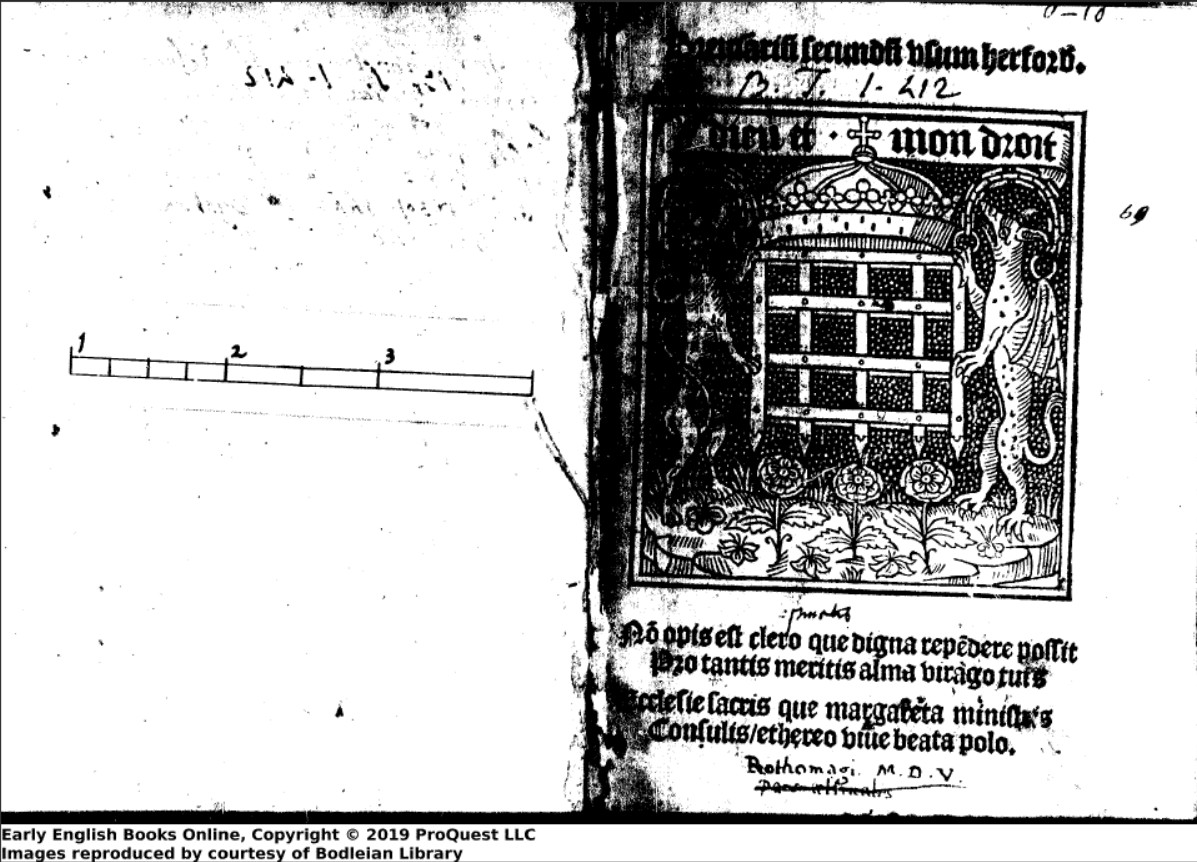
In 1505 a breviary for Hereford Abbey was printed in Rouen (Rotomagus) by a certain Inghelbert Haghe.  I learn from an 1893 book1 that:

Of this book only three copies are known. One, textually perfect, and containing both parts, is in Worcester Cathedral Library. The Bodleian has a Pars Estivalis, slightly imperfect, and another copy is in private hands.

A wretched microfilm of the Bodleian copy of the first part is in Early English Books Online (EEBO).  This database is only accessible to research libraries who subscribe, which is a bit sad.  But as I discovered today, it is actually quite difficult to find this book even in EEBO, thanks to the abbreviated title.  The searcher is advised to look for “Breuiariu secundu vsum herford”!  The url is here.

Breuiariu[m] secundu[m] vsum herford
Alternate title: Breviary. Hereford
Bibliographic name/number: STC (2nd ed.) / 15793.
Anonymous; Catholic Church.  EEBO Bodleian Library records – unstructured. [526] p. London: Emporio [P. Olivier and J. Mauditier] impensis et cura Ingheiberti haghe [in London, at the expenses of Margaret, Countess of Richmond] ,, 1505.

The copy comes complete with copyright notice, or rather, admission of guilt.

The rest of the PDF is no better, and often far worse.  Is it better than nothing?  Not really.  If anybody from ProQuest is reading this, it would be good to improve things here.

The Hereford Breviary was edited under that title in three volumes for the Henry Bradshaw Society by W.H.Frere, in 1904.  Here are the volumes at Archive.org:

But, incredibly, it is not printed in full!  p.vii:

It has already been stated that the text is not given in full; various reasons led to this course: the full text seemed unnecessary because so much of it is common to other Uses ; and moreover a student with one Breviary before him, wishing to trace out its differences from another, is hindered rather than helped by having the second one in full; he would rather have its differences pointed out than its whole text.

The man who wrote those works must have anticipated the infuriated reaction of researchers.  And indeed the lections of the saints’ offices are not included.  The only information is from vol. 2, p.194, where we learn that there are three readings.

While an 1893 book is not necessarily the last word on bibliography, it seems that the only way to access the full text is to be very nice to the Dean and Chapter of Worcester Cathedral.  A fine body of men, no doubt!  But I think that, just between you and I, this breviary may get omitted from my collection of Botolph materials.

  1. E. Gordon Duff, Early Printed Books. London, 1893. Online here.[↩]