Coming back to life

Apologies for the outage.  I did indeed have to move host – twice in fact.  Nixihost was great, until I tried to upload my site and found the upload speed was 50 kilobytes per second.  My internet connection upload runs as 81 megabytes a second.  So that was impossible.  Clearly they have sold too many websites for their capacity.  But they were nice people.  The web hosting trade seems every bit as wild west as it was 20 years ago, and it’s quite a minefield.  Let’s see how it goes with the new host (upload speed in megabytes, thankfully).

The Tertullian Project website is back, mostly, at tertullian.org.  I did remove some PDF books that are on Archive.org, just to keep bandwidth down.

The Mithras site is not available yet.

The blog is sort of up, but not really complete as yet.  It needs more work, which will happen on Monday, I think.  I also have to work out how to implement the contact form once more.  A few images from October seem to have got lost.  But… getting there.

Update: I think the blog is now working.

Taking offline tertullian.org and roger-pearse.com

My apologies, but both roger-pearse.com and tertullian.org will probably go off-line shortly for about a week.  My web host, Pair Networks, has just presented me with an $85 bill for “over usage” last month.  Unfortunately there is no indication of why this occurred, nor any warning that it was occurring.  Nor can I get in contact with anybody with authority to help until Monday.

It is likely that I will have to move hosts, hence the outage.  In the mean time I will block access to the sites.  My apologies.  Everything will reappear eventually.

The little that is known about Demetrius of Cyzicus… part 2

In my previous post about this obscure 11th century Byzantine bishop, I gave the 1959 entry by Beck.  This drew upon and abbreviated the old  French (1912!) DHGE (Dictionary of Ecclesiastical History and Geography) article.

Many volumes of the DHGE are online somewhere.  I know this because I have a directory full of volumes.  But I was unable to find a link now.  Since it is out of copyright, but inaccessible, I thought that I would make it available here.  I will put the original French in a footnote.[ref]5. DEMETRIUS DE CYZIQUE. — Rien n’oblige à admettre l’existence de deux Démétrius de Cyzique ni à distinguer le polémiste du canoniste; il faut s’en tenir à Lequien, Oriens Christianus, 11, 758. Le seul argument énoncé par L. Petit, dans le D. T. C., en faveur de l’existence du premier, au Xe s., est l’adresse qui précède l’opuscule sur les jacobites, écrit à la demande de Constantin Porphyrogénète (P. G., cxxvii, 879-902). Or ce Porphyrogénète ne s’identifie pas nécessairement avec Constantin VII (944-59); son petit-fils, frère et successeur de Basile II, Constantin VIII (1025-28), avait bien plus de raisons de consulter un ecclésiastique sur les jacobites que son grand-père, suffisamment érudit. D’autre part, sous le règne effectif de Constantin VII, il n’y a pas de place pour un Démétrius sur le siège de Cyzique, occupé sans interruption par Théodore. En effet, avant 946, date de la mort d’Anastase d’Héraclée (Theoph. Cont., éd. Bonn, 439; S. Runciman, Romanus Lecapenus, 235), Théodore de Cyzique, en compagnie d’Anastase, est membre d’une commission chargée d’enquéter sur Alexandre de Nicée : ms. Patm. 706, fol. 104. En 956, le méme Théodore se signale par son opposition à Polyeucte et, en 959, Constantin Porphyrogénète vient le voir A l’Olympe peu avant de mourir (Cedrenus, II, 335, 337).

Petit semble avoir révisé son opinion catégorique exposée à l’article Démétrius, car à l’article Isaac l’Arménien (D. T. C., viii, 13), il attribue l’exposé des erreurs arméniennes au métropolite vivant sous Alexis Studite (1025-46). En tout cas il faut bien distinguer cet opuscule De Jacobitis et Chatzizariis de la Narratio de rebus Armeniae, dont G. Garitte vient d’élucider les origines : ce qui est certain c’est que celle-ci n’a rien à voir avec Démétrius de Cyzique, sinon accidentellement par la faute des copistes et surtout des éditeurs postérieurs à Combefis. Aux mss. du De Jacobitis indiqués par L. Petit: Athous 927, 3666, 3758, 4501, Palatinus 356, Scorialensis R I 15, Constantinopolitanus S. Sepulcri 391, Mosquensis 319 et 323, il faut ajouter Parisinus 1315 (prototype de l’éditeur), Angelicus 30, Atheniensis Bibl. nat., 2972, Lesbiensis Leim. 7; et la liste n’est sans doute pas complète.

Dans les sources historiques, Démétrius apparaît pour la première fois en janv. 1028, au synode présidé par Alexis Studite (Grumel, Regestes, n. 835). Avant la fin de 1029, Romain Argyre lui confère le titre de syncelle ainsi qu’à deux autres métropolites. En 1030, il assiste au synode tenu contre les jacobites de Méli-tène (Regestes, n. 839), dont le tome est confirmé en 1032 (Regestes, n. 840). En 1037, il figure parmi les opposants au patriarche Alexis (Regestes, n. 842). Après cela, il n’y a plus trace de lui dans les sources. On connaît cependant un poème de Christophore Mitylenaios (Gedichte, éd. Kurtz [Teubner], 13), adressé à Démétrius de Cyzique pour le consoler de sa podagre. Démétrius survécut à son patriarche, décédé en 1046, mais en 1054 (Regestes, n. 869), c’est Théophane qui est métropolite de Cyzique.

Citons pour mémoire une chronique perdue de Démétrius de Cyzique, connue par le seul témoignage de Skylitzès; on n’a aucune raison de penser que l’auteur diffère de notre métropolite.

Les oeuvres éditées se trouvent dans P. G., CXIX, 1097-1120 : il s’agit de deux consultations canoniques sur les empêchements de mariage.

Les oeuvres inédites se rencontrent dans deux mss., Vatic. gr. 712 et Ambrosianus 682 (Q 76 sup.), indépendants l’un de l’autre; seul l’Ambrosianus porte dans le titre le nom de Démétrius. Deux discours sont communs aux deux témoins : Δίκαιον ἡν ἡμᾶς τοῖς θεῖοις: s’adressant aux « empereurs », Démétrius, au nom des anciens canons, prétend interdire au patriarche de Constantinople de consacrer les évêques d’une autre éparchie et même les métropolites dont le sacre est réservé aux évêques de sa province. Δέσποτα ἡμῶν… οὐ τὸ ἴδιον θέλημα: discours à un empereur qui prétendait casser les sentences synodiques dans une missive où il écrivait : « Quiconque s’oppose à un écrit impérial, qu’il soit puni comme Démétrius sacrilège. » L’Ambrosianus a en propre un troisième discours : Ἐπειδή τινες ὡς οἴονται, contre ceux qui disent qu’on ne peut démissionner (de l’épiscopat). Le Vaticanus en a deux autres : Εδει μὲν ἡμᾶς ὧ παναγιώτατε δέσποτα : discours prononcé devant le patriarche contre ceux qui affirment que les synodes ne doivent pas avoir lieu chaque année à Constantinople mais dans les éparchies; Τίς λαλήσει τὰς δυναστείασ: discours devant l’empereur pour demander une loi précise concernant les degrés de parenté par rapport au mariage.

Ces opuscules sont essentiellement des dissertations canoniques et il n’est pas possible d’en fixer la date à première vue. Seul le discours 4, Vatic. 712, fol. 182v0-92, contient une donnée historique précise; l’orateur cite plusieurs exemples de synodes constantinopolitains, deux de Photius, le synode d’union (Nicolas), le synode qui rétablit Euthyme dans les diptyques sous Polyeucte, le synode de Sisinius, puis deux synodes du patriarche Antoine « que certains d’entre nous ont vu, ceux qui ont été admis par lui aux rangs du clergé » (fol. 190v°). Cette remarque suppose un certain éloignement dans le temps : ce serait peu avant 1054. D’autre part, dans ce discours, Démétrius prend une position assez contraire à celle qu’il soutient dans le premier où il demande une restriction de la juridiction patriarcale. On peut supposer que le premier est dirigé contre Alexis, avec la connivence d’un empereur (Michel IV?). Sous Cérulaire, Démétrius, âgé et assagi par sa podagre, semble avoir pris le parti du patriarche et soutenu ses prétentions jugées naguère anticanoniques. On peut voir aussi un rapport entre le discours sur le mariage et un acte de 1051-52 (Regestes, n. 858).

Il y a lieu de se demander si un autre discours, de tendance assez semblable à celle du premier, n’appartient pas au même métropolite. Il est contenu dans le Scorial. R I 15, fol. 24v°-47 : Καὶ πᾶσι μὲν ἄλλοις ἀρμόζειν et propose un retour à la discipline ancienne, c.-à-d. antérieure aux empiétements des patriarches de Constantinople.

Un ms. du xvıe s., Meteor. S. Stephani (cf.Νέος Ἑλληνομνήμων, xxi, 1927, p. 326), indique Démétrius de Cyzique comme auteur d’un opuscule sur le jeüne; c’est une erreur d’attribution, car ce texte, qui a été aussi attribué au patriarche Nicolas, est de Jean l’Oxite (cf. Échos d’Orient, xxxιι, 1933, p. 287-89).

En plus des ouvrages qui ont dû être cités au cours de l’article, voir : J. Croce, E. Hermann, Textus selecti ex operibus commentatorum byzantinorum juris ecclesiastici, Rome, 1939, p. 11-12; ils distinguent deux Démétrius. — Codices Vaticani Graeci, ΙΙΙ, recension R. Devreesse : le rédacteur rapproche le premier discours de l’époque d’Alexis Commène. — G. Garitte, La « Narratio de rebus Armeniae », Louvain, 1952, surtout 386-97. — V. Grumel, Les métropolites syncelles, dans (Revue des) Études Byzantines, 111, 1945, p. 94-95. — K. Krumbacher, Gesch. der byzant. Literatur; voir index où trois Démétrius de Cyzique sont distingués.[/ref]

Here is what ChatGPT gives us for it.

    *    *    *    *

DEMETRIUS OF CYZICUS. — There is no reason to believe in two Demetriuses of Cyzicus, or to distinguish the polemicist from the canonist; instead we should adhere to Lequien, Oriens Christianus, II, 758. The only argument advanced by L. Petit, in the Dictionnaire de théologie catholique (D. T. C.), in favour of the existence of the former, in the tenth century, is the address preceding the short treatise on the Jacobites, written at the request of Constantine Porphyrogenitus (P. G., cxxvii, 879–902). Now, this Porphyrogenitus cannot necessarily be identified with Constantine VII (944–59); his grandson, brother and successor of Basil II, Constantine VIII (1025–28), had far more reason to consult a churchman about the Jacobites than did his grandfather, who was sufficiently learned. Moreover, during the effective reign of Constantine VII, there is no place for a Demetrius on the see of Cyzicus, which was occupied continuously by Theodore. Indeed, before 946, the date of the death of Anastasius of Heraclea (Theoph. Cont., ed. Bonn, 439; S. Runciman, Romanus Lecapenus, 235), Theodore of Cyzicus, together with Anastasius, was a member of a commission charged with investigating Alexander of Nicaea: ms. Patm. 706, fol. 104. In 956, the same Theodore is noted for his opposition to Polyeuctus and, in 959, Constantine Porphyrogenitus came to visit him at Olympus shortly before his death (Cedrenus, II, 335, 337).

Petit seems to have revised the categorical opinion he expressed in the article Demetrius, for in the article Isaac the Armenian (D. T. C., viii, 13), he attributes the exposition of the Armenian errors to the metropolitan living under Alexis Studites (1025–46). In any case, this short treatise De Jacobitis et Chatzizariis must be clearly distinguished from the Narratio de rebus Armeniae, whose origins G. Garitte has recently elucidated: what is certain is that the latter has nothing to do with Demetrius of Cyzicus, except accidentally through the fault of copyists and, above all, editors after Combefis. To the manuscripts of the De Jacobitis indicated by L. Petit — Athous 927, 3666, 3758, 4501, Palatinus 356, Scorialensis R I 15, Constantinopolitanus S. Sepulcri 391, Mosquensis 319 and 323 — must be added Parisinus 1315 (the editor’s prototype), Angelicus 30, Atheniensis Bibl. nat. 2972, Lesbiensis Leim. 7; and the list is doubtless not complete.

In the historical sources, Demetrius appears for the first time in January 1028, at the synod presided over by Alexis Studites (Grumel, Regestes, no. 835). Before the end of 1029, Romanos Argyros conferred upon him the title of syncellus, as he did upon two other metropolitans. In 1030, he attended the synod held against the Jacobites of Melitene (Regestes, no. 839), whose tome was confirmed in 1032 (Regestes, no. 840). In 1037, he appears among the opponents of Patriarch Alexis (Regestes, no. 842). After this, there is no further trace of him in the sources. We do, however, know of a poem by Christopher of Mytilene (Gedichte, ed. Kurtz [Teubner], 13), addressed to Demetrius of Cyzicus to console him for his gout. Demetrius survived his patriarch, who died in 1046, but in 1054 (Regestes, no. 869), it is Theophanes who is metropolitan of Cyzicus.

For the record, we may mention a lost chronicle by Demetrius of Cyzicus, known only from the testimony of Scylitzes; there is no reason to think that its author was different from our metropolitan.

The published works are found in P. G., CXIX, 1097–1120: they consist of two canonical consultations concerning impediments to marriage.

The unpublished works are found in two manuscripts, Vatic. gr. 712 and Ambrosianus 682 (Q 76 sup.), independent of one another; only the Ambrosianus gives the name of Demetrius in the title. Two discourses are common to both witnesses:

Δίκαιον ἦν ἡμᾶς τοῖς θείοις (It is right to follow the divine canons): addressing the “emperors,” Demetrius, invoking the ancient canons, claims to prohibit the patriarch of Constantinople from consecrating bishops of another eparchy and even metropolitans whose consecration is reserved to the bishops of his own province.

Δέσποτα ἡμῶν… οὐ τὸ ἴδιον θέλημα (Our master… should not follow his own will): a discourse addressed to an emperor who was attempting to overturn synodal judgments, in a letter in which he had written: “Whoever opposes an imperial document, let him be punished like the sacrilegious.”

The Ambrosianus has a third discourse of its own: Ἐπειδή τινες ὡς οἴονται (Since certain people suppose…), directed against those who say that one cannot resign from the episcopate.

The Vaticanus has two more:

Ἔδει μὲν ἡμᾶς ὦ παναγιώτατε δέσποτα (It was indeed incumbent upon us, O most holy master): a discourse delivered before the patriarch against those who maintain that synods should not be held every year at Constantinople but in the eparchies;

Τίς λαλήσει τὰς δυναστείας (Who shall declare the mighty acts?): a discourse before the emperor requesting a precise law concerning degrees of kinship in relation to marriage.

These short works are essentially canonical dissertations, and it is not possible to establish their date at first sight. Only discourse 4, Vatic. 712, fols. 182v–192, contains a precise historical datum. The speaker cites several examples of Constantinopolitan synods: two under Photius, the synod of union (Nicholas), the synod that restored Euthymius to the diptychs under Polyeuctus, the synod of Sisinnius, and then two synods of Patriarch Antony, “which some of us have seen, those who were admitted by him to the ranks of the clergy” (fol. 190v). This remark presupposes a certain lapse of time: the speech would therefore date from shortly before 1054.

On the other hand, in this discourse Demetrius takes a position fairly contrary to that which he maintains in the first, where he calls for a restriction of patriarchal jurisdiction. One may suppose that the first was directed against Alexis, with the connivance of an emperor (Michael IV?). Under Cerularius, Demetrius, now elderly and chastened by his gout, seems to have taken the patriarch’s side and supported claims that he had formerly judged to be contrary to the canons. A connection may also be seen between the speech on marriage and a document of 1051–52 (Regestes, no. 858).

It is worth asking whether another speech, of a tendency quite similar to that of the first, does not also belong to the same metropolitan. It is contained in Scorial. R I 15, fols. 24v–47: Καὶ πᾶσι μὲν ἄλλοις ἁρμόζειν (And while it is fitting for all others), and advocates a return to the ancient discipline, that is, to the discipline preceding the encroachments of the patriarchs of Constantinople.

A sixteenth-century manuscript, Meteor. S. Stephani (cf. Νέος Ἑλληνομνήμων, xxi, 1927, p. 326), indicates Demetrius of Cyzicus as the author of a short treatise on fasting; this is an erroneous attribution, for this text, which has also been attributed to Patriarch Nicholas, is by John the Oxite (cf. Échos d’Orient, xxxii, 1933, pp. 287–89).

In addition to the works that cited in the course of the article, see:

J. Croce, E. Hermann, Textus selecti ex operibus commentatorum byzantinorum juris ecclesiastici, Rome, 1939, pp. 11–12; they distinguish two Demetriuses.
— Codices Vaticani Graeci, III, recension by R. Devreesse: the editor dates the first speech to the period of Alexios Komnenos.
— G. Garitte, La « Narratio de rebus Armeniae », Louvain, 1952, especially pp. 386–97.
— V. Grumel, Les métropolites syncelles, in (Revue des) Études Byzantines, III, 1945, pp. 94–95.
— K. Krumbacher, Gesch. der byzant. Literatur; see the index, where three Demetriuses of Cyzicus are distinguished.

    *    *    *    *

A few thoughts on this elderly article.  The 19th century claims about two or more authors of the same name are not important now.

First a bibliographical point, which confused me initially.  “Regestes” means V. Grumel, Les Regestes des actes du Patriarcat de Constantinople, fasc 3. (1932).

The lost history is worth a bit more discussion.  In his introduction, Scylitzes mentions a lost Chronicle “of his own times and a little before” by Demetrius of Cyzicus, who is presumably our author.[ref]the CFHB 5 edition (1973) p.4, l.30.[/ref]  This is translated by John Skyzilites: A Synopsis of Byzantine History, 811-1057, tr. John Wortley, CUP 2010, p.4:

Theodore Daphnopates, Niketas the Paphlagonian, Joseph Genesios and Manuel, these two of Constantinople, Nikephoros the deacon from Phrygia, Leo from Asia, Theodore, bishop of Side and his nephew of the same name who presided over the church of Sebasteia, Demetrios, bishop of Kyzikos and the monk John the Lydian – these all set themselves their own goals: maybe the glorification of an emperor, the censure of a patriarch, or to extol a friend – each attains his own ends under the guise of writing history and everyone of them falls far short of the mentality of those godly men of whom we spoke. For in composing a rambling account of his own times (and a little before) as though he was writing history, one of them writes a favourable account, another a critical one, while a third writes whatever he pleases and a fourth sets down what he is ordered to write. Each composes his own ‘history’ and they differ so much from each other in describing the same events that they plunge their audience into dizziness and confusion.

Setting aside this dismissal of rival authors, we learn that the work covered the times of Demetrius himself, and a period beforehand.

We can also expand on the mention of Romanus III Argyrus.  Cedrenus records that before the end of 1029, Romanos III Argyros (1028-1034) conferred the title of Syncellus upon him and two other metropolitans, and that Romanos had thought well of Demetrius even before he became emperor.[ref]Cedrenus, Bonn edition (1839), vol. 2, p.486 lines-16, 487 line 8; from V. Grumel, Titulature de Métropolites Byzantins. I.  Les métropolites syncelles, in (Revue des) Études Byzantines 3, 1945, pp. 92-114: p.94-5 n.14: “He also made three metropolitans into syncelli: Cyriacus of Ephesus, as being a kinsman of the patriarch; Demetrius of Cyzicus, whom he had greatly loved even before he became emperor; …”.[/ref]

The De Jacobitis et Chatzizariis was first edited by F. Combefis, in his two volume Novum Auctarium Graeco-Latinae Bibliothecae Patrum,  volume 2, column 261 f., and his text has been reprinted ever since.  Those looking for this volume online need to know that volume 2 of the book, (the Tomus Alter Historicis et Dogmaticus) of the 1648 edition is uniquely titled, and therefore catalogued, under the name of its core treatise: Historia Haeresis Monothelitarum sanctaeque in eam sextae synodi actorum vindiciae.  It may be found online here.  If you go to column 261, you will find that it is anonymous, but under the correct title, with parallel Latin translation and marginal notes.  Only at the end does Combefis include a note attributing it to Demetrius of Cyzicus.

Let’s end with a screen-grab of that page:

How the successors of Basil II squandered his power – an incident

T. H. Benner’s thesis, Die Syrisch-Jakobitische Kirche under Byzantiner Herrschaft im 10. und 11. Jahrhundert, contains a translation into German of both the Greek text of Demetrius of Cyzicus against the Armenian Jacobites, and of an Arabic version of the same text.  I fear that the pseudo-theological noodling is something that I will not turn into English, particularly as the statements about Armenian beliefs are largely false.  But Dr B.’s introduction caught my eye.

12.3. The Treatise of Demetrios of Cyzicus on Jacobite and Armenian Doctrine of Faith and Liturgy.

Constantine VIII, the younger brother of Basil II, ascended the throne on December 16, 1025. Only now, as an old man, did he emerge from the shadow of his immensely powerful brother. He commissioned Demetrios, the Metropolitan of Cyzicus, to compose a treatise on Jacobite and Armenian theology and religious practice.  This was a sign of the impending changes in imperial religious policy, which under Basil II had consisted in the tacit toleration of heretical groups.

Whereas up to 1025 the Melkite episcopate had been able to take action against Jacobites and Armenians only in isolated instances (at Antioch and Sebasteia in 986), since reasons of state forbade unsettling the endangered eastern provinces unduly, a shift in the balance of power between emperor and episcopate took place over the following few years—to the emperor’s disadvantage, although he himself drove this development forward. The increase in ecclesiastical power since the accession of Alexios, the former abbot of the Stoudios Monastery, who became patriarch on the very day of Basil II’s death, December 15, 1025, manifested itself in the fact that it became possible to persuade the emperor to enforce the state’s legislation against heretics, which had never been repealed. This development was to come fully into effect under Constantine’s successor, Romanos III Argyros.

Demetrios’s treatise, which was preceded by an earlier work that the metropolitan now excerpted, pursued the aim of proving the Jacobite and Armenian churches heretical in two respects: in their doctrine and in their religious practice. It becomes clear that, five hundred years after the great Christological controversies, knowledge of the Monophysite churches had greatly diminished. The metropolitan attributes to them a Monophysite theology that the Jacobites themselves had rejected for centuries.

The bigoted and incessantly quarrelsome Byzantine clergy were not mollified by this foolish, indeed disastrous policy, and the infighting continued.  The same patriarch Alexius I  was willing to crown Michael IV as emperor, but only in return for a bribe of fifty pounds of gold[ref]https://en.wikipedia.org/wiki/Romanos_III_Argyros[/ref].  But in June 1037 he was obliged to issue a statement in response to demands for his own resignation by various bishops, including Demetrius of Cyzicus.  This is summarised as follows by Grumel in Les Regestes des actes du Patriarcat de Constantinople, vol. 3 (1932), p.347, entry 842:

Warning to the metropolitans (among others Demetrius of Cyzicus, Antony of Nicomedia, and the two brother metropolitans, one of Side and the other of Ancyra), who claimed that his elevation was anticanonical and wanted to depose him in order to replace him with John, the brother of the emperor Michael IV. — He will resign on condition that all the metropolitans whom he has ordained during the eleven and a half years that he has been patriarch be deposed, and that an anathema be pronounced against the three emperors whom he has crowned.

Nothing can save a state whose leading men behave in such a way.

A few notices, a few contacts, and the problem of AI agents

My apologies to those who have found that the Contact Form had ceased to work.  I have installed a new one.  Many thanks to the kind gentleman who told me that it was out of action – I had not known.

In the last few days, I’ve had a number of comments appear on old posts.  Some of these do not appear to be genuine, but are evidently by bots.  Or, as we now call them, AI agents.

I’m not the only one, of course.  I came across an interesting article at A London Inheritance, which, after a discussion of an old photograph, made some very relevant comments about these things, under the title of “The Blog is being Stalked by AI”.

But over the last couple of months I have noticed a new form of AI, one which sends me emails and adds comments to the blog.

This has happened to me also.  Probably it has happened to everyone posting online.  But it is an infernal nuisance.  It’s not what I am here for.

There have always been unscrupulous people online, who see an enthusiast donating his time and look for a way to take advantage of it.  At one time I used to get schoolchildren sending me emails which were little more than a “can you write my homework for me?”  Indeed I remember one such child being foolish enough to supply his father’s email address, to which I duly replied.  Little Johnny came home to an enquiring parent.  But AI has at least disposed of this.

Some people write with the unconcealed purpose of using me as a free research service for their own benefit.  But then again you get honest enquirers.  It’s tricky picking a path between the two.  I do my best.  I apologise if I get it wrong.

AI emails are definitely a curse.  I had occasion to complain to a train company recently about the disgraceful state of the toilets at the station maintained by themselves.  To my surprise I got a long email back, which seemed helpful.  I ventured to reply with a couple of simple suggestions; and I got an even longer email back, full of slightly silly reasons why some simple task was impossible.  At that I grew suspicious, and popped the email into an online AI detector.  Sure enough, the email was simply autogenerated excuses.  Very cynical.

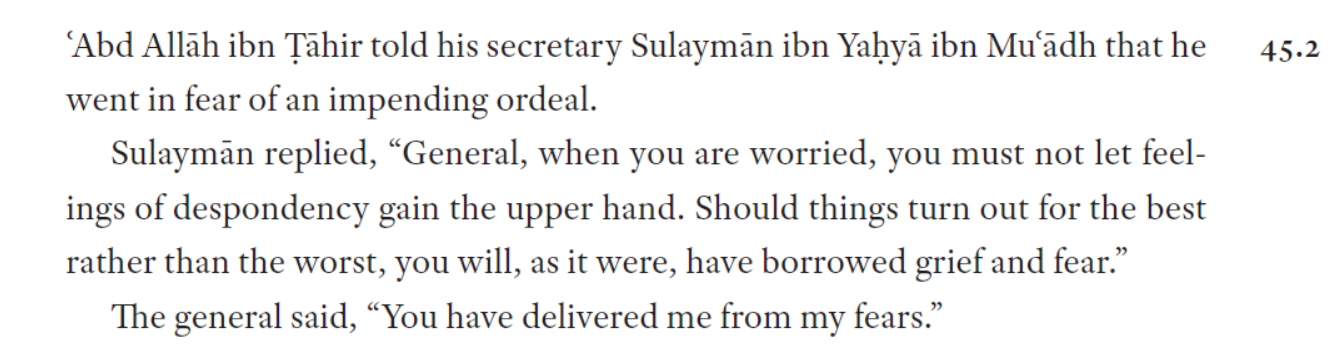
While all this nonsense was going on, I came across a charming account on Twitter, posting excerpts from Arabic literature, and giving sources.  Here’s one:

Came across this little exchange between a 9th-century Abbasid general and his secretary about worrying over something that might never happen. His secretary had a good way of putting things into perspective.

Found this in al-Tanukhi’s 10th-century Deliverance Follows Adversity p. 101

The book is Al-Faraj baʿd al-shiddah (Deliverance Follows Adversity).  The printed text is Stories of Piety and Prayer: Deliverance Follows Adversity by al-Muhassin ibn ‘Ali al-Tanukhi, edited and translated by Julia Bray with facing Arabic text, and printed in New York in 2019.  Al-Tanukhi was from Basra and lived in the second half of the 10th century AD.

Let the demons of AI do their worst!

An English translation of Mar Zay‘a: The Saint of Jilu, out soon from Gorgias Press

An email from David Wilmshurst, who has continued his work on texts relating to the Church of the East.  He’s got another book coming out, around the end of October, through Gorgias Press.  This contains an English translation of the hagiographical Life of Mar Zay‘a, a legendary saint of Palestine who supposedly belonged to the 4th century AD.  The book is titled “Mar Zay‘a: The Saint of Jilu”.

He writes:

Mar Zay‘a was a legendary saint of Palestine who supposedly flourished in the 4th century.  The Syriac text of his Life, probably written by a bishop or priest of Jilu in the 18th century, was published by Bedjan in 1890 in Volume 1 of his Acta Martyrum et Sanctorum.  Although it is one of the more readable saints’ lives in Bedjan’s collection, it has remained for more than a century without an English translation.

I have now produced the first English translation of this intriguing text.  It was obviously written to extol the church of Mar Zay‘a in the large village of Matha d’Mar Zay‘a in Jilu.  Besides telling a good story, it contains much interesting topographical information of the kind which delights scholars of ecclesiastical geography like me.  … I have also supplied a substantial commentary which discusses the evidence for the early settlement of the Hakkari region in southeast Turkey by Christians of the Church of the East.

The French Dominican missionary Jean-Maurice Fiey was the first scholar to discuss the early Christian history of Hakkari, in his 1964 article ‘Proto-histoire chrétienne du Hakkari turc’.  It used to be believed that there were no Christian settlements in the Hakkari region before the 1390s, when large numbers of Christians fled from the Mosul lowlands and took refuge in the Hakkari mountains to escape the depredations of Timur Leng.  Fiey argued vigorously against this view and demonstrated that there were Christians in Hakkari at least as early as the 5th century, when the region was divided between the East Syriac dioceses of Dasen and Beth Bgash.

I have been able to use a wider range of sources than Fiey had at his disposal, and the new evidence I present in this book strengthens Fiey’s contention that the Hakkari region was a vigorous site of Christian activity long before the ‘flight to the mountains’ towards the end of the 14th century.

As in my previous books, my reconstruction of the early history of Christian Hakkari draws largely upon the prosopographical and topographical evidence provided either by Syriac manuscript colophons or by references in saints’ lives (including the Life of Mar Zay‘a) and other sources.  I have also profited from my growing familiarity with the history of the Greek Orthodox and Armenian Churches to set the history of the East Syriac Christians of Hakkari in a wider regional perspective.

He’s also sent a copy of the cover:

… a rather splendid image of Mar Zay‘a slaying the Angel of Death (who looks rather like a Himalayan yeti to my eyes)!

I have suggested in my commentary that the appearance of the Angel of Death may have been inspired by the ferocious bears which used to roam the Hakkari mountains.  My partner Diyah (an Indonesian Muslim) tells me that in Islamic thought the Angel of Death is believed to appear to those about to die.  Did the Christians of the Middle East have a similar belief? I wonder.

This is probably the most famous image of Mar Zay’a, yet the Life which I have translated does not mention the Angel of Death (although at one point Zay’a raises a king’s son from the dead).

The little that is known about Demetrius of Cyzicus… part 1

In my first post about Demetrius of Cyzicus (fl. ca. 1028) I wrote that the Greek work against the Jacobites etc.,…

… was composed between 1026-28 by the deeply obscure Demetrius, Metropolitan of Cyzicus. What little is known about him can apparently be found in H.G. Beck, Kirche und theologische Literatur im Byzantinischen  Reich (Munich, 1959), p.532, although I have not looked.

Well, I have now located this volume, and others, and I find that I was misled by my reference, and rather more is known.  But anyway, let’s start with the Beck paragraph, and then give a ChatGPT translation of it.

Ein Günstling des Kaisers Konstantinos VIII. und besonders des Kaisers Romanos Argyros war der Metropolit von Kyzikos, Demetrios. 1028 ist er durch seine Unterschrift unter ein Synodaldekret bezeugt. 1037 ließ er sich ohne Glück in eine Konspiration gegen den Patriarchen ein. Wahrscheinlich ist er der Verfasser einer „Ἔκθέσις κατ’ ἐπιτομὴν τοῦ τῶν Ἰακωβιτῶν δόγματος“, die er im Auftrag des Kaisers Konstantinos verfaßt haben will und ihm widmet. In addition to the Traktates you can read, you will be able to leave them in a very thick place. Mit der vieldiskutierten Narratio de rebus Armeniae hat der Traktat nichts zu tun, ebensowenig Demetrios mit der Abfassung der einem Isaak zugeschriebenen Invektiven gegen die Armenier (S. 533 u. 628). If these are the versions of literary products in which they are published, they are included in the unglücklichen bibliographischen Umständen zu verdanken.

Demetrios is also the Kanonist hervorgetreten. Wir kennen eine Μελέτη über die Verwandtschaftsgrade und einen kanonischen Bescheid über einen Sonderfall der Verwandtschaftsgrade. Fünf, vielleicht sechs Logoi über verschiedene juristische Fragen sind noch unediert.²

  • Gegen die Jakobiten: PG 127, 878–885 (unter dem Namen des Philippos Monotropos), der fehlende Anfang und Schluß: G. Ficker, Die Erlasse des Patriarchen Alexios Studites, Kiel 1911, 22–23; – die μελέτη: PG 119, 1097–1116 and Rhalles-Potles V 354–366; – Bescheid: PG 111, 1116–1120 and Rhalles-Potles V 366–368.

² Ehrhard 79, 1. 89; – DTC IV 264–265 (L. Petit); – LTK III 202 (A. Michel); – DHGE XIV 208–210 (J. Darrouzès); – G. Garitte, Narratio de rebus Armeniae, Louvain 1952 (im Kommentar ausführliche Diskussion des gesamten Zuteilungsproblems mit kritischer Sichtung der Literatur).

Running this through ChatGPT gives us:

A favourite of the emperor Constantine VIII, and especially of the emperor Romanos Argyros, was Demetrius, metropolitan of Cyzicus. In 1028 he is attested by his signature on a synodal decree. In 1037 he became involved, unsuccessfully, in a conspiracy against the patriarch.

He is probably the author of an “Abbreviated Exposition of the Doctrine of the Jacobites,” which he claims to have composed at the commission of the emperor Constantine and dedicated to him. From the conclusion of the treatise it emerges that he had already previously delivered an opinion on the same subject.  Note that the treatise has nothing to do with the much-discussed Narratio de rebus Armeniae , nor does Demetrius have anything to do with the composition of the invectives against the Armenians attributed to Isaac (pp. 533 and 628). The fact that these three different literary works were brought into connection with one another is due solely to unfortunate bibliographical circumstances.

Demetrius also distinguished himself as a canonist. We know of a Meletē (=study/treatise) on degrees of kinship, and of a canonical ruling concerning a special case involving degrees of kinship. Five, perhaps six, logoi (=discourses) concerning various legal questions are still unpublished.²

  • Against the Jacobites : PG 127, 878–885 (under the name of Philippos Monotropos); missing the beginning and ending: G. Ficker, The Decrees of Patriarch Alexios Studites , Kiel 1911, 22–23; the meletē : PG 119, 1097–1116 and Rhalles–Potles V 354–366; the canonical ruling: PG 111, 1116–1120 and Rhalles–Potles V 366–368.

² Ehrhard 79, 1. 89; DTC IV 264–265 (L. Petit); LTK III 202 (A. Michel); DHGE XIV 208–210 (J. Darrouzès); G. Garitte, Narratio de rebus Armeniae , Louvain 1952 (with a detailed discussion in the commentary of the entire problem of attribution, with a critical review of the literature).

Note that the abbreviations in the above are:

This article is a start.  It is shorter than it needs to be, as is perhaps inevitable in so wide a survey of authors.  It clearly draws upon the old DGHE article which goes into much more detail.  It is also notable for the sheer age of the material referenced, even allowing that Beck’s article itself is now seventy years old.  The vague “bibliographical circumstances” are simply the accident that the three texts all appeared one after another in one manuscript and the first editor ascribed them all to Demetrius.  

A kind commenter drew my attention to an interesting article by Zachary Chitwood in GRBS 54 (2014) (online here, pp.300-301) which manages to cover a lot of the background to Demetrius’ anti-Jacobite text in a footnote: 

The introductory and closing paragraphs of the text are printed in Ficker, Erlasse 22–23, while the rest of the text corresponds to PG 127.880–884. The text printed in PG is erroneously ascribed to “Philippus Solitarius” instead of Demetrios of Kyzikos (the likely author); see Dagron, TravMém 6 (1976) 201 n.108; Ficker, Erlasse 23; an analysis of the text and a German translation in Benner, Die syrisch-jakobitische Kirche 123–136.

Abbreviations again: TravMém = G. Dagron, Travaux et Mémoires.  Ficker = G. Ficker, Erlasse des Patriarchen von Konstantinopel Alexios Studites (Kiel 1911).  The Benner item is a thesis, from 1990, which exists in PDF but curiously is not on Academia or somewhere like that.

So we now know something.

A poem addressed to Demetrius, Metropolitan of Cyzicus

Our obscure 11th century Greek cleric, Demetrius, Metropolitan of Cyzicus, had the good fortune to have a poem addressed to him by Christopher of Mytilene.  The latter was a contemporary poet who wrote a collection, Various Verses, of which this poem is number 22.  Even more fortunately the collection then had the good fortune to be edited and translated in the excellent Dumbarton Oaks series:

  • Floris Bernard and Christopher Livanos, eds. and trans., The Poems of Christopher of Mytilene and John Mauropous, Dumbarton Oaks Medieval Library 50 (Cambridge, MA: Harvard University Press, 2018).

This reprints the 1903 Kurtz edition with an English translation and commentary.[ref]E. Kurtz, Die Gedichte des Christophoros Mytilenaios, Leipzig: Neumann (1903), p.13 (poem 22). [/ref]

Christopher’s verses do not seem to have been popular.  As the editors remark:

Only one manuscript transmits the collection in its entirety: Grottaferrata Z.α.XXIX, which was copied in the thirteenth century, in a milieu of Greek-speaking poets in southern Italy. This manuscript is heavily damaged, because, as Christopher himself seems to have foreseen in poem 103, mice ate away at the book. As often in Byzantine manuscripts, the verse lines were laid out in two columns, to be read from left to right. Since the lacunas often extend over more or less one column, in many poems every other verse is lost. Fortunately, there are some Byzantine poetic anthologies that include dispersed poems of Christopher (mostly not, or wrongly, attributed), which help to reconstruct the complete text. However, those poems transmitted only in the Grottaferrata manuscript remain in their sorry state.

Here is the translation of the poem:

22. To Demetrios, the metropolitan of Kyzikos, on his gout

Why do you moan about everything so long and so often?
It is your feet that suffer, gout that consumes you.
Up against these pains, hold the garlands
woven for you by the long-lasting diseases,
whose bitter afflictions you endure—
a disciple of Job, the long-suffering.
Raise your spirits with hopes of trophies,
and do not, do not appear, by the very Trinity,
to be lesser than petty sufferings, you winner of all!
The man proven greater than any passion of the soul,
who has overpowered the principalities and powers of darkness,
and erected a great victory monument in his life,
that man . . .
And where is the sharp mind of Demetrios?
. . .
Let faith be the razor-sharp blade
. . .
let hope be the shield, and divine protection the spear
. . .
. . .
the malicious disease that has attacked you
. . .
and shoots its arrows one after the other
. . .
the vile one, not tolerating those who trample upon him,
. . .
but you should firmly trample on him once more.
. . .
and shatter him; and even if he bites again.
. . .
if you endure the scratches until the end
. . . for praise,
looking at the future and ignoring the present.

Rather outside our period, but interesting to see, and especially to learn about the effect that mice can have on a manuscript of poetry.

Demetrius, Metropolitan of Cyzicus, “Expositio Breuiter Doctrinae Iacobitarum” – Full Greek text edited

Independent scholar Alex Hourani tells me that he has created a Greek text  from manuscripts of a largely unpublished medieval text.  The anti-heretical work, which is referred to under various titles, was composed between 1026-28 by the deeply obscure Demetrius, Metropolitan of Cyzicus. What little is known about him can apparently be found in H.­G. Beck, Kirche und theologische Literatur im Byzantinischen Reich (Munich, 1959), p.532, although I have not looked.[ref]James Morton, “Law and Orthodoxy under the Komnenoi”, Dumbarton Oaks Papers 76 (2022), 145-162, p.151, n.32.  Online here.[/ref]  A page at Dumbarton Oaks tells us that Demetrius was appointed syncellus in 1029, and later made oikonomos of the Great Church, sometime before April 1032.

His Greek text is here:

The text is there entitled “Expositio Breuiter Doctrinae Iacobitarum” (ἔκθεσις κατ᾿ ἐπιτομὴν τοῦ τῶν Ἰακωβιτῶν δόγματος καὶ τῶν ἀλλων ὧν ποιοῦσι παρὰ τὴν ἐκκλησιαστικὴν καὶ ὀρθόδοξον πίστιν τε καὶ παράδοσιν, “An exposition in summary form of the doctrine of the Jacobites and of the other things which they do contrary to the ecclesiastical and orthodox faith and tradition, written by Demetrios, Metropolitan of Cyzicus“).

However it is also referred to sometimes as “Liber de rebus Armeniae (contra Iacobitas),” and a shortened version of it appears under that title in Patrologia Graeca 127, cols. 880-84, where it is wrongly attributed to Philippus Solitarius. The text was printed from MS. Paris gr. 1315.[ref]Bernadette Martin-Hisard, “Le discours des Georgiens sur leur orthodoxie: les heretiques Armeniens et Pierre le Foulon (VIIe-XIIe S.)”, in: Rivista di Studi Bizantini e Neoellenici 47 (2010) 195-264, p.243, n.204.[/ref]

The old McClintock and Strong article on Philip the Solitary mentions the work, and an AI search tells me that the 1648 Combefis editio princeps labelled it “De Fide et Coeremoniis Armeniorum, Jacobitarum, Chatzitzacriorum et Romanorum seu Francorum”.[ref]François Combefis, Novum Auctarium Graeco-Latinae Bibliothecae Patrum, Volume 2, columns 261ff, Paris, 1648, but I have been unable to access the book.  Update: it is here.  It turns out that Combefis gave volume 2 a separate title.  Volume 2 (the Tomus Alter Historicis et Dogmaticus) of the 1648 edition is uniquely titled after its core treatise: Historia Haeresis Monothelitarum sanctaeque in eam sextae synodi actorum vindiciae.[/ref].

A list of manuscripts appears in the Pinakes database here.  Hourani’s text is from MS Real Biblioteca Escorial R. I. 15, MS Sinai Greek 1795, and MS Heidelberg Cod. Pal. Graec. 356, ff. 129-132v. These include a preface indicating that it was composed at the request of Constantine VIII (1025-1028).

There is a discussion and summary of the text in German, see T. H. Benner, “Die syrischjakobitische Kirche unter byzantinischer Herrschaft im 10. und 11. Jahrhundert” (PhD diss., Marburg, Philipps­Universität, 1989), 123–26; see also Z. Chitwood, “The Patriarch Alexios Stoudites and the Reinterpretation of Justinianic Legislation against Heretics,” GRBS 54 (2014): 300–301.[ref]Morton, q.v., n.33.[/ref]

The work is of interest as the first text to explain the term “Melchite”.  Dr H. has also drafted an interesting article on the origins of the term which is on Academia here.  Here is the relevant passage (I have slightly revised the translation which is very literal):

4.  τοῦ τοίνυν δηλωθέντος Ἰακώβου τὸ τοῦ Εὐτυχοῦς δόγμα πεπαῤῥησιασμένως κηρύττοντος, σχίσμα γέγονεν ἐν τοῖς Σύροις. καὶ οἱ μὲν Ὀρθόδοξοι οἰ τῇ συνόδῳ καὶ τῷ βασιλεῖ Μαρκιανῷ ἀκολουθήσαντες, ἐκλήθησαν Μελχῖται· ὡς φρονοῦντες τὰ τοῦ ὀρθοδόξου βασιλέως. ἐπεὶ μελχὶ λέγεται καθ’ Ἐβραίους καὶ Σύρους ὁ βασιλεὺς. οἱ δὲ Εὐτυχιανισταὶ καὶ ἐπὶ τούτοις Μονοθελῆται, οἱ τῷ μοναχῷ Ἰακώβῳ τῷ εὐτελεῖ καὶ ἀνωνύμῳ Σύρῳ πεισθέντες, ὠνομάσθησαν Ἰακωβῖται. καὶ ἔκτοτε μέχρι τοῦ νῦν, οὕτως ἀπ’ ἐκείνου καλοῦνται.

4.  This Jacob preached the doctrine of Eutyches outspokenly, and a schism happened among the Syrians. The orthodox, who followed the synod and the emperor Marcian, were called Melchites, as if they held to the opinions of the orthodox emperor, because a king is called “melchi” according to the Hebrews and the Syrians.  The Eutychianists and also the Monothelites who were persuaded by Jacob, the worthless monk and nameless Syrian, were called Jacobites. Since that time, and until now, they are called as such after him.

Here’s a DeepSeek output for the first section of the text:

An exposition in summary form of the doctrine of the Jacobites and of the other things which they do contrary to the ecclesiastical and orthodox faith and tradition; written by Demetrios, Metropolitan of Cyzicus; at the prompting of the Christ-loving lord Constantine, the purple-born emperor; in which there is also (a section) concerning the Chatzitzarioi:—

(1) Since God has bestowed upon the world your nature, that transcends nature and is truly most kingly as a choice possession, O good-loving lord; and having granted to your might the readiness in all things; in you alone of all men He wondrously mingled things that cannot be mingled: kingship and teaching; the flower of the purple and the power of words; and for this reason you have already turned many of the Hebrews from the error handed down from their fathers; and you have refuted no few of the Athinganoi and Paulicians; and you yourself have been deemed worthy to become the mouth of God, according to the divine oracles; for He who brings out, it says, the worthy from the unworthy, “as my mouth shall he be”.

But now the great and burning zeal for God has stirred you up also to the refutation of the Jacobites; so that these too, holding distorted and blasphemous doctrines, may not escape notice, creeping in under the guise and skin of sheep as wolves, and falsely calling themselves orthodox. In clear and concise language I shall set before your majesty the matters concerning their heresy from the books of the Fathers; adding also the matters concerning the Chatzitzarioi, just as you commanded. And the affairs of the Jacobites stand as follows. …

The “Chatzitzarioi” or Staurolatrians[ref]Andreas Rhoby, “Byzantine Greek Words in English Vocabulary?” online here.[/ref] seem to be an Armenian cross-worshipping judaising group of the period.

Always interesting to see bits like this.

The seal of Demetrius of Cyzicus

The texts of critical editions under French law are not subject to copyright?

An interesting post on Twitter by Gregory Crane of the Perseus project leads to some interesting finds:

The Scaife viewer build on work by @PonteIneptique. It would be easy to import the texts into gitlab.inria.fr/almanach/cllg/ from @ThesLingGraecae. We have chosen not to do so but there is no copyright at play. Here are the biggest 20 not yet in Perseus….

Thibault Clérice seems to be the main man here.  Inria seems to be doing some very useful things.   The Corpus Liberatum Linguae Graecae site at gitlab:

The CLLG Freed Corpus is a free XML-TEI corpus of Ancient Greek texts derived from the Thesaurus Linguae Graecae (TLG) E CD-ROM.
It has been transformed using Diogenes and enriched with Dapytains-compatible citation structures.

The corpus is developed within the CLLG project, funded by the Programme Inria Quadrant at Inria.

The corpus is tested with HookTest.

With the interesting postscript:

Texts are distributed under French law, which holds that the texts of critical editions are not subject to copyright protection, as they do not constitute an expression of the editor’s personality (CA Paris, Pôle 5, 2ème Ch., 9 June 2017, no. 16/00005).

The Cour d’appel de Paris judgement is here, but I have not tried to read it.  It seems to be a case where a publisher, Libraire Droz, sued another publisher, Libraire Classiques Garnier.  Droz lost.  AI Overview:

In CA Paris, Pôle 5, 2ème Ch., 9 June 2017, no. 16/00005, the Paris Court of Appeal confirmed that a publisher cannot claim copyright protection over public-domain medieval texts when the transcription involves no original creative input.

Lack of Originality: The court held that Librairie Droz did not perform a creative or transformative editorial adaptation on the underlying medieval texts. Transcribing, retranscribing, or applying standard paleographic methods (like fixing punctuation or abbreviations) to public domain material does not imprint the work with the author’s personality.

Copyright Infringement Rejected: Because the texts lacked the originality required to qualify as works of the mind (œuvres de l’esprit), the infringement (contrefaçon) and damages claims by Librairie Droz were dismissed.

Even more interesting is CoMMA:

…a large-scale corpus of medieval manuscripts produced through automatic text recognition. The corpus contains around 2.5b tokens drawn from more than 23,000 digitized manuscripts in Latin and Old French, harvested via IIIF. Unlike other resources, it is made of raw, non-normalized text enriched with layout analysis in various formats.

A PDF describing this is here.  It does say:

For medieval manuscripts in Western languages, recognition accuracy is increasingly limited, not by models but by the availability of ground-truth data, with current error rates often below 10%.

10% is a big error rate, tho.  Even 1% is painful in OCR.  But it’s a massive step forward.

I see other projects which are bootlegging the Thesaurus Linguae Graecae.  The TLG is run by the excellent Maria Pantelia, who relies on subscriptions to hire people to transcribe texts.  So I have very mixed feelings here.  The TLG is wonderful and necessary.  It needs that revenue stream until the project is complete.

Much as I want to see everything available to everyone freely, I agree with Gregory Crane.  I’m not going to do things that might injure the TLG.  Nobody else should do so either.  Let Dr Pantelia carry out her mission.  The world will not end if we have to manage for a few more years until she’s done.

In general, if there are people out there producing stuff that promotes the classics, patristics, the ancient world, let them enjoy the income from their labour.  Heaven knows there isn’t huge money to be made.  A few PDFs for use by the poor people, of books that are sold at hundreds of dollars; that is one thing.  That won’t affect the publisher revenue stream.  But let’s not wreck projects like the TLG.

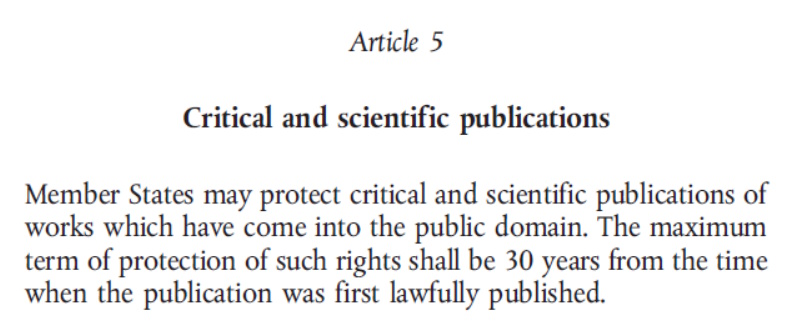
Update (26 Sep 2026): I learn from a twitter post by Gregory Crane that “the EU allows nations to copyright editions for up to but not more than 30 years.”

The regulation in question is article 5 of the EU Copyright Term Directive (Directive 2006/116/EC, originally 1993/98/EC) (Download PDF here).   The regulation is optional, however.  Relevant extract:

An AI search (caution!) tells me that only Germany – inevitably – and Estonia have implemented it.  No doubt the German government – which seems to be completely subservient to the publishing industry – drew up this foolish clause.