The Latin hymn “Tantum ergo sacramentum”, and its 19th century translation by Edward Caswall

In yesterday’s post, there was a reference to a Latin hymn beginning “tantum ergo sacramentum,” whose English translation misled Knox’s schoolboy.  At the time I knew nothing about this.  Thankfully a kind gentleman online knew more.

It seems that this is an excerpt from the medieval 13th century hymn by Thomas Aquinas; and the  translation used is that by Edward Caswall, which was first published in 1849. According to Wikipedia, this translation can be sung to the same tune as the Latin, although this useful feature is achieved at the price of some juggling of lines and words.

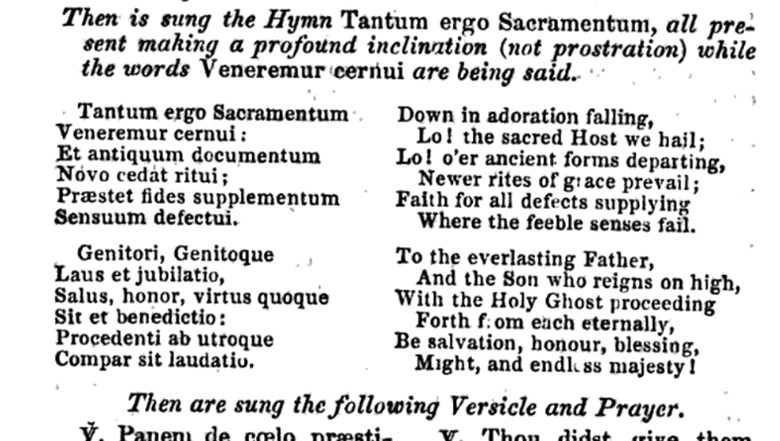
An 1854 manual of Catholic devotion happily includes the Latin and this English version in parallel:

Tantum ergo sacramentum
Veneremur cernui:
et antiquum documentum
novo cedat ritui;
Praestet fides supplementum
sensuum defectui.

Genitori genitoque
laus et jubilatio,
Salus, honor, virtus quoque
sit et benedictio!
Procedenti ab utroque
compar sit laudatio!

Down in adoration falling,
Lo! the Sacred Host we hail,
Lo! o’er ancient forms departing
Newer rites of grace prevail;
Faith for all defects supplying,
Where the feeble senses fail.

To the Everlasting Father,
And the Son Who reigns on high
With the Holy Ghost proceeding
Forth from Each eternally,
Be salvation, honour, blessing,
Might, and endless majesty.

The volume in question is “The Golden Manual, or, Guide to Catholic Devotion, Public and Private, Compiled from Approved Sources“, Burns & Lambert (1854).  The excerpt above is on page 665.    It is interesting that the rubric takes the time to discourage the prostration (cernui) that might otherwise inevitably occur.

Caswall’s translation first appeared in “Lyra Catholica: containing all the Breviary and Missal hymns, with others from various sources. Translated by Edward Caswall M.A.”, London: Burns (1818), page 112.  Edward Caswall himself was a friend of John Henry Newman, and the origins of the Lyra Catholica are discussed in his 2005 biography by Nancy Marie De Flon.1  Caswall made the translation after converting to Catholicism and thereby losing his Anglican living, which left him with time on his hands.  Having independent means, he had no need to seek employment, which means we today benefit from his efforts.

Other translations of the Tantum ergo sacramentum” do exist, of course.  This one seems rather closer to the meaning, although the lines have again been transposed.

Let us worship, humbly bending,
This so glorious sacrament;
And let ancient rites, here ending,
Yield to worth, new rites present;
May faith too, assistance lending
Aid where sense proves impotent.

To the Father, ever heeding
Our petitions, glory be:
To the Son, on Calv’ry bleeding,
Raise the song of jubilee:
And of Him, from both proceeding,
Chaunt the praises equally. Amen.

This example is from “Select Hymns and Prayers. Translated from the original Latin into English lyric verse. By a member of the Society of Jesus. Lat. & Eng“, Dublin (1852), in this case pages 43-44.

English translations of material from the Roman breviary are always handy to have!

  1. Nancy Marie De Flon, Edward Caswall: Newman’s Brother and Friend, Gracewing Publishing (2005), p.152.  Google Preview here.[↩]

An anecdote on “living Latin” by Ronald Knox

There is a 1923 book titled “Church Latin for Beginners: An Elementary Course of Exercises in Ecclesiastical Latin” by Miss J. I. Lowe (online here) which contains two prefaces, as well as an appendix with a handy list of syntactical usages. At the time Catholic services were still held in Latin, so such a book had an obvious value.

The first preface, by a Canon William Barry, opens with the words:

I was very glad to see in print this little volume, which deals with our Church Latin; and I hope that it will be widely read and studied. The want of such a help has long been evident. Classical or heathen Latin is a beautiful creation of genius ; but as a language it is dead. The Latin of Catholic Christendom is a living literature; great portions of it are every day read and recited all over the world, by thousands on thousands of priests, seminarists, religious orders of men and women. But they have never been taught the grammar of it, seldom have learned by reflection how marvellous a transformation it is of a language singularly hard to refashion ; yet the miracle stands perfect in their sight.

Perfect I call it, and take my position close to such masters of style as Ruskin, Matthew Arnold, and J. A. Symonds, whose hearty recognition of what another has termed “baptized Latin” was enhanced by their Oxford training in the classics. Not a degenerate offspring of Roman speech in decay, but a most original and happy adaptation of the popular idiom to sacred uses, our literature of sanctuary, cloister, and the schools is a world in itself.

This is followed by a preface by Ronald Knox, which makes many interesting points, but begins with this:

There is a story told in one of our Catholic Colleges (and probably in all of them) which throws, it is to be feared, a sinister light upon the easy familiarity with which altar-boys, choirs, and even congregations patter out their ecclesiastical Latin. A boy in Latin class was exhibiting a mulish ignorance as to the meaning of the word tantus, and the class master, with that fatal tendency we all have to adopt the method of cross-examination, was trying to get the right meaning out of him. At last in despair he suggested: “Well, you have met the words Tantum ergo Sacramentum before; at least you know what that means.” At which a great light dawned upon the boy, and he said : “Oh, yes, sir, I know that : it means ‘Down in adoration falling.'” Most Catholic schoolmasters have had similar, if not quite so poignant, experiences .

No doubt it was ever so.  All the same, we are the poorer for the loss of this kind of Latin.

From my diary

My attempt to finish off the St Botolph materials was derailed by two weeks of a cold, but I’m now back to it.  I’m currently working on translating the full text of the “translation” of his remains.  This took place under King Edgar, and basically consisted of a raid on the ruined monastery at Iken.  It will be good to get this done.

A thought on the GNO edition of Gregory of Nyssa

Yesterday I received an email asking if I could locate the Greek text for a passage in a translation from a work by Gregory of Nyssa, and complaining that it wasn’t obvious what the Patrologia Graeca reference would be.  Oh lucky me.

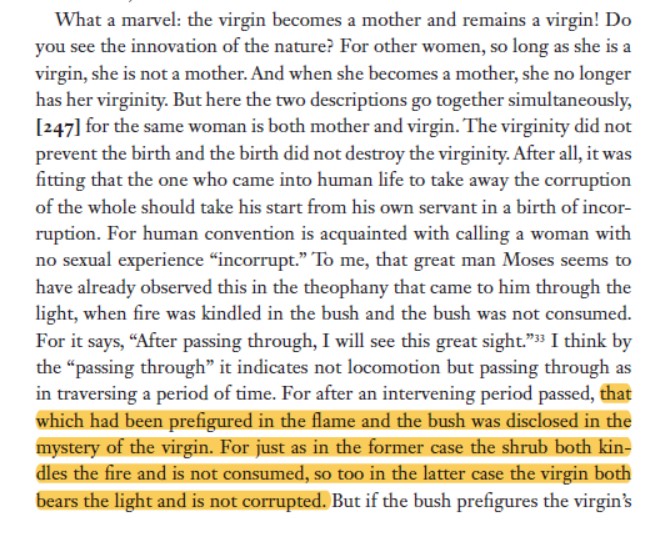
What a marvel: the virgin becomes a mother and remains a virgin! Do you see the innovation of the nature? For other women, so long as she is a virgin, she is not a mother. And when she becomes a mother, she no longer has her virginity. But here the two descriptions go together simultaneously, [247] for the same woman is both mother and virgin. The virginity did not prevent the birth and the birth did not destroy the virginity. After all, it was fitting that the one who came into human life to take away the corruption of the whole should take his start from his own servant in a birth of incorruption. For human convention is acquainted with calling a woman with no sexual experience “incorrupt.” To me, that great man Moses seems to have already observed this in the theophany that came to him through the light, when fire was kindled in the bush and the bush was not consumed. For it says, “After passing through, I will see this great sight.”33 I think by the “passing through” it indicates not locomotion but passing through as in traversing a period of time. For after an intervening period passed, that which had been prefigured in the flame and the bush was disclosed in the mystery of the virgin. For just as in the former case the shrub both kindles the fire and is not consumed, so too in the latter case the virgin both bears the light and is not corrupted.

The translation is a portion of Gregory of Nyssa, Oration on the Saviour’s Nativity, translated by Andrew Radde-Gallwitz, taken from Mark DelCogliano (ed.), The Cambridge Edition of Early Christian Writings vol. 3: Christ: Through the Nestorian Controversy, Cambridge (2022), pp. 403-419; p.409.  I’d not seen this series, which is very nicely produced.  I also discover that a draft of the same translation is online at hcommons.org here – well done!

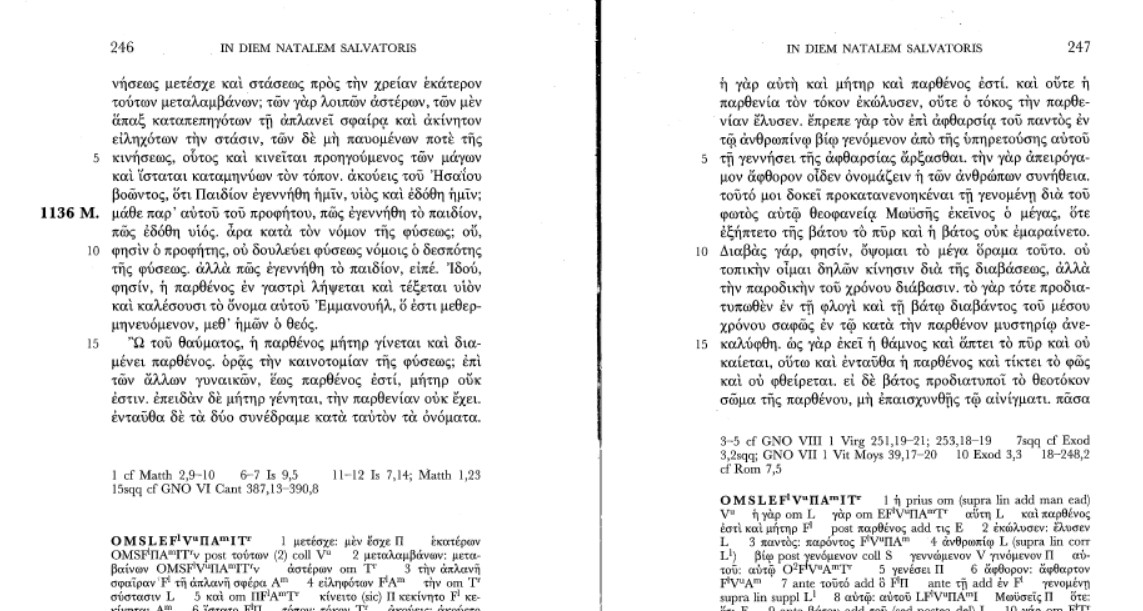
The bold [247] turns out to be the page number in the Greek text, printed in the Gregorii Nysseni Opera series published in a lotta lotta volumes with confusing numeration by Brill.  From the intro:

The text translated here is from the critical edition of Friedhelm Mann in Ernestus Rhein, Friedhelm Mann, Dörte Teske, and Hilda Polack, Gregorii Nysseni Sermones, Pars III, GNO 10.2 (Leiden: Brill, 1996), 235–269. Numbers in square brackets correspond to page numbers in this edition.

Erm, yes.  The volume numbering probably makes sense if you have the set before you; otherwise not.  I know that producing daft volume numbering is a cherished tradition of German editors, but… guys, it’s got to stop.  Memo to Brill: horse-whip any academics who try this trick in future.

So our passage is on page 247 of the GNO edition.  And if you can find the right one, then you can move forward.

First however, a quick whinge.

What the translator does NOT do is two essential essential things.  And if you are editing or translating a text, please do these in your introduction.  Please.  Why force every user to do this?

Firstly, give the Clavis Patrum Graecorum (CPG) reference number.  It’s what it’s for.

In this case the work turns out to be CPG 3194, “Oratio in diem natalem Christi”.  This is also listed in the BHG index as 1915.  The PG text is 1128-1149, reprinting the Morel edition of 1638.

There.  That’s solid, useful bibliographical information, available for the price of a number.  Why the heck not refer to it?

Secondly, give the Latin title(s) of the work.  Come ON boys!  Why make the reader reverse translate your shoddy little vernacular paraphrase?  We want to access the literature.

In this case the CPG and GNO differ: the latter calls it “In Diem Natalem Salvatoris”, for some unknown reason.

Where the GNO edition DOES score is that it printed the PG column number in bold, with “M” for Migne, the PG editor.  So we can indeed link back to the PG text.

So here we can see that our passage is that found in Migne’s Patrologia Graeca vol. 46 col. 1136.

A quick sanity check shows that page 247 does indeed refer to “mater” and “parthenos”, so we have the right passage.

There’s no chapter or verse divisions, so anybody using the GNO edition has to refer to GNO page number – yes, the bibliographical reference with the confusing volume numbers (second memo to Brill: stop these bums doing this, yes?).

I wondered if there was actually any divisions in the PG edition.  Taking a look, we find that Migne gives the title as “In diem natalem Christi” or, at fuller length, “Oratio in diem natalem Christi et in infantes qui in Bethleem occisi sunt a Herode” – Oration on the nativity of Christ and on the infants who were killed at Bethlehem by Herod.”

But the PG has no chapter divisions either.  Rats!

That seems more work than it should be, to be honest.

Christmas homilies tend to attract translators.  A translation also exists in Beth Dunlop’s unpublished 2004 thesis “Earliest Greek Patristic Orations on the Nativity” (Boston College, 2004), p.154 f., and another translation appears without attribution at Orthodox Christianity Then And Now.  There are probably others.

Thoughts on Psalm 1:1 in Latin – “pestilentiae”?

One of the useful features of Bible Gateway is the parallel versions, and if you use it with the Latin Vulgate and the Douay-Rheims, it is useful indeed.  Here it is for Psalm 1.

Beatus vir qui non abiit in consilio impiorum, et in via peccatorum non stetit, et in cathedra pestilentiae non sedit;

Blessed is the man who hath not walked in the counsel of the ungodly, nor stood in the way of sinners, nor sat in the chair of pestilence.

A quick look at some modern version shows an interesting difference.  The modern versions are translated from the Hebrew.  Here is the ESV – basically the Old RSV.

Blessed is the man
    who walks not in the counsel of the wicked,
nor stands in the way of sinners,
    nor sits in the seat of scoffers;

Scoffers is also rendered “mockers”.

Now the Vulgate Latin for the Psalms is not translated from the Hebrew, but from the old Greek translation, the Septuagint (LXX).  This reads:

μακάριοςμακαριος ὃς οὐκ ἐπορεύθη ἐν βουλῇ ἀσεβῶν καὶ ἐν ὁδῷ ἁμαρτωλῶν οὐκ ἔστη καὶ ἐπὶ καθέδραν λοιμῶν οὐκ ἐκάθισεν

And the Hebrew itself reads:

So where does “pestilentiae” come from?  Our Hebrew manuscripts are mainly 10th century AD. So was Jerome working from a different Hebrew text?

Well, we can find out.  Jerome may have translated the psalter from the LXX, but he also did a translation from the Hebrew.  This was helpfully translated by the SPCK: J. M. Harden, Psalterium iuxta Hebraeos Hieronymi, SPCK (1922), online here.  And it reads:

Beatus uir, qui non abiit in consilio impiorum, et in uia peccatorum non stetit, et in cathedra derisorum non sedit.

So the Hebrew of Jerome’s day was no different.  This is purely an LXX thing.

Now I don’t know a word of Hebrew, so I won’t try and look into that.  But I did find a commentary online which discusses this very question here.  It looks as if it’s a genuine question, how to render that Hebrew word – used only twice in the Psalms, and with different meanings in each case -, and other ancient translators such as Aquila and Theodotion struggled with it too.

So where does the LXX reading come from?  Well, again I know nothing of Septuagintal studies, so I can only speculate.  But I don’t think ancient translations were notable, as a rule, for their accuracy.  We all remember the preface of Jerome – somewhere! – that says that there were as many versions of the Old Latin bible as there were manuscript copies.  So maybe the unknown translator just bodged something in at that point and moved on, never dreaming that we would be talking about it two millennia later and more.  It’s an interesting thought.

From my diary

Rabbit holes are dangerous things.  As I try to pull together the pieces of the project to translate the Life of St Botolph, I find that some of the basic stuff never got done, because of all the rabbit holes that I went down.

So I never got around to translating BHL 1429, the abbreviated Life made by John of Tynemouth.  I made a Latin text alright; but never did the translation.  So I am doing that now.  It’s actually a good opportunity to revisit some of my translation choices for the full Life (BHL 1428).

I also never got around to making the translation of BHL 1431, the full text of the “translation” of the relics of St Botolph.  So that will be next.

Onwards!

How to locate the “Life” of a specific saint (Botolph) in random early modern breviaries

While trying to finish up the St. Botolph material, I came across a sentence in a fascinating article about St Botolph in Scandinavia. This referred to Scandinavian breviaries which might contain a “Life” of St. Botolph.  I already knew that a very abbreviated “Life” of St Botolph was to be found in the Schleswig Breviary of 1512.  But now…

The other printed breviaries that have this Vita are Aarhus, Uppsala and Linköping. This means that although the theory that this Vita was  composed in Scandinavia still holds, there is no longer evidence to fix it to Denmark.1

No reference is given.

Where to start?

Luckily there is a splendid website on early printed breviaries in Hungary: Usuarium, A Digital Library and Database for the Study of Latin Liturgical History in the Middle Ages and Early Modern Period.  You can search for each town, and it will give you a list of early printed liturgical texts.  It even has online copies, and detailed lists of contents.

I started with the Uppsala breviary (Breviarium Upsalense), which can be found here.  This was printed in Stockholm in 1496.  The site also gives a  broad list of contents, which is incredibly handy.  This tells me that the “sanctoral offices” are on pages 453-741.

Looking for Botolph in this vast sea of saints, in no obvious order, in a terrible font, was a nightmare.  I completely failed the first time, retiring hurt, to think and guess again. I had thought initially that it might be in alphabetical order of saint name – it begins with Andrew – but not so.  Then I thought perhaps Saint’s day order, but I couldn’t see it.  Paging through hundreds of pages of hard-to-read text, hoping to spot one small word… was futile.

But I did succeed, so I will share how I did this.  I was able to download a PDF of the whole volume, thankfully, and used my elderly copy of Adobe Acrobat Pro 9 to add bookmarks when I located stuff.

I could see from the website contents that it began with “St Andreas”, i.e. St Andrew.  I googled, and found that St Andrew’s day was Nov. 30.

The orginal volume is unhelpfully without any page or folio numbers.  But the Usuarium site helpfully says that the Sanctoral offices start on p.453 of the PDF/online copy.  So there I went.  Sure enough, St Andrew was there.  I bookmarked this, “Andrew (Nov 30) – 453”.

Next I went to page 741, the end of the sanctoral offices.  Or so Usuarium told me – I could not have determined this myself.  I bookmarked this as “end”.  I then paged back a bit, and found St Katherine.  Back to Google, search “St Catherine Day”. It tells me Nov 25, so I add a third bookmark, “Katherine (Nov 25).

I went back to Andrew, paged down and found… St Barbara (Dec. 4).  Bookmarked that too.  That’s a good start.

So… it looks like the offices are in order of saints’s days.  And the name of the saint is in the fat red text, the rubric.

Botolph is June 17.  So he should be somewhere in the middle.  I picked page 600, and jumped.  Luckily on this page I discovered St Margaret.  Another Google gave me July 20.  Added a bookmark for that, and started paging back, looking up saints as I went.

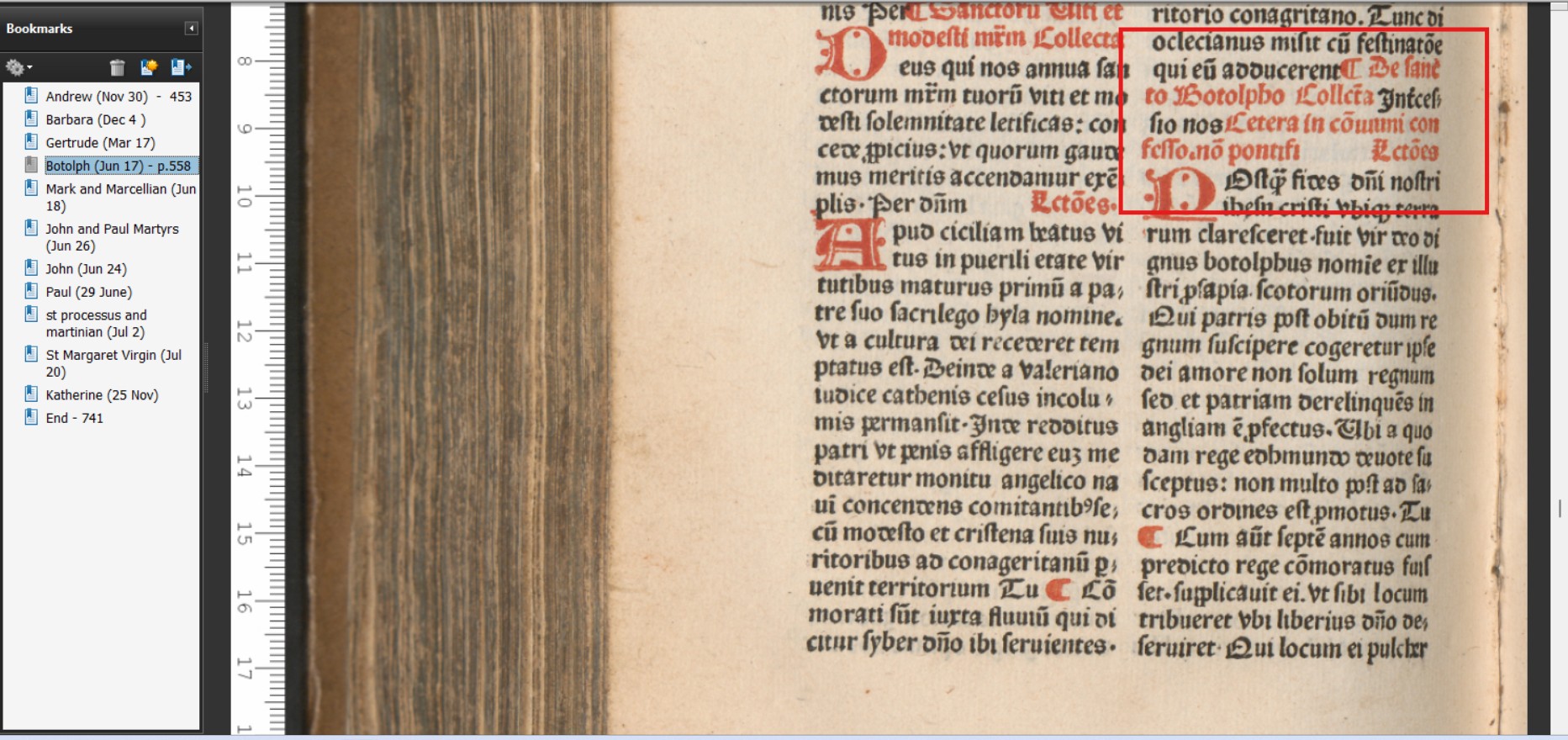
And… eventually… I found St Botolph, on page 558.

I then located the Aarhus breviary, which had defeated me last night.  It was harder to read, which had not helped.  But the same method worked:

  • Mark the start and end of the sanctoral offices.
  • Add bookmarks for the saints as you find them, with saint’s day, so you can see how far you are through the liturgical year.
  • Do a bit of simple arithmetic to guess which pages are halfway between where you are and what you’re looking for.  Then see if you are too early or too late.
  • Repeat and rinse.

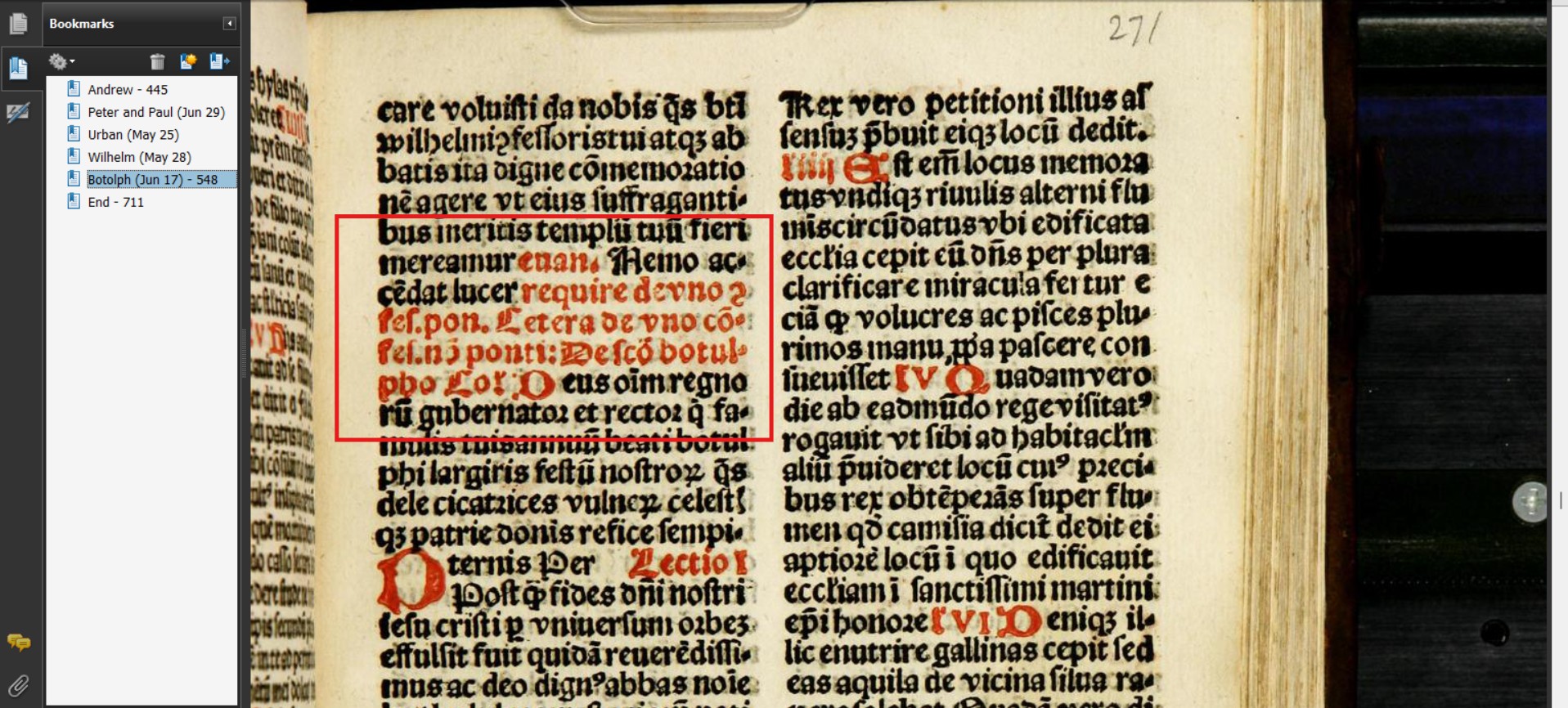
Here it is, on p.548:

I do wish there was someway to feed back my book marks to Usuarium.  One area that the web has NOT solved is collaboration with random strangers.

Some may ask why I didn’t simply use a modern calendar of saints.  The answer is that I couldn’t find one that looked useful!  Probably one exists… somewhere!

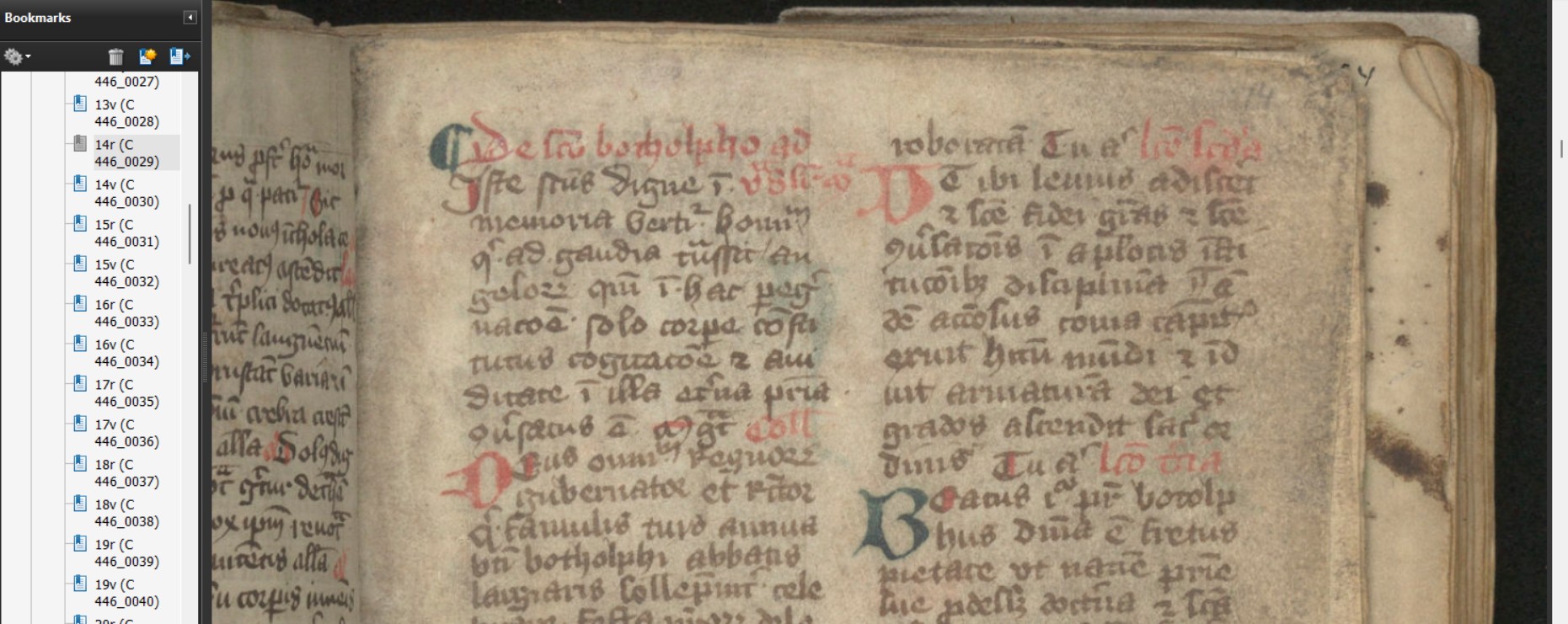
Just to round up the search, I found that the Linköping breviary was not at Usuarium.  But google revealed that there was a “Breviarium Lincopense” in 1493.  Indeed it led me to a website Alvin here, which had it online and in PDF, and with a link to the manuscript catalogue with detailed description (on p.125) of the contents.  The breviarium is folios 1v-23r.  The last line of the catalogue informs us that Botolph is on folio 14r.  And the folios are indicated in the download of the PDF!

This is a manuscript, tho.  I’m not looking forward to collating this text *at all*!

All the same, this is simply fabulous.  The raw material of scholarship is just a click or four away… *if* you can find the right search query!

  1. John Toy, “St Botulph: an English saint in Scandinavia”, in M.O.H.Carver (ed.), The Cross Goes North: Processes of Conversion in Northern Europe, AD 300-1300, York (2003), pp.565-570.[↩]

From my diary

I’ve reached the point at which I want to wrap up the many-tentacled texts about St Botolph, and fling the texts and their translations over the wall.  The weather has been lovely lately, but a few days of rain beckon, which would be perfect for the purpose.

It’s funny how stuff disappears, even if you are assiduous in preserving copies of everything.  Yesterday I had an email about a translation of part of Photius which I did more years ago than I can imagine.  So I went looking for PDFs of the photocopies from which I made it.  And… they are vanished.  I scanned the boxes of photocopies into PDF long ago, and they sit on my disk yet, in folders marked “downstairs filing cabinet, upper drawer” and the like.  The filing cabinet is long gone, I should add.  Yet the Photius was nowhere.  I can even remember the pages.  But they are gone.

I spent much of the last two days trying to download a PDF titled “Liturgy of the Hours” from a dubious site.  As such sites do, it throttled the download.  At one point it dropped to 200 *bytes* a second!  It was only a 65mb file, but the download kept failing repeatedly.  Such a waste of time!  I did get it in the end and – inevitably – it turned out to be the wrong book!  That delayed yesterday’s post.

Although I am no gardener, I also spent part of yesterday trying to reseed a portion of my front lawn which had turned to moss.  I’m not winning.  The ground was originally heathland, so basically sand.  Water it, and it forms a thin water-resistant layer, under which the ground remains totally dry.  I don’t know how gardeners remain sane!

Bible Gateway offline in Europe and UK: probably censorship from Ofcom

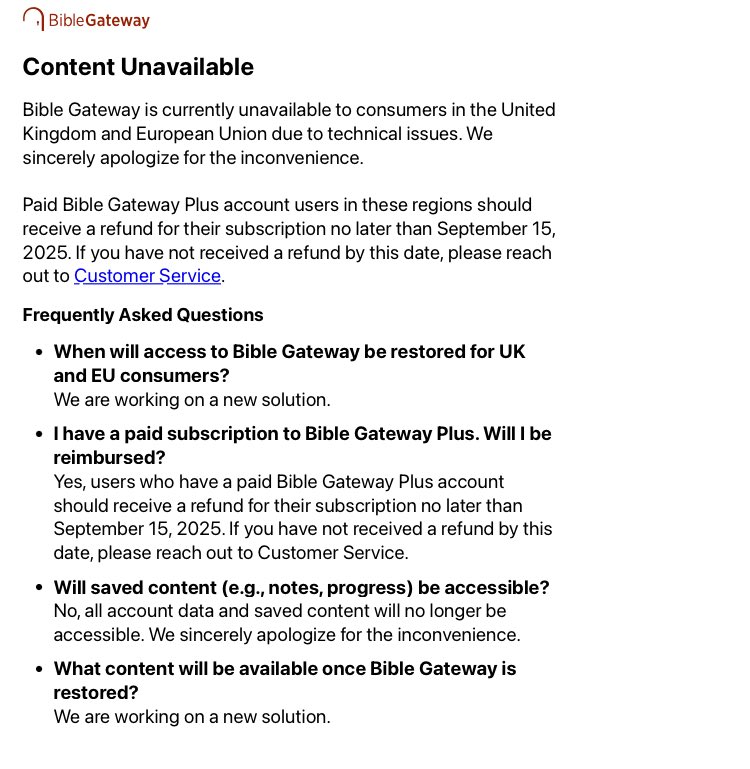
British users of BibleGateway.com got an unpleasant surprise last night:

This must be in response to a threat of official action.  And unfortunately, in Britain, such action is a real possibility.

Those in charge of the United Kingdom have passed a law requiring those accessing “adult” material to register their ID and prove their age.  The stated motive is to “protect the children.”

Now I’m all in favour of getting porn off the internet.  But I have never detected the slightest concern about this from those in power, any more than they care about spam.  Nor do I believe that these people care about the children, because the same people have connived at Muslim rape gangs in Rotherham.

So it’s a pretext, and we should ask instead what the likely effect will be.  The effect will be the real motive.

The practical effect of this measure is to end online anonymity, and – importantly – to start a process of state control of who can – and cannot – access the web.  Because if you have to register your ID to access this site or that site, if you have to get approval to use the web for some sites, basically it’s a trivial step, technically, to make this every site.

Who might be responsible?  A little while ago an agency called “Ofcom” wrote a threatening letter to 4Chan, who have applied for protection in the US courts.   So I’d be very suspicious that it was the same people.  Who else would do this?

But who are “Ofcom”?  This was originally a minor department responsible to regulating telecoms companies, but its officials now seem have wide ambitions.  It looks as if Ofcom has sent a threatening letter to Bible Gateway, trying to impose some kind of control on it.  Rather than agree, the US company has simply blocked UK access.  The European Union access seems to be an afterthought here.

But possibly the GDPR regulations come into this.  These were originally an EU measure supposed to ensure big companies did not abuse address and other details of ordinary people.  But I’ve never seen any sign of it being used for that purpose.  Rather it is a means of interference.

We can’t know for sure at this point.  But there seems to be a pattern here of petty bureaucrats trying to do a power grab over the internet.

It won’t work, of course.  There’s no reason why US companies should give some bunch of officials in a foreign country control over their operations.  They will just do what BibleGateway have done, and block the UK and EU, and shove them back into the darkness of the pre-internet era.

Grim stuff.  Why can’t people just leave people alone?

Via Jonathan Black on Twitter.

Updated to rephrase.

Update 26 September 2025: the site has reappeared without explanation.  Let’s hope whatever happened will not recur.

“A virgin, a tree and a death were the symbols of our defeat.” – a Chrysostom quote?

A correspondent wrote to me, asking if I knew the source of the following patristic quote.  It is found in many places on the web, in longer or shorter versions, and attributed to Chrysostom, but with no further details.  Here is the fullest version I could find:

Have you seen the wonderful victory? Have you seen the splendid deeds of the Cross? Shall I tell you something still more marvellous? Learn in what way the victory was gained, and you will be even more astonished. For by the very means by which the devil had conquered, by these Christ conquered him; and taking up the weapons with which he had fought, he defeated him.

Listen to how it was done. A virgin, a tree and a death were the symbols of our defeat. The virgin was Eve: she had not yet known man; the tree was the tree of the knowledge of good and evil; the death was Adam’s penalty. But behold again a Virgin and a tree and a death, those symbols of defeat, become the symbols of his victory. For in place of Eve there is Mary; in place of the tree of the knowledge of good and evil, the tree of the Cross; in place of the death of Adam, the death of Christ.

Do you see him defeated by the very things through which he had conquered? At the foot of the tree the devil overcame Adam; at the foot of the tree of the Cross Christ vanquished the devil. And that first tree sent men to Hades·, this second one calls back even those who had already gone down there. Again, the former tree concealed man already despoiled and stripped; the second tree shows a naked victor on high for all to see. And that earlier death condemned those who were born after it; the second death gives life again to those who were born before it. Who can tell the Lord’s mighty deeds? By death we were made immortal: these are the glorious deeds of the Cross.

Have you understood the victory? Have you grasped how it was wrought? Learn now, how this victory was gained without any sweat or toil of ours. No weapons of ours were stained with blood; our feet did not stand in the front line of battle; we suffered no wounds; witnessed no tumults; and yet we obtained the victory. The battle was the Lord’s, the crown is ours. Since then victory is ours, let us imitate the soldiers, and with joyful voices sing the songs of victory. Let us praise the Lord and say,

Death is swallowed up in victory.
O death, where is thy victory?
O death, where is thy sting?

The Cross did all these wonderful things for us: the Cross is a war memorial erected against the demons, a sword against sin, the sword with which Christ slew the serpent.  The Cross is the Father’s will, the glory of the Only-begotten, the Spirit’s exultation, the beauty of the angels, the guardian of the Church. Paul glories in the Cross; it is the rampart of the saints, it is the light of the whole world.

My correspondent was unable to find a reference.

After much searching, I found an Opus Dei facebook post, which does give a reference:

FROM THE OFFICE OF READINGS, COMMON OF THE BLESSED VIRGIN MARY

To most of us, the words: “office of readings, common of the blessed Virgin Mary” are unintelligible jargon.  Nor does a google search help much.  The persistent will find this site about the “liturgy of the hours”, which is actually what is referred to.  The page has a useful guide to the jargon:

The “Liturgy of the Hours” (a.k.a. “The Divine Office” or “Breviary”) is the daily prayer of the universal Church, with different “hours” prayed at various times of the day and night. It is based primarily on the Psalms, but also incorporates other biblical texts, canticles, hymns, prayers, and even some non-biblical readings. The three “major hours” are Morning Prayer, Evening Prayer, and the Office of Readings (prayed at any time during the day). Other hours include “Daytime Prayer” and “Night Prayer.”

Basic Terminology:

  • “Ordinary of the Liturgy of the Hours” – the overall structure of the various prayer times, from the Introductory Dialogue to the Final Prayer and Blessing, with various sequences of Hymns, Psalms, Canticles, Antiphons, Readings, Responses, and Prayers in between.
  • “Four-Week Psalter” – the arrangement of the biblical Psalms and Canticles that is used on most days and weeks of the Liturgical Year.
  • “Proper of Seasons” – texts used in the various “seasons” of the liturgical year: Advent, Christmas, Lent, Easter, and “Ordinary Time.”
  • “Proper of Saints” – special texts used only on the more important feast days of the Lord Jesus, the Blessed Virgin Mary, or other Saints.
  • “Commons” – additional texts that could be used, mostly on an optional basis, on the feasts and memorials of lesser-known saints

This is rather an alien world, but that’s definitely very helpful.  A bit further on I find that the printed source volume(s) – necessary for reference in print – are:

Liturgy of the Hours. 4 vols. Catholic Book Publishing, 1990. (8160 pages; the official full set for USA)

Even more fortunately another page on the same site listed the “commons” readings here.  A search through this gave me:

John Chrysostom – On the grave and the cross 2 – 3.1646 & 4.1660 – Memorial of the Blessed Virgin Mary on Saturday, alt.

Yes!  The third column is the volume/page number: vol. 3, page 1646, and vol. 4, page 1660.

So this is most likely the source of our translation, and its appearance in various forms on websites is easily explained from its liturgical use.

Unfortunately this mighty – and mighty expensive – volume cannot be downloaded in PDF form for free, as far as I can tell.  So I have not verified the above page numbers.

But there is often more than one way to attack these sorts of questions.  Before I found the Opus Dei reference, I tried a different search which gave interesting results.  Instead of just searching using the first line, I searched for the striking phrase, “A virgin, a tree and a death were the symbols of our defeat”. I saw that one of the results had “A virgin, the timber…” and I thought that this might perhaps be a more original version. That article is here, an article by Fr. Carlos Biestro, “The Enclosed Garden”, in: Mary at the Foot of the Cross – III: Mater Unitatis, (2002) pp.172-222; p.182.

Biestro’s footnote tells us that the source text is Chrysostom, De coemeterio et de cruce (On the grave and the cross), chapter 2, and the Greek text used is PG 49, col. 396 (the complete text is in columns 393-398, and it is also in the Savile edition vol. 5, pp.565-566).

This work  by Chrysostom has the reference number CPG 4337.  A search on the CPG number revealed quite a bit of scholarly activity, including a complete English translation:

David M. Friel, “Chrysostom’s Homily on the Word Koimeterion and on the Cross: A Translation and Commentary,” in: Vigiliae Christianae 76 (2021), pp.1-36. DOI: https://doi.org/10.1163/15700720-12341486.  Also Academia here.

This 2021 translation is not the origin of the online quotations: that comes from the Liturgy of the Hours in the 1990 version.  The Friel translation gives the same material, with facing text, on pp.12-14, in chapter 2.  The rendering is more stilted and more literal.

Yet another English translation exists online, by John Sanidopoulos, at the Mystagogy Resource Centre: “Homily on the Name ‘Cemetery’ and on the Cross of our Lord and God and Savior Jesus Christ” (29 April 2025).

I did not encounter any translations into other modern languages – Migne will have a modern Latin translation, of course -, but it is a fair assumption that they do exist.

So… the quotation is quite genuine.  But one could wish that more websites also indicated the source!