A little more on the lost “De baptismo” of Melito of Sardis in Coptic

Ten years ago Alin Suciu proposed that a homily preserved in Sahidic Coptic in a fragmentary manuscript in the Pushkin Museum in Moscow was in fact a genuine work by second-century patristic author Melito of Sardis.  Remarkably his article arguing this is now about to appear, in Adamantius.  The first page is on Academia.edu here.

Here’s the abstract:

This article reexamines a fragmentary Sahidic papyrus codex in Moscow that preserves a homily on baptism and the four cosmic elements. First edited by Alla Elanskaya, the text has remained largely neglected because of its damaged state and uncertain authorship. It is argued here that the homily is best understood as an authentic work of Melito of Sardis († ca. 180 CE). A close philological investigation shows how the homily combines Aristotelian and Stoic physics with Middle Platonic philosophy, presenting Christian baptism as both the realization of cosmic harmony and the path to human deification. Its theology and stylistic features closely parallel Melito’s Peri Pascha and On the Soul and the Body. By situating the Moscow papyrus within Melito’s literary corpus, the study expands the understanding of his theology and demonstrates how second-century Christianity adapted philosophical cosmology in its reflection on baptism.

The text itself was printed back in 1991, but apparently attracted little attention.

Let’s hope that this is indeed a work of Melito!

Were the pyramids built alongside a now lost branch of the Nile?

Back in 2017, I reported on the discovery of the log book of Inspector Merer in the Wadi al-Jarf in Egypt.  Merer was the captain of one of the boats that shipped stone to build the Great Pyramid of Khufu / Cheops at Giza.

In antiquity the Nile had seven branches which emptied into the sea in the Nile Delta. We can see from tomb paintings that in those days there were tropical animals such as crocodiles and hippopotamus in Egypt.  But only two branches of the Nile delta remain today, and the crocodile has long since receded to the Sudan.  The climate in the Near East grew dryer in late antiquity, causing the Sahara to invade the cornlands of north Africa, and affecting Syria also.

Today the Nile is four miles from the plateau on which the pyramids stand.  But in antiquity the level of the Nile was higher, and there were many branches running to what are today isolated ancient Egyptian monuments.

In 2022, a study by H. Sheisha &c in PNAS (online here) revealed the existence of a lost watercourse close to the Giza plateau, which they call the Khufu branch of the Nile.1  Abstract:

The pyramids of Giza originally overlooked a now defunct arm of the Nile. This fluvial channel, the Khufu branch, enabled navigation to the Pyramid Harbor complex but its precise environmental history is unclear. To fill this knowledge gap, we use pollen-derived vegetation patterns to reconstruct 8,000 y of fluvial variations on the Giza floodplain. After a high-stand level concomitant with the African Humid Period, our results show that Giza’s waterscapes responded to a gradual insolation-driven aridification of East Africa, with the lowest Nile levels recorded at the end of the Dynastic Period. The Khufu branch remained at a high-water level (∼40% of its Holocene maximum) during the reigns of Khufu, Khafre, and Menkaure, facilitating the transportation of construction materials to the Giza Pyramid Complex.

The article explains:

Core drillings and subterranean engineering works for Giza’s modern urban projects have yielded stratigraphic evidence consistent with a paleo-branch of the Nile. In particular, Old Kingdom structures unearthed during these interventions offer insights into the local cultural waterscape at the time of the pyramid builders. Furthermore, the Wadi el-Jarf Papyri, discovered at a Khufu-age port on the Red Sea coast (9, 12, 13), attest to the existence of such a harbor complex, called Ro-She Khufu (“Entrance to the Lake…” or “…Basin of Khufu”). The Journal of Merer, a large corpus of these papyri, describes the transport of limestone from Toura, ∼17 km from the Giza Plateau, to the construction site of the Great Pyramid of Khufu. A striking parallel exists between the names of the basins and waterways in the papyri and the spatial organization of Giza’s Fourth Dynasty waterscape, as reconstructed by archaeologists (5).

The fluvial-port-complex hypothesis postulates that pyramid builders cut through the western levee of the Khufu branch of the Nile and dredged basins down to river depth in order to harness the annual 7-m rise of the flood like a hydraulic lift, bringing the higher water levels to the base of the Giza plateau (5, 6).

Building upon this, a further article in 2024 by E. Ghoneim suggests that the lost branch of the Nile – which they call the Ahramat or “Pyramid” branch – was much more extensive than just the Giza area.  They propose that it ran close to thirty-one pyramids.   The Ghoneim article is published and open-access in Nature here.2

Abstract:

The largest pyramid field in Egypt is clustered along a narrow desert strip, yet no convincing explanation as to why these pyramids are concentrated in this specific locality has been given so far. Here we use radar satellite imagery, in conjunction with geophysical data and deep soil coring, to investigate the subsurface structure and sedimentology in the Nile Valley next to these pyramids. We identify segments of a major extinct Nile branch, which we name The Ahramat Branch, running at the foothills of the Western Desert Plateau, where the majority of the pyramids lie. Many of the pyramids, dating to the Old and Middle Kingdoms, have causeways that lead to the branch and terminate with Valley Temples which may have acted as river harbors along it in the past. We suggest that The Ahramat Branch played a role in the monuments’ construction and that it was simultaneously active and used as a transportation waterway for workmen and building materials to the pyramids’ sites.

They add:

The branch appears to have a surface channel depth between 2 and 8 m, a channel length of about 64 km and a channel width of 200–700 m, which is similar to the width of the contemporary neighboring Nile course. The size and longitudinal continuity of the Ahramat Branch and its proximity to all the pyramids in the study area implies a functional waterway of great significance.

Great significance indeed.

  1. H. Sheisha, D. Kaniewski, N. Marriner, M. Djamali, G. Younes, Z. Chen, G. El-Qady, A. Saleem, A. Véron, & C. Morhange, “Nile waterscapes facilitated the construction of the Giza pyramids during the 3rd millennium BCE,” Proc. Natl. Acad. Sci. U.S.A. 119 (37) e2202530119, https://doi.org/10.1073/pnas.2202530119, (2022).[↩]
  2. Ghoneim, E., Ralph, T.J., Onstine, S. et al. The Egyptian pyramid chain was built along the now abandoned Ahramat Nile Branch. Communications Earth & Environment 5, 233 (2024). https://doi.org/10.1038/s43247-024-01379-7[↩]

Eusebius of Emesa, Homily 1 – Latin text

As promised, yesterday I scanned the text of the ancient Latin translation of the first homily of Eusebius of Emesa (fl. ca. 330), “De arbitrio, voluntate Pauli and domini passione”, “On freewill, the will of Paul, and the passion of the Lord”.  This work has the reference number CPG 3525.  In fact I learn from the CPG that this is one of the few homilies by Eusebius of Emesa where the original Greek is preserved; printed in PG 86: 536-545.

Here’s the scan, in MS Word .docx format, of the edition by E. M. Buytaert, Eusebe d’ Emese. Discours conserves en latin, vol. I; series: Spicilegium sacrum Louaniense 26, Louvain (1953):

I’ve not been through this, so there are certainly OCR errors in it.  Indeed I just spotted one while reading over the first sentences: “Stephanus” had been read as “Stephaniis” (!) which certainly confused the machine translator.  You can only get clean scans if you manually type the thing yourself. Alternatively you get much better texts if you work with each word and sentence, as you do when translating.

The only manuscript source for the homily is MS Troyes 523 (12th century), otherwise known as the Codex Trecensis 523.  A microfilm of this can be accessed here.  I’ve posted this picture before, but here is the picture of the opening:

And here is the corresponding page from E. Buytaert’s edition:

I.e.

EUSEBIUS EMESENUS: DE ARBITRIO, VOLUNTATE PAULI ET DOMINI PASSIONE.

[I] Paulus lapidabatur ob Dominum Iesum. Qui properabat et laetabatur ut Stephanus lapidaretur et qui persequebatur et interficiebat Stephanum ut non praedicaret Christum ante, invenitur post agnitionem Christi haec pro Christo pati, quae adversum Christum ante gerebat. Antequam enim lumen videret, putabat palpans invenire se viam; viso autem lu­mine, agnovit et viam.

The heading given by Buytaert is taken from the coloured list of sermons – De Filio is the second – at the start.  What a pity that no coloured images of this are available.  But full credit to the French for getting the microfilms online.

It’s also interesting to see the punctuation; that Buytaert starts a new sentence with “Qui” where no capital appears in the manuscript, and does not where “Et” is marked in the manuscript.

Should we attend to medieval punctuation?  Is it even ancient?  Or the product of some monastic copyist?  I must confess that I do not know the answer.  It would be interesting to know if there is a handbook or paper on how to convert what we find in the manuscripts into a modern punctuation scheme.  I slightly suspect that each editor makes it up as he goes along.  But surely there should be rules?

But is the homily interesting?  Is it worth our time?  Well, I’ve uploaded this file into Deepseek, as a way to get a quick no-guarantees output in English.  On the face of it?  Not very.  But maybe it will reveal more as I work with it.  More soon.

From my diary

This evening I started work on the homilies of Eusebius of Emesa.  Homily 1, De Arbitrio, is 31 pages of Latin in Buytaert’s critical edition – the only edition. I pulled these into Finereader, and ran the Latin recognition on them.  Then started going through them, shrinking the default rectangles for text recognition to exclude line numbers and apparatus.  I did 15 pages before I had to break off.

On Monday I’ll do the rest, make whatever minor corrections are needed, and upload it here.  Then I’ll run it through some kind of machine translation and see what it’s about.  Then we shall see whether it’s interesting.

Yesterday I was waiting for a webpage to load.  Which was interminable.  This has happened a lot lately.  So I decided to find out just what it was doing.

First I ran a complete scan of the system using Kaspersky. After many hours this found nothing much. It did find an embedded KAK virus in 4 very old emails.  This was a scripting language virus, in VB script, run when you viewed the emails in HTML mode.  But at that time I never did.  The email client I used didn’t support it.  Anyway I just edited the section out of the old .mlog text files and that was that.

This afternoon I googled for some software that would show me what URLs the browser (Chrome; but I had the same problem in Edge) was accessing, while it was sitting there. I had a vague idea that it might be accessing some very slow advert site, and this was blocking the display.  I found something called Charles, which I installed. It did indeed show an awful lot of URLs being accessed; but when the page was hanging, it just sat there.

While it was doing so, I went to the developer tools in Chrome, and clicked on the “Network” panel. And… nothing was happening other than repeated calls to Kaspersky.

Now I have run Kaspersky Antivirus and Firewall for a decade or more. Anyway I deinstalled it – I hope it *has* gone, because you used to need a separate tool for that – and, bingo! everything worked.  I can only presume that the software had got corrupt on disk.  I enabled the Microsoft Defender antivirus that comes with Windows instead.  All good.

I’m dubious about using Russian software that has cloud links, to be honest.  Our countries are engaged in a rather nasty proxy war with Russia, after all.

I did read an amusing observation online this week, tho.  It was analysing a virus.  The code checked if the Russian language pack was installed, and did not execute if it was!  Food for thought.

My very old copy of Adobe Acrobat Pro is showing its age.  I’d buy a new copy, but greedy old Adobe won’t let you.  You can only rent access.  No thank you.

So I was looking at PDF-Xchange.  I evaluated it quite favourably, but I thought I would register when next I needed it.  But no more.

While looking for these problems earlier, I was startled to find an update was running for this software.  An updater that wasn’t in the Startup, and which I could not remove.  No thank you.  I uninstalled the whole package.  Except… that didn’t get rid of it!  I’d rebooted, and it was still there and loading on my taskbar.

I never did locate the exe.  It is clearly hidden somewhere.  But I removed everyone of the registry entries for it, and rebooted. It has not reappeared.  Now this is malware behaviour.  This doesn’t happen by accident.  Go nowhere near this package.  I have no dealings with companies that do stuff like this.

The sermons of three men named Eusebius: Eusebius of Emesa, Eusebius of Alexandria, and Eusebius Gallicanus

In the fifth-to-sixth centuries AD, in Gaul, we find quite a number of Latin sermons under the name of “Eusebius”.  This is not, of course, Eusebius of Caesarea, the historian.  So who are they?

The first Eusebius is Eusebius of Emesa, the fourth century bishop.  He has a great advantage on the other two, which is that he actually existed.  A bunch of his sermons, 29 in all – originally composed in Greek – migrated over to Gaul, where they appear in an ancient Latin translation.  These were edited in the 1950s by Buytaert in two volumes. (I discuss vol. 1 here) The first volume contains a collection of seventeen sermons (CPG 3525) preserved in a twelfth century manuscript from Troyes in France.  For three of these the original Greek is extant, luckily. The second volume contains a further twelve sermons (CPG 3526), originally edited by Sirmond, which Buytaert has numbered as 18-29.  Other homilies are preserved in Greek, in Syriac fragments, and there is also a collection of eight homilies in Armenian.

The second Eusebius is Eusebius of Alexandria, which is the name attached to a collection of 22 homilies (CPG 5510-5531) transmitted to us along with a “Life” of the author by a certain John the Notary (CPG 5533).  The text of the homilies can be found in PG 86: 313-461, and the “Life” in PG 86:297-309. Sadly the “Life” is complete fiction, from which we learn two important things.  Firstly, that John the Notary had no idea of the actual history of the 5th century AD, in which he locates his hero.  And secondly, from an analysis of the style and language, we learn that the sermons were composed by the same author as the “Life”.  Ps.Eusebius of Alexandria is John the Notary.

The homilies of ps.Eusebius of Alexandria were also transmitted to Gaul and translated into Latin.  This we know from a Latin sermon of that period which is basically a combination of two of the sermons of ps.Eusebius of Alexandria, and also from our third Eusebius, some of whose sermons  show knowledge of the ps.Eusebius of Alexandria collection.

The third Eusebius is known today as Eusebius Gallicanus, or “Eusebius the Gaul”.  The name is modern, devised by a 17th century editor, to refer to a collection of seventy-seven Latin homilies (CPL 966, cf. CPG 3543), some of which are prefixed with a statement that they were made by a “Lord Eusebius” and translated from Greek.  Other editions attribute the collection to “ps.-Eusebius Emesenus” – yes, to our first Eusebius, Eusebius of Emesa.  But they are not his.  The Eusebius Gallicanus collection was not composed by anybody, but rather compiled.  It was assembled in the 6th century out of pre-existing materials, probably at Riez, and making use of materials collected at the monastery of Lerins.  Some of the sermons are by Faustus of Riez, and other known figures.

The modern publication history of Eusebius Gallicanus is complex.  It is one of the more significant gaps in Migne’s Patrologia Latina.  The collection was only edited in modern times, by F. Glorie in the Corpus Christianorum Series Latina, volumes 101, 101A, and 101B.

From my diary

Up and into the car and I was on the road before 07:30.  I arrived at the research library that I use before 09:00, and had to wait for a few moments in a little queue of cars to be let into the car park.  A fresh new readers’ pass, lasting only one week, awaited me in reception. In fact I had goofed.  The regulations only allow you a free one-week pass once a year, and I had forgotten this.   Next time I will purchase a one-month pass!

The IT there is terrible – the library seems to have been cheated badly by its supplier – but it did not seem to have changed since last time. So I was able to work with a minimum of pain, to my surprise and delight.  I had the Microsoft Authenticator app on my phone, I knew the right userid and password.  Indeed I was even able to log into the terminal (“kiosk”!) which is reserved purely for adding money to your card, in order to use the photocopiers.  Even better, I found that I had left quite a bit of money on the account last time, so I refrained from adding more.  I knew from past experience that money on university library accounts which are used only infrequently can vanish!

I went in search of the book that I needed.  To my surprise, the two main staircases have been renamed “alpha” and “beta”, although I know not why.  Despite the name change, the lift that I needed to use was not working.  But it was only a single flight of stairs to my floor, and I found the volume that I wanted easily enough. The smell of the cleaning fluid, and dust, brought back memories of thirty years ago, when I was just starting out on the voyage that produced this blog.  Here at least time has not corroded.

I found a photocopier which was working, with no queue, and I was able to photocopy the whole book – only 80 pages – in peace, checking each page afterwards in case I had inadvertently cropped the text.  Longer ago there was a dedicated a photocopier room, with at least five photocopiers.  But since then, someone has decided that it would be better to abolish this, and to distribute the copiers in obscure places around the corridors.  Arriving early has its advantages here too.  I would imagine that the copiers are mainly used by visitors, as students can just borrow the books and scan them in their rooms.

I had not had breakfast, so I made a visit to the library tea-room. This was a little odd, although much the same as before.  There were only snacks, unfortunately, but I made do.  For some reason large new portraits of unknown women (and a few African men) had been mounted Soviet-style on the walls.  There was also a great number of posters, each instructing customers how to throw away their paper plates, used cans, and a great list of other possibilities, in specified containers.  The text was detailed and prescriptive, and too small for eyes like mine to read.  The whole effect was somewhat East German.

Then out, into a slight rain.  The time was only about 10:30, but the car park was already full to brimming, as I had known that it might be.  A car cruising around hopelessly, searching for a space, was glad to take my space.   The lack of parking is hard on visitors who are not local.

Rather than return the way that I came, out of curiosity, I cut through the town to return.  It is probably ten years or more since I did so.  At one time I worked there, and even went to church there sometimes, so some of the roads are familiar.  The areas I passed through looked as if they had been ravaged by local government maladministration.  The roads had been left unrepaired for a decade or more.  At one major junction the whole road surface had buckled up, and I saw cars picking their way cautiously through it.  On the road sides the weeds now grew so freely everywhere that at one point I wondered if I was on the right road.

I came to one major junction, once very familiar, where memory recorded a garage – always slightly incongruously situated – but instead I found a characterless block of flats.  Indeed I saw a whole district of blocks of new flats, little windows in flat exteriors.  The effect was again very Soviet.  Surely if such things are needed, they could be built in local stone and in keeping with the heritage of the town?

Change is inevitable, but I think that the whole place could do with a bit more change in a positive direction.

Fortunately I was home by lunchtime, and a MacDonald’s with medium fries banished any gloom.  The photocopies have passed through the scanner, and a PDF resulting has just gone through Abbyy Finereader.  In this area at least there is improvement!

Photographs and Videos of the submerged ruined Roman fort at Walton Castle

A few years ago I wrote a number of posts about the ruins of the Roman fort at Felixstowe in Suffolk.  The fort is known as Walton Castle.  It stood on the cliff-top until the 1740s when it slid into the sea.  The remains are visible at low water, about 50 metres offshore. A diving expedition in the 1960s led by Jeff Errington surveyed them.  I did attempt to locate a copy of the diving expedition report, supposed to be held by Ipswich Museum Service, deposited with the Suffolk Record Office, and therefore in the archives at their new building, “the Hold”; but my efforts proved fruitless, despite contacting Jeff Errington himself, who was still running a diving business in 2020.  The whereabouts of the “Errington Report” remain unknown, to me at least.

A few weeks ago I received an interesting email from a lady named Jackie Hole.  She and her husband run an ice-cream kiosk at “The Dip”, directly opposite the place where the ruins are visible.  The Dip is the local name for the place where a stream runs down to the sea.  The fort stood on the southern side of the Dip, and a Roman cemetery was on the north side.

Over the past few weeks, we’ve been filming the remains at low tide from Old Felixstowe (we’re based at The Dip), and have managed to capture some reasonably clear drone footage during very low tide windows.

What’s interesting is that when the light and tide line up, parts of the structure become just visible enough to suggest outlines, although still quite difficult to interpret from the shore….

It feels like one of those moments where the site is briefly more legible than usual.

and…

… here are the easy access links to public posts – we’ve started proper documentation for the museum with tide heights, times, drone height and the same (ish) path every time we go out so we’re trying to do our bit with regards to modern record keeping!

https://www.facebook.com/reel/1282413653753367 – the original video – this started the whole thing as it just seemed super low
https://www.facebook.com/reel/1294183855949571 – not such a low tide but really interesting sand patterns on a calm water day
https://www.facebook.com/reel/1641026057347315 – something arty

There also is a video of kayaking out to the ruins, on YouTube here.

These are extremely interesting.  It’s worth remembering that these “rocks” are about eighth feet tall, as is evident from some of the photographs from the 60s.

Here is a still:

Walton Castle ruins, 18 April 2026

And an aerial photo:

Aerial view of Walton Castle Ruins March 20 2026

The small patch of ruins to the right is invisible at ground level.  This was an unusually low tide, on March 20, 2026, between 06:00-07:30: Felixstowe Pier low = 08:27 at 0.56m.

It’s wonderful to see an interest being taken in this neglected monument!

Procopius of Gaza, Letters – machine translation now online with notes.

A little while ago I mentioned that I had abandoned my project to make a translation of the letters of the sixth century sophist, Procopius of Gaza.  I found that I had started a project too large for me, which required more time, effort and knowledge of Greek than I possess.

When I started to work on Procopius, the first thing I did was to make a working tool to orient myself, to find my way around the text before I started into the Greek, but using an existing translation.  The one chosen was the 2010 Italian translation by Federica Ciccolella, which I ran through Google Translate, and came to think was rather impressive.  I don’t suppose the result of the machine translation is very accurate.  But skimming through it does give a very nice idea of the size and shape of the letters, and allows you to find your way around the Italian.

I also did the same to the notes, using DeepSeek AI (I can’t recall why I used  that).  I stuck a selection of these into the same file, as endnotes to each letter, so I could understand what I was dealing with.  The notes in the Italian are magnificent, vast, detailed and some of them amount to short essays on the subjects in question.  These must have taken years to compile.  But I just grabbed enough to make sense of the meaning.

The project is dead, but I thought that the file with the working materials might be useful to anyone else who feels an interest in the letters of Procopius of Gaza.  Obviously if you know Italian well, you’d use the original, but I find that many people don’t.  And the letters of Procopius, which are superficially mundane, are in fact wonderful if you want to get a feel for the early sixth century in the Eastern Roman Empire.

Anyway I thought that I would share the working file with you.  Here it is:

The files are also on Archive.org here.

The contents have no scholarly value, obviously, so don’t quote it – for that go to the source volume!1  But if you’re curious… well, it might help you!

  1. Eugenio Amato, Rose di Gaza: gli scritti retorico-sofistici e le Epistole di Procopio di Gaza. Series: Hellenica 35. Alexandria: Edizioni dell’Orso (2010). ISBN 9788862742337.  The letters are on pp.290-437; notes on 438-503.[↩]

The library at Mashhad / Mašhad / Meshed in Iran

In 2011 I reported on the discovery of Arabic translations of important works by Galen, at the library at Meshed (or Mashhad) in north-eastern Iran.  My last post back then mentioned (although I was unclear what the discovery was) the discovery in the same library of what turns out to be the lost books IV to VII of the Arithmetica of Diophantus of Alexandria, in the Arabic Translation Attributed to Qustā ibn Lūqā. 

The Diophantus indeed has been published with translation by Jacques Sessiano, and is available on Amazon here.  The blurb is rather interesting:

This edition of Books IV to VII of Diophantus’ Arithmetica, which are extant only in a recently discovered Arabic translation, is the outgrowth of a doctoral dissertation submitted to the Brown University Department of the History of Mathematics in May 1975.

Early in 1973, my thesis adviser, Gerald Toomer, learned of the existence of this manuscript in A. Gulchin-i Macani’s just-published catalogue of the mathematical manuscripts in the Mashhad Shrine Library, and secured a photographic copy of it. In Sep­tember 1973, he proposed that the study of it be the subject of my dissertation. Since limitations of time compelled us to decide on priorities, the first objective was to establish a critical text and to translate it. For this reason, the Arabic text and the English translation appear here virtually as they did in my thesis.

It seems that this library contains copies in Arabic of Greek scientific and mathematical works which are not known to us.

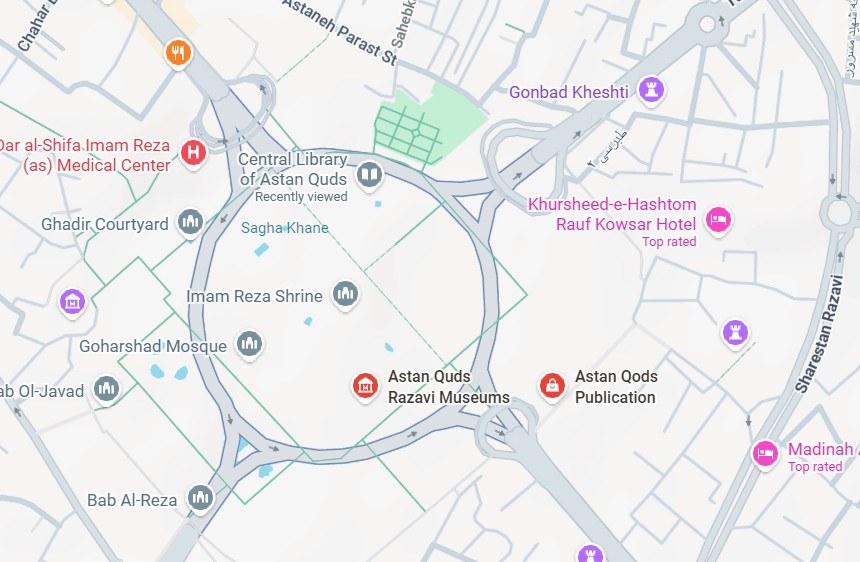
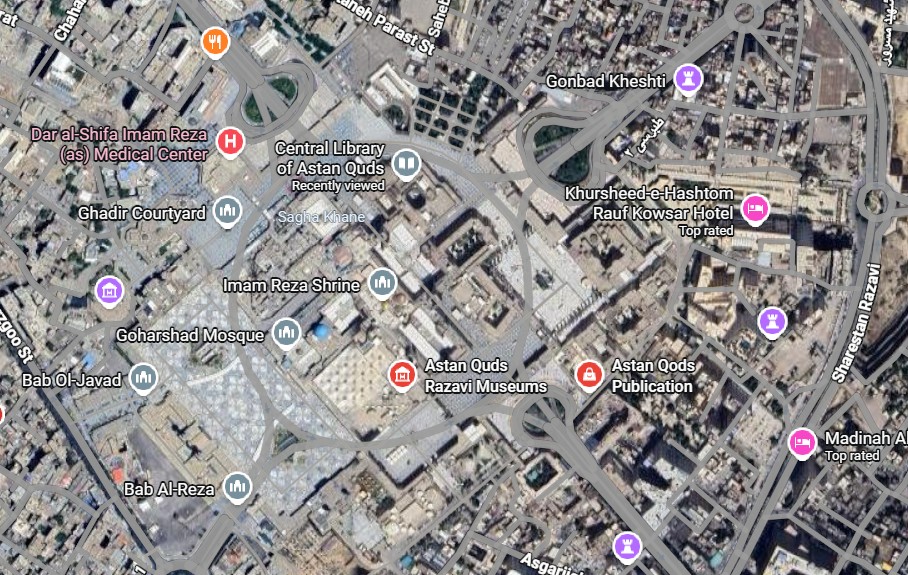
I found myself wondering where this library was, and what could be known about it.  To my surprise, it is not exactly an obscure library.  Mashhad (which seems to be the favoured spelling online) is a significant city in Iran.  The name itself is a word which means “tomb of the martyr”, so there are many “mashhads” in Iran.  This one refers to the Imam Reza, the eighth Shia Imam, who is buried in the city, which is therefore a major Shia pilgrimage site.  The shrine and the associated buildings form a complex in the city centre, which can be viewed easily on Google Maps.


There is an Encyclopedia Iranica article on “Āstān-e qods-e rażawi” here, which clarifies that Astan Quds Razavi is the name of the complex of buildings around the shrine.

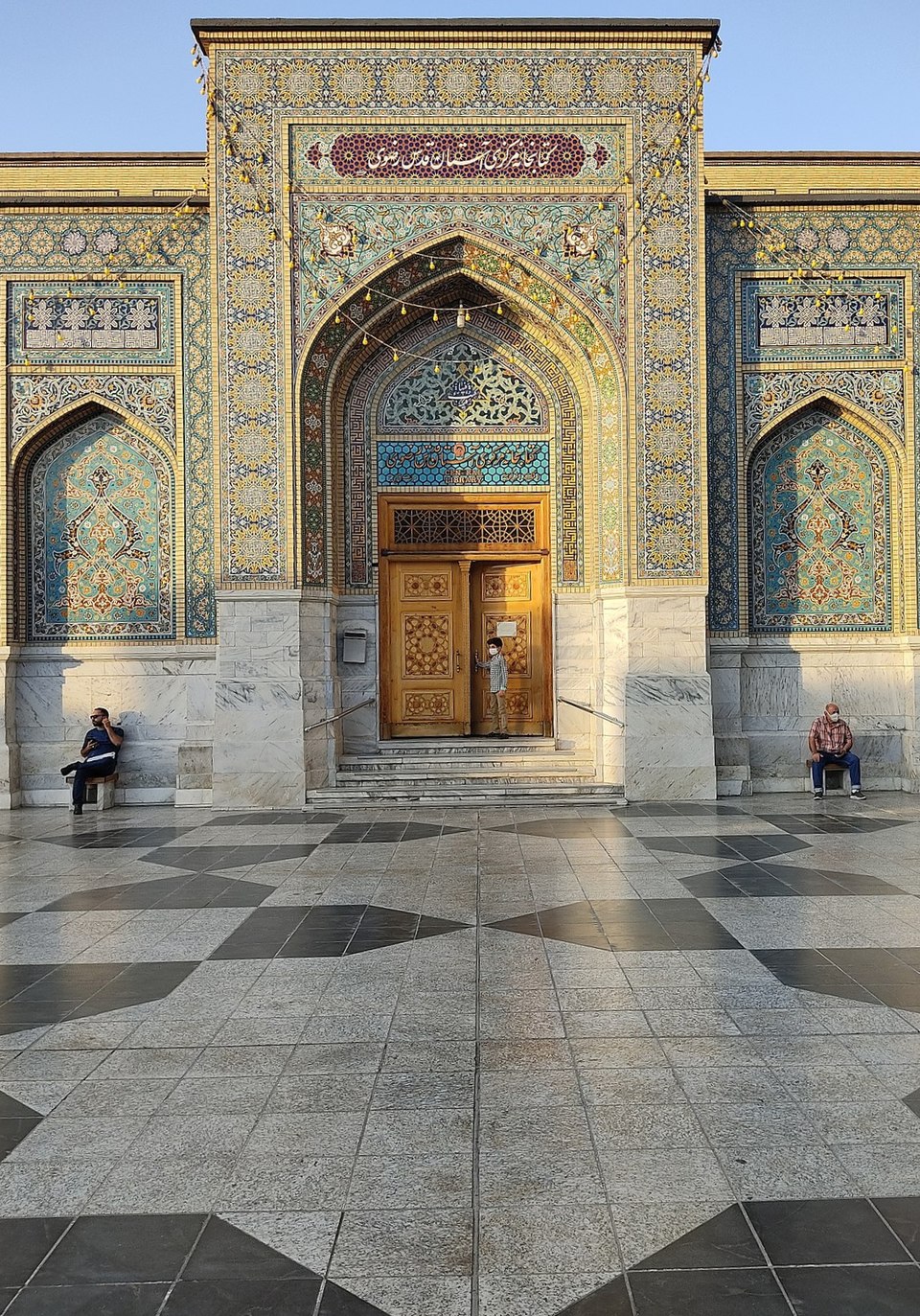
The library of interest to us is the “Central Library of Astan Quds Razavi”, which has a Wikipedia page here.  The library itself has a website, an online catalogue and email address: http://www.aqlibrary.org and info@aqlibrary.org (these details from here), although these appear to be currently offline, no doubt because of the ongoing foolishness out there right now.

I confess that looking at the map fills me with a desire to do a coach tour of Iran.

In fact the building itself is modern, although it was built in a traditional style.  Internally the building is modern.

As the Amazon blurb indicates, the librarian compiled a catalogue of the manuscripts.  His name turns out to be Gulchin Maani, or rather “Golčin Maʿāni, Aḥmad” (d. 2000), and there is an Iranica Online article about him (with photograph, in jacket and tie).

In 1342 Š./1963 he moved to Mašhad, where he served as bibliographer of the manuscript collection of Āstān-e qods-e rażawi (q.v.). He prepared the following catalogues of Persian and Arabic manuscripts of the library:

  • volume VII, on history and literature (published in 2 parts, Mašhad, 1346 Š./1967);
  • volume VIII, on mathematics (Mašhad, 1350 Š./1971);
  • and a list of its Qurʾān manuscripts (Rāhnemā-ye ganjina-ye Qorʾān-e Ketāb-ḵāna-ye Āstān-e qods-e rażawi, Mašhad, 1347 Š./1968).

In addition, he catalogued some of the majmuʿas (miscellanea manuscripts) of the Majles Library (Našriya-ye nosḵahā-ye ḵaṭṭi 5, 1345 Š./1966, pp. 153-203) and the manuscript collection of ʿAbd-al-Ḥosayn Bayāt (Našriya-ye nosḵahā-ye ḵaṭṭi 6, pp. 63-117).

In total, he catalogued 2,360 manuscripts in these works.

Volume VIII of his catalogue, then, was the one which listed the Diophantus.   What else might be in there?  The variety in transcription spellings makes it very difficult to search for bibliography.  Copies of that catalogue must exist in the West, surely?

I imagine all this is old hat, well-known, to real professionals in Arabic and Persian philology, such as Theo Beers.  Indeed I don’t even know who the workers in the field are.  But it’s interesting stuff.  What else might be found in that library, or in that library catalogue?


From my diary

Reading the letters of the 6th century sophist, Procopius of Gaza, I am struck by the number of places in which the translator, Federica Ciccolella, notes “this is a proverbial expression” and gives sources.  Indeed the notes in that translation are really rather fabulous, and in-depth!

For the last month I have been laid low with a rather vicious winter cold, which has affected an awful lot of people here and keeps coming back.  So I’ve not written much.  Today was pretty much the first day of summer, the first day on which air-conditioning was essential in the car.  Inevitably this was the day for some emergency dentistry!  I’ve also been stood outdoors with a hose, trying to water in some grass seed.  It is now raining heavily.  These are the little things of life!

A fair number of interesting topics to blog about have come in.  A kind correspondent drew my attention to a post made in 2009 about a Vatican palimpsest containing 400 lines of Menander, otherwise lost.  The discovery was made in 2003.  Here we are, 23 years later, and the edition has yet to appear.  To my eye the two prospective editors are perhaps much too senior/busy to get it done, and need to recruit others.  Who knows.  There is an Italian article on the discovery, tho, and I might try and get hold of it.  If I feel bold, I might even write and ask about the progress,

Another topic that I wrote about long ago is the submerged remains of a Roman fort at Felixstowe in East Anglia.  It seems that a local couple are engaged in photographing and filming the ruins, and measuring them.  I will post about this when I can.

I also discovered some details about the library in Mashhad in Iran, which seems to contain quite a lot of Greek scientific works in Arabic translation.  Again, I will post about this.

But what I am doing at the moment is some work on Procopius of Gaza.  I have returned to work on this.  The last time I wrote, I found that I had bitten off more than I could chew.  What I am now doing is going through the Google Translate output for the Italian translation, and adding into it extracts from the footnotes.  The combination is far more readable.  I’ve just reached the end of letter 100 (out of 174), so this plan of attack is working.  The result won’t have any scholarly value at all, but should help anglophone people to access the text.

I’ve also discovered that 25 letters of Aeneas of Gaza exist, with Italian translation.  This is another sophist of the early 6th century.  It would be good to do these also.

So there is plenty to do!