
Mithras is a perennial favourite for online nonsense. It seems that “AI” is parroting a strange article, attributed to Reinhold Merkelbach, and appearing on the fake “Britannica” website. 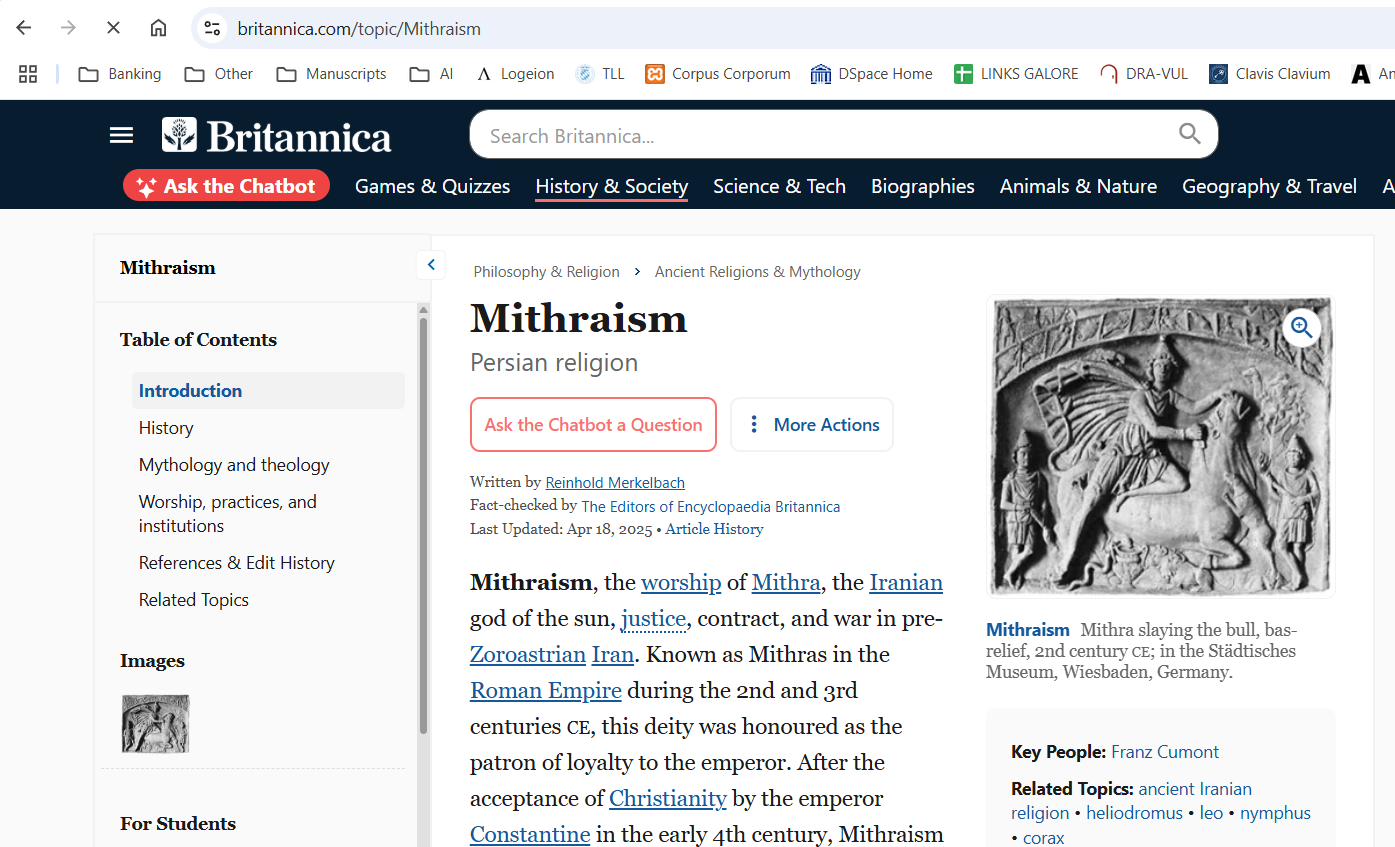
Britannica went out of business sometime in the 1990s, destroyed by the rise of the personal computer. Nobody knows who owns it now, or who actually writes the articles. I have often found them full of crude errors.
Reinhold Merkelbach was indeed a substantial scholar, but he has been dead since 2006. So he most certainly did not edit that 2025 article.
In fairness, it might be that the article draws upon some older article in which that scholar of an early generation expressed ideas that were already obsolete. But this I cannot tell.
The statements made in that article seem to reflect the pre-1971 idea that Roman Mithras – not recorded before AD 80 – “must” be the same as the ancient Persian cult of Mithra or Mitra.
But the 1971 conference on Mithraic studies demolished this idea very thoroughly. The archaeology of Mithras is very distinctive, especially the underground temples. But not one of them is known from outside the Roman empire. And all the earliest archaeology comes from Rome. If you look at Vermaseren’s two mighty volumes, the Corpus Inscriptionum Monumentumque Religionis Mithriacae, you see a man who still places the eastern material first. But that eastern material betrays the problem: it is a shabby, thin collection. The section on Rome dwarfs it.
It was therefore impossible to avoid the conclusion that the Roman cult was a fake. It was like the Greek “Zoroaster” literature – something which appears to be oriental, but is in fact home-grown, and merely dressed up in foreign garb. This sort of barbarian appeal is something known in our own times, from the popularity of the fakir in Edwardian drawing-rooms, and the guru in the hippy movement of the 1960s.
The “AI” practice of producing a digest of random nonsense, treated as authoritative by the young, is a real curse. For the unwary look no further. All sorts of ideas that many of us laboured to combat are now reappearing.
I have found that my own website of Mithras material is now slipping down the algorithm. Today I have moved it to a subdomain, so it can be now found at https://mithras.tertullian.org. Old links will redirect. Why? Because dear old Google won’t recognise any site as a “site” unless it is on its own domain or subdomain.
I have also today discovered that Twitter has allowed it’s “twitter card” product to decay. Tweets including material from my site just bring up boxes with no images. I’ve tried to fix that today, but it may take a little while.
Of course large corporations have the resources to fix these things. It is the ordinary chap who is left behind. Yay for the internet of corporations.
I’ve been away for a few days, but I return to a full inbox – that curse of the holiday-maker! My apologies if I have not got to your email yet.
I left a comment on this article previously, but it never appeared… I’m not sure if perhaps there was an error? I’ll try again with a new one. This post seems to have some errors in it.
“Britannica went out of business sometime in the 1990s, destroyed by the rise of the personal computer. Nobody knows who owns it now, or who actually writes the articles. I have often found them full of crude errors.”
I am not sure where this claim comes from. Britannica did not go out of business, though they did leave the print field. The Encyclopedia Britannica site is still owned by the same company as did the physical encyclopedia. And we do know who write the articles, as various ones have them credited. To be fair, some ambiguously just credit “Britannica Editors” but a full list is at https://www.britannica.com/editor/The-Editors-of-Encyclopaedia-Britannica/4419#the-editors.
“The statements made in that article seem to reflect the pre-1971 idea that Roman Mithras – not recorded before AD 80 – “must” be the same as the ancient Persian cult of Mithra or Mitra.”
I don’t see how that is the case for the article you cite (https://www.britannica.com/topic/Mithraism). It in fact explicitly says “The most plausible hypothesis seems to be that Roman Mithraism was practically a new creation, wrought by a religious genius who may have lived as late as c. 100 CE and who gave the old traditional Persian ceremonies a new Platonic interpretation that enabled Mithraism to become acceptable to the Roman world.” Maybe it could have emphasized this point more, but it does clearly note major differences between the Roman and Persian Mithras.
In regards to whether Reinhold Merkelbach wrote the article on the website, it appears he did. The article on the website is nearly identical to the article on Mithraism in what I believe was the last printed edition (see https://archive.org/details/newencyclopaedia12chic/page/288/mode/2up). That article has “R.Me.” at the end, presumably short for Reinhold Merkelbach. Since the article on the site is just a slightly edited version of that article, it means that Merkelbach wrote it.