A list of the very many patristic passages translated in the “Liturgy of the Hours”

There are a great many devotional sites on the web.  A lot of these are Roman Catholic, or Greek Orthodox, and many of them post English versions of passages from the Fathers, or the Acts of the Martyrs, or Lives of the Saints.  Sometimes the passages given are from really rather obscure patristic sources.  The translations are always very fluent and readable.

Unfortunately these pages seldom indicate the source.  Possibly this comes from fear of copyright issues, or simple ignorance.  But I have spent time, before now, attempting to identify a bibliographic source for such passages, and I do not think that I am alone.

Some months ago I came to realise that many must originate from the Liturgy of the Hours.  This is the title of the official American translation of the Latin Liturgia Horarum, the four-volume Roman Catholic service-book.  Few non-Catholics will have heard of this book.  Probably more will have heard of the “Breviary”.  The Liturgy of the Hours is the 20th century replacement for the Breviary.

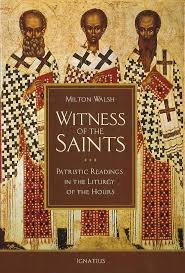
The Liturgy of the Hours is a mighty book, and sold – when you can find it – for a mighty price.  Fortunately Ignatius Press in San Francisco brought out a volume containing only the translations of patristic material: Milton Walsh, Witness of the Saints: Patristic Readings in the Liturgy of the Hours, San Francisco: Ignatius Press (2012) (Amazon).  This is considerably more affordable – $35 -, and contains useful indexes.

In particular it begins with a section listing all the authors quoted, and the passages quoted.  For each author a brief but very useful summary is given of the author, and what the passages quoted contain.  All this material is copyright, of course, and frankly worth every penny.  Nobody who reads it will fail to learn something.

But our interest is going to be for bibliographic purposes.  And what most of us need is something far briefer: a simple list of authors and passages, and where they might be found in the liturgy.  So I have extracted this rather dry information out of Dr Walsh’s volume into a single short Word file.  It’s here:

I hope that it will help with identifying random passages quoted anonymously on the web!  And the ready availability of Witness of the Saints may help us find them.  Definitely an essential volume.
Looking for Ethiopian Studies bibliography, with particular reference to hagiographical literature

I have an AI output with an English translation of the Ge`ez – Classical Ethiopian – text of the 15th century “Life” of Abba Garima by Yohannan.  It ‘feels’ more or less right.  But I don’t know any Ethiopian, and I cannot even read the language, so it’s impossible to say.

Today I scanned the Italian introduction, summary, and notes by Carlo Conti Rossini, the editor of the “Life”.  I’ve run that through Google Translate, and so I have enough to write some words about the text. The summary of the “Life” (a “gadl” in Ethiopic) seems to agree with the AI output, which is encouraging.

But of course Rossini was writing in the 1890s, which is a very long time ago.  It came to me that there must have been work on this text since then.  But where might I find this?  A google search gives little.  Knowing nothing about Ethiopian studies, I have spent some time today looking for bibliography.  This is what I found, rightly or wrongly.

  • Jon Abbink, “Ethiopian Society and History: A Bibliography of Ethiopian Studies, 1957-1990”, Leiden: African Studies Centre (1990).  Online here.
  • Jon Abbink, “Eritreo-Ethiopian studies in society and history:1960-1995”.  Leiden: African Studies Centre (2022).  Online here.

Thank heavens for the Leiden African Studies Centre!  Abbink writes:

The period before 1957 is relatively well covered in general bibliographies like the ones by R. Jones (see below item 39), H.W. Lockot (German language publications; item 48), and now, Paulos Milkias, item.58.

I.e.

39.  Jones, R.
1958    Ethiopia. In: Africa Bibliography Series, North East Africa, General/Ethnography/Sociology/Linguistics, pp. 19-39.
London: International African Institute.

48.  Lockot, H. W.
1982    Bibliographia Aethiopica. Die äthiopienkundliche Literatur des deutschsprachigen Raums.
Wiesbaden: Steiner, 441 p.

58. Paulos Milkias
1989    Ethiopia: a Comprehensive Bibliography.
Boston: O.K. Hall, 710 p

These I have not consulted.  Of course our interest is hagiographical literature.

Section 23 of Abbink is “Christian and Hagiographical Literature”, on p.281.  From this I learned of the existence of this:

  • G.W.B. Huntingford, “Saints of Mediaeval Ethiopia”, in: Abba Salama 10 (1979) p.257-341.  “Abba Salama” turns out to be “Abba Salama: A Review of the Association of Ethio-Hellenic Studies”.  It seems to be inaccessible, however.  But there are many references to it in relevant sources, such as:
  • Steven Kaplan, “Hagiographies and the History of Medieval Ethiopia”, in: History in Africa 8 (1981), pp. 107-123.  (JSTOR)  Summary, references here.  This looks useful.
  • G. Lusini, “A companion to Medieval Ethiopia and Eritrea”, in: S. Kelly, A Companion to Medieval Ethiopia and Eritrea, Brill (2020), pp.194-216.  This seems tremendously useful, and a PDF copy has strayed online here.

From the last I learned of the existence of a French translation of the “Life” of Abba Garima!

  • Gérard Colin, Saints Fondateurs du Christianisme Éthiopien: Frumentius, Garimā, Takla-Hāymānot, Ēwostātēwos, Paris: Les Belles Lettres (2017), pp.6-37.  This is modestly priced – 22 euros – unusually.

This, of course, I must consult if possible.  A library near me has a copy, so I have spent some time jumping through hoops in order to regain access to the premises.  The book is off-site, apparently, so I may have to wait a couple of days to set eyes on it.

Update April 16, 2025.

Another extremely useful item is the Encyclopedia Aethiopica.  This is edited in 5 volumes by Siegbert Uhlig, and is up-to-date.  The scope of the work means that it is fairly basic, but that is still far more than we get from anywhere else.

In Hamburg there is a project to create a Clavis – a numbered list – of Ethiopian literature.  This is being led by Alessandro Bausi, and the TraCES project page is here.  The beta version of the Clavis is actually offline at the moment however.  A collection of digital versions of Ethiopic texts is also being created.

Also in Hamburg Dr Aaron Butts has got funding for some serious work on the Nine Saints.  The “BeInf – Beyond Influence” project page is here.