
In yesterday’s post there was a letter (ep. 17) from Aeneas of Gaza to the sophist, Dionysius of Antioch. Dionysius is the author of 85 letters, which the Italian editor, Positano, describes (p.103) as “che sono le più vuote della letteratura greca (v. Schmid, «R. E.» V 975 n. 127).” – “the emptiest in Greek literature”.
This striking phrase made me look up the reference in the Realencyclopädie, and the article is indeed in volume 5, page 975, entry 127. In English:
127) Dionysios of Antioch, a Christian (see ep. 41, 42, 49, 70, 71), a sophist (he mentions his students Kalliopios in ep. 23, Severus ep. 24, Modestus ep. 8, 16, 50), living in Daphne (Aeneas Gaz. ep. 17) near Antioch. The teacher whose death he laments in ep. 66 is probably Procopius of Gaza (+ c. 580), with whose style the letters of D. show the closest affinity. He alludes to his activity as an official panegyrist in ep. 11, 28; he speaks of illness in ep. 41, 42 (podagra and insomnia). 49. The letter of recommendation Aeneas Gaz. ep. 17 is addressed to him. 85 letters by him survive, corresponding to his own conception of the purpose of the letter (ep. 31), almost entirely devoid of content, the first 46 except for 5–7 with named addressees, the rest without such; some of them (1 = Liban. 1108; 33 = Liban. 1188. Synes. 30, see Hercher Epistologr. p. XLa) also appear in the letter collections of Libanios and Synesios respectively. The first 46 were published in the collections of Aldus (Venice 1499), H. Stephanus (Paris 1577), F. Cujacius (Orleans 1606), R. Hercher (Epistologr. Graeci p. 260ff.), the latter of whom added nos. 47–85 after a copy taken by A. Westermann from Parisin. 2010 and his own collation.1
The German author’s “fast völlig inhaltleere Briefe” = “almost entirely contentless letters”, so Positano is not quite reflecting what the RE says.
I’d never looked at Ruldolf Hercher’s massive 843 page Epistolographi Graeci (1843), which may be found in a poor-quality scan at Google here, and a very much better quality colour scan at the BSB here. Here’s the first page (p.260) of the Dionysius page. Helpfully a Latin translation is supplied with each.
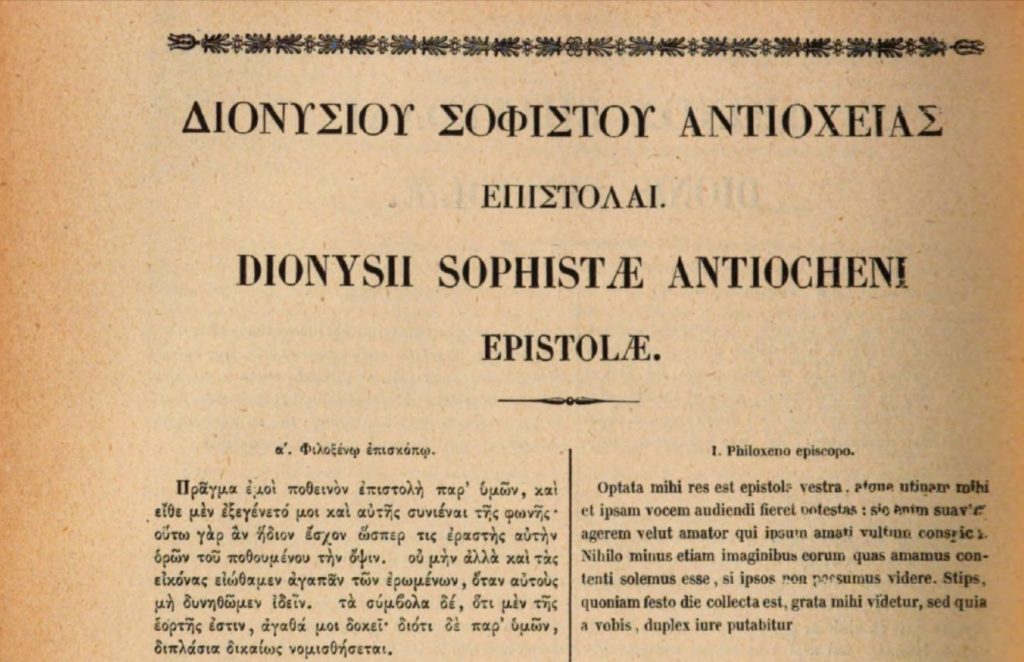
At a site previously unknown to me, AncientLibrary.net, I found an electronic text of the Greek of the letters of Dionysius of Antioch here, taken from the Eulogikon GitHub site. This supplies the following text:
Φιλοξένῳ ἐπισκόπῳ. Πρᾶγμα ἐμοὶ ποθεινὸν ἐπιστολὴ παρʼ ὑμῶν, καὶ εἴθε μὲν ἐξεγένετό μοι καὶ αὐτῆς συνιέναι τῆς φωνῆς· οὕτω γὰρ ἂν ἥδιον ἔσχον ὥσπερ τις ἐραστὴς αὐτὴν ὁρῶν τοῦ ποθουμένου τὴν ὄψιν. οὐ μὴν ἀλλὰ καὶ τὰς εἰκόνας εἰώθαμεν ἀγαπᾶν τῶν ἐρωμένων, ὅταν αὐτοὺς μὴ δυνηθῶμεν ἰδεῖν. τὰ σύμβολα δέ, ὅτι μὲν τῆς ἑορτῆς ἐστιν, ἀγαθά μοι δοκεῖ· διότι δὲ παρʼ ὑμῶν, διπλάσια δικαίως νομισθήσεται.
which DeepSeek AI gives as:
To Bishop Philoxenus. A letter from you is a thing I long for, and I wish it had been possible for me even to understand your very voice; for so I would have been more pleased, like a lover seeing the face of the beloved. However, we are accustomed to cherish even the likenesses of those we love, when we cannot see them. As for the tokens, that they are of the festival, seems good to me; but because they are from you, they will justly be reckoned twice as much.
Empty indeed.
One of the uses of the AncientLibrary site is that you can open the page in Chrome and then request instant translation in your browser. This I did, and I found that all the letters were similarly empty of any real content. It was all about style: all mouth and no trousers, as the saying has it.
Hercher does include a critial apparatus, not at the bottom of the page but in the introduction, on p.xxxix (which is page 44 of the Google PDF). This tells us that the first 24 letters are from MS. Vaticanus gr. 82, which he added to from Vatican. 1354 and “Mazarineum” (?) 611 A. Three letters, 21, 40 and 46, came from the Aldine editio princeps, and letters 47-85 he took from MS. Paris gr. 2010. From these critical remarks I learn that the “letter 1” which we have just given is also found among the letters of Libanius (no. 1108). I suspect that it may not belong to Libanius.
I suspect that few today will have read the preface of Hercher to his Epistolographi Graeci, not since Latin ceased to be the language of scholarship. Here is Deepseek’s rendering of it. Already the practice of treating manuscripts with reagents to make them more legible is causing concern, it seems.
PREFACE
We have gathered into one place the scattered and wandering flocks of the Greek letter-writers, so that the modes and varieties of their voice, if anyone’s ears are open to receive it, might be more conveniently known and assessed than before. More than sixty writers come forth, sixteen hundred letters.
The author and initiator of this book was Anton Westermann, professor at Leipzig, whom a fatal necessity recently removed from the sight of his friends. When he had shaped nearly half of what is contained in this volume in such a way that he seemed to have sufficiently satisfied his own intention, being weak from a severe and long-lasting illness, he laid down the burden he had undertaken and sent his papers to Paris, so that they might be handed over to a future editor of the Letter-writers. At Dübner’s urging, they were delivered into my hands.
I have reworked the entire Greek text of Westermann at my own risk, so that I alone now guarantee both whatever is found to have been done well and whatever has been committed against the laws of the art.
It is helpful, so that it may be understood how much progress has been made toward the restoration of certain writers, to set down a few examples by way of specimen.
The ninth letter of Anacharsis, mutilated and cut off at the end, I have filled out with a just supplement by the aid of manuscripts.
The patchwork of Aristaenetus, such as it has been left in the most recent edition, I have repaired and reconstructed—with the patches and stitches of learned men admitted more confidently than was once done—with the rags of the ancient writers, which he had interpolated with his own. Some things were also supplied by the Vienna manuscript.
In the letters of Hippocrates I have introduced nearly an infinite number of readings, which, lying in oblivion, it was possible to draw out from the innermost bosom and lap of the Littré margin. Hence I have not only emended certain letters but transformed them.
I have revised Isocrates against the most noble Urbinate codex, which I myself collated anew.
Some letters of the Emperor Julian I have corrected against Italian codices, by far the most against the Vossian codex, whose collation Dübner had most generously communicated to me (for he himself had once formed the plan of editing Julian). Afterwards the power was granted me to compare this with the Vossian itself. From this I understood that Dübner had passed over one rather serious variant, but had administered the rest excellently and splendidly, in accordance with his constant exercise of codices, which he underwent almost daily. There is also something for which I especially congratulate myself regarding that gift. For Dübner, in order to bring back to light the letter-strokes which had vanished from age in the Vossian, had smeared the most precious pages with a certain staining juice, effective for a time, but in the future disastrous. And so for him indeed, as he said, the outcome proceeded according to his wish; but gradually it came about that the paper, soaked with those liquids, turned black; and now the matter has been brought to such a point that not a few things which he had recovered by his art either wholly or in part can be discerned in no way at all. Therefore the adjudication of these passages has been placed in Dübner’s discoveries alone.
The 104 letters of Procopius, which Angelo Mai—or, to speak the truth, his filthy (“impurus”) assistant Matranga—had copied from the Vatican codex in such a way that in six hundred places the speech was mutilated and gaping, I have made clean by the virtue of the same Vatican read more diligently and skillfully, and of two Laurentian codices, and I have restored to them the hateful and counterfeit elegance of Procopius. I have used the same codices to purify and supplement the Procopian letters published by Aldus, and from the same source I have brought some unpublished things to light.
I have ensured that the letters of Synesius are received as little polluted as possible, chiefly by the integrity of the Laurentian codex. But I must speak here of the Boissonade papers, which Gustavus Boissonadius, son of Franciscus, a man most learned in the discipline of civil law, who has not once embraced the study of antiquity with his benefits, converted to my use by a most welcome derivation. Franciscus, then, wrote at the beginning of the century a commentary on the letters of Synesius, in which he set forth the readings of four Parisian codices with the notes of Petavius and his own, for the most part imperfect and to be supplied by him afterwards. Of these, those pertaining to the fourth letter he published in 1842, most copiously augmented; the others (for he seems to have early abandoned all thought of editing Synesius) he so consumed that he dispersed and scattered them through the multiform commentaries with which, as time went on, he communicated Greek writers. The rest, although they too are less finished, nevertheless even so serve no small purpose for interpreting the speech of Synesius. From them, therefore, I have set down below what seemed most conveniently observed.
But enough about the proper praise of this volume. Αὐτὸ δείξει, ὁ τὸν πονηρὸν καθηγούμενος ἔσται.2 Now I must say a word about some of its faults.
For since this is the eighth year since the Greek Letter-writers began to be written out in type (of which delay I place all the blame and cause on myself alone), it has happened that once I passed myself by, and once another passed me by. Namely, the letters of Aelian, which in the sixty-fifth year they had completed by my order for the Parisian work, I published somewhat more emended at Leipzig in the following year; and likewise the little book On the Epistolary Form, which I had placed at the beginning of this volume chiefly from Westermann’s recension, in the sixty-ninth year Hugo Hinck brought forward with the authority of the Vatican books in such a way that there can be no doubt that they have preserved a more ancient and truer form of the little book.
Then, with so many and such various writers thrown into one bundle, it could not happen that I cultivated, cherished, and loved them all equally, that there was always the same face in me, the same countenance, that I put the same and one care into emending all. For who is there who, unless he was born for this very thing, would apply himself to the Phalaridean letters—to use this term—throughout the whole year, or would linger over the futile and fictitious sentiments of Dionysius of Antioch?
Then Fortune acted maliciously in this, that for the speech of certain writers needing help, the protection of manuscripts, which could be opposed to the first edition, was left either none or sufficiently weak and infirm. Hence, on a badly laid foundation, I have tested conjectures of differing savor, and I have entrusted not a few faults to the sharpness of others. For in making the criticism of the Letter-writers it was not permitted to rest for infinite time and to be moved by perpetual and long-lasting hope, that I, wandering through the same tracks, would always extort new and better things by chance or by my own genius, but the work had to be circumcised at last at some point.
I pass to another matter. The Latin interpretation, with which the Greek Library is accustomed to prelude to the Greek speech, Westermann partly refined diligently and skillfully from the earlier editions, so that the Latin might respond more accurately to the Greek, and partly was the first to compose, such as the letters of Diogenes. I myself have translated into Latin the letters of Dionysius and Procopius, first published by me and by Maius, and likewise the rest which I first made public.
I have compiled two indices, one of the beginnings of letters, the other of names and things.
Concerning the sigla which I have used to abbreviate the names of codices, it will be said in the annotation in their places. Bare words, whenever they are brought in after the lemmata, show the readings of the codices. I have marked the Aldine with the letter a. The letter B signifies Boissonade, W Westermann. I have everywhere indicated emenders and conjecturers with upright uncials, manuscripts with italics. I have made an asterisk in the notes wherever I have of my own accord broken, or certainly wished to break, the authority of the codices; in the text, pairs of asterisks wherever a hiatus lay open.
I did not wish to confine the personated writers in brackets, lest I make things difficult for those who, even after the disputes of Bentley and others, seem to themselves to look upon not the frigid deceits of sophists but the certain offspring of kings themselves, of tyrants, poets, philosophers. Let this therefore be said also for the sake of those who are still accustomed to cling to the letters of Plato and Isocrates as genuine.
I have wrongly included in this volume the letters of Alexander, which Arrian inserted into his book on the deeds of Alexander. Likewise, while engaged in another matter, I have received from Josephus the letters of King Antiochus and Ptolemy Philadelphus together with the letter of Eleazar. These therefore must be skipped over. On the contrary, the letter of Appian ought to have been received, and perhaps the letters of Fronto.
But I shall make an end of prefacing. It remains that I give and have the greatest gratitude my mind can conceive to the most serious helpers of my work, Baehrens of Heidelberg, Bruun of Copenhagen, Halm of Munich, Pluygers of Leiden, who from their treasures have furnished me the most solid foundations for the text of Themistocles and Julian.
Written on the Kalends of December, in the year 1871.
150 years ago, and a magnificent collection. It is only a pity that the volume does not have a table of contents.
- Deutsch: 127) Dionysios von Antiocheia, christlicher (ep. 41. 42. 49. 70. 71) Sophist (Schüler von ihm Kalliopios ep. 23, Severus ep. 24, Modestus ep. 8. 16. 50) in Daphne (Aeneas Gaz. ep. 17) bei Antiocheia. Mit dem Lehrer, dessen Tod er ep. 66 beklagt, dürfte Prokopios von Gaza (+ c. 580) gemeint sein, mit dessen Stil die Briefe des D. die nächste Verwandtschaft zeigen. Seine Thätigkeit als eines officiellen Festredners deutet er ep. 11. 28 an; von Krankheit redet er ep. 41. 42 (Podagra und Schlaflosigkeit). 49. An ihn gerichtet ist der Empfehlungsbrief Aeneas Gaz. ep. 17. Erhalten sind von ihm 85, seiner eigenen Auffassung vom Zweck des Briefes entsprechend (ep. 31) fast völlig inhaltleere Briefe, die ersten 46 äusser 5—7 mit benannten Adressaten, die übrigen ohne solche; einige von ihnen (1 = Liban. 1108. 33 = Liban. 1188. Synes. 30, s. Hercher Epistologr. p. XLa) stehen auch in den Briefsammlungen des Libanios bezw. Synesios. Die ersten 46 herausgegeben in den Sammlungen von Aldus (Ven. 1499), H. Stephanus (Paris 1577), F. Cujacius (Orleans 1606), R. Hercher (Epistologr. Graeei p. 260ff.), welcher letztere nach einer von A. Westermann genommenen Abschrift aus Parisin. 2010 und eigener Collation noch nr. 47—85 hinzugefügt hat. [↩]
- RP: A Greek proverb meaning time will reveal its value or otherwise.[↩]