An old hoax: the Turkish Aramaic “gospel of Barnabas” forgery from 2012 resurfaces

An old hoax has re-emerged online this week.  Here’s one example, but an image search reveals that it’s hanging around Muslim forums online.

A groundbreaking discovery in Türkiye has unearthed a supposedly 1500 year-old Gospel that has sparked intense debate and challenged deeply ingrained beliefs in religious history… It is written in Syriac, an ancient dialect of Aramaic, using gold lettering on loosely tied leather.

This ancient text, known as the Gospel of Barnabas, offers a radically new perspective on a key issue in Christian theology: the crucifixion of Jesus Christ. In a shocking revelation,….
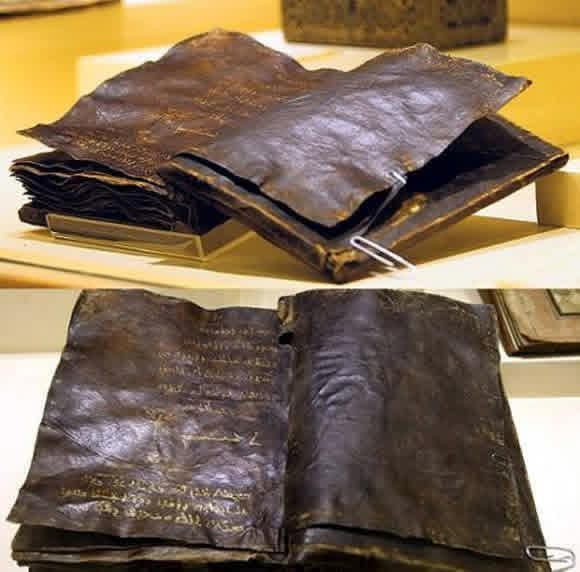
This story emerged in 2012, and was comprehensively dealt with at that time.  It’s not “1500 years old” – the writing in the colophon above actually says it was written in 1500 *AD* – 500 years old.  It’s a copy of Matthew’s Gospel in the Syriac Peshitta version.  But it’s not even that old; it’s a modern fake, using neo-Syriac book hand, and written by someone with limited knowledge of Syriac.  There is a gang of Turkish forgers out there who keep producing “ancient” manuscripts, often in purple and gold.

Google search is so bad these days that the results mainly link to the nonsense, not to the careful refutations published back in 2012.  The place to look is Jim Davila’s Paleojudaica blog, and in particular this article ‘More on that Turkish Aramaic “Bible”‘ which links to all the various resources.  This seems to be the first in the chain. From this I learn that a couple of scholars at the AINA website analysed it:

This “Bible” is written on leather in gold letters. The picture of the front cover show inscriptions in Aramaic and a picture of a cross.

[photo]

For any native speaker of Modern Assyrian (also known as neo-Aramaic), and that would be your average Assyrian today, the inscription is easily read. The bottom inscription, which is the most clearly visible from the published photos, says the following:

Transliteration: b-shimmit maran paish kteewa aha ktawa al idateh d-rabbaneh d-dera illaya b-ninweh b’sheeta d-alpa w-khamshamma d-maran

Translation: In the name of our Lord, this book is written on the hands of the monks of the high monastery in Nineveh, in the 1,500th year of our Lord.

Nineveh is the ancient Assyrian capital and is located in present-day north Iraq, near Mosul.

There are spelling errors that are immediately noticeable.

The first word, b’shimmit maran (“in the name of our Lord”), is erroneously spelled with a ‘t’ instead of a ‘d’. The ‘d’ in Assyrian is the genitive, and it prefixes the word that follows. It should read b-shimma d-maran, not b-shimmit maran (note, the last word of the sentence is correctly spelled d-maran (“of our Lord”)).

The first word also contains another spelling error. The correct spelling for “name” in Assyrian is ashma, with the initial ‘a’ being silent. Therefore, when correctly spelled, ‘in the name of our Lord” should be written as b-ashma d-maran.

The word idateh is misspelled, it should end with an ‘a’, idata. Also the phrase al idateh (“on the hands”) is incorrect, it should read b-idata (“by the hands”).

The bottom sentence uses the word ktawa (“book”) to refer to the book, but in Assyrian the Bible is never referred to as a “book.” One says awreta (Old Testament), khdatta (New Testament), or ktawa qaddeesha (holy book). Given this, since no one has seen the inside of this “Bible,” we cannot be sure if it is in fact a Bible.

Most significantly, this writing is in Modern Assyrian, which was standardized in the 1840s. The first bible in Modern Assyrian was produced in 1848. If this book were written in 1500 A.D. it should have been written in Classical Assyrian.

It is highly unlikely for monks to make such elementary mistakes. It remains to be seen whether this book is a forgery, or even what kind of book it is.

The bottom inscription also says the book was written in 1500 A.D..

Peter Williams at ETC also looked at this:

The photo starts by homing in on the word ‘Amen’ halfway down the left hand page. As it scrolls over the wording above it is clear that it is Matthew, we get the sequence:

[dn]trwn klm’ dpqdt[kwn]…
‘n’ ‘mkwn ‘n’ kl[hwn]
[yw]mt’ ‘dm’ lšwlm[h]

that they should keep all that I have commanded [you]
I am with you all
[da]ys until the end [of]

It’s just plain Peshitta.

Now are my eyes deceiving me or does the last line of the colophon they show say something about ‘in the year 1,500 of our Lord’?

bšnt’ ‘lp’ whmšm’ dmrn

If so, the media dating is only out by a millennium, but I’m not sure of my reading at this stage.

The pointed Nestorian script is the giveaway that we’re not dealing with something 1,500 years old.

It is puzzling that if the end of Matthew is on the left hand page, the right hand page should be blank. Also with only two verses appearing on this page of Matthew (28:19-20) there is certainly no way this manuscript has enough pages to contain the four gospels and no way that the whole of Matthew could occur to the right. Moreover, it’s odd that all the writing is grouped on the right hand side of the page. These are features which would make me think of it as a modern forgery. Why go to the effort of using gold and yet have the appearance on the page so irregular and the margins so uneven?

After this everything went very quiet.

And what does AI have to say?  I uploaded the image earlier to Google Image Search and I got this:
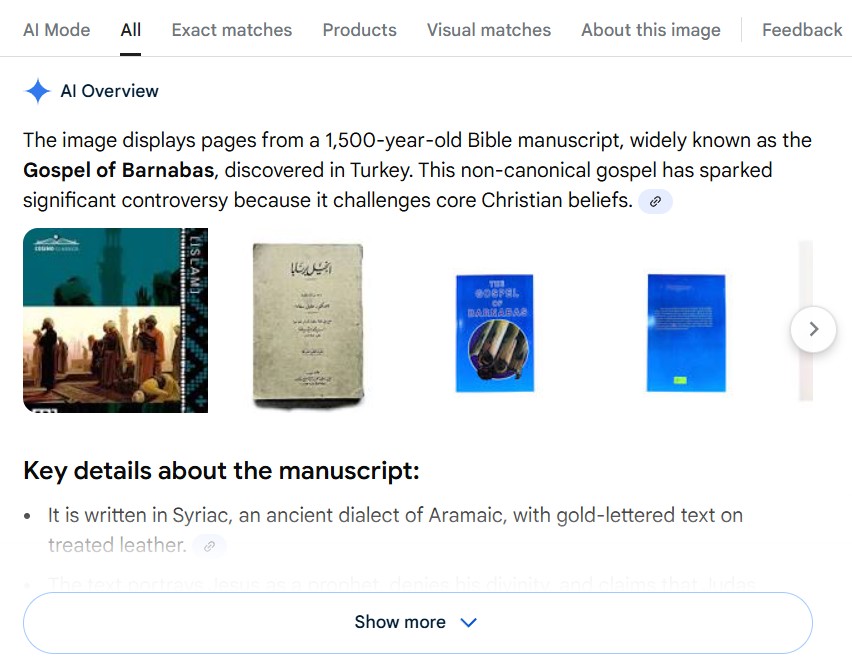
I have sent feedback that it is a hoax, but I have no idea if there is anyone listening.  Oh well.  I hope this modern blog post will catch at least some of the Google traffic.

Chasing some fake news about the Gospel of Barnabas

Weird websites can be a lot of fun!  Often they get hold of some obscure fact, which might pass us by.  It can be interesting to track it down.  I was reading Twitter earlier today and came across a series of tweets by an Islamic propagandist, one of which mentioned the Acta Sanctorum.  The page is headed How the Gospel of Barnabas survived.

The modern “gospel of Barnabas” is extant in Italian and Spanish, and was written in the renaissance by a renegade who converted to Islam.  It references events after 1300, so cannot be ancient.  The page is dedicated to proving that it is.

Here’s the claim that caught my eye:

In the fourth year of Emperor Zeno (478 C.E. ), the remains of Barnabas were discovered and there was found on his breast a copy of the Gospel of Barnabas written by his own hand. (Acia Sanctorum Boland Junii Tom II, Pages 422 and 450. Antwerp 1698).

All spelling as found.

Now I don’t believe for a moment that this is the actual source used by the author of that web page.  It’s clearly something copied from some undisclosed source.  But as it happens I have been collecting URLs for the original edition of the Acta Sanctorum.  So let’s go and look at these references!

It took little time to locate a copy of June volume 2, in the original Antwerp 1698 edition.  It’s on Google Books here.  For some strange reason they display it online in colour, but download is only in black and white.

The reference to p.422 can be briefly disposed of.  The text starts on p.421, and, as a note in the margin of p.422 makes plain, this is the text of the introduction by the Bollandists; “auctore D.P.”, in fact!  It is not an ancient or medieval text, although it quotes some ancient references.  In the right hand column, a few lines from the bottom, we read that the body of the apostle was found “& Evangelium supra pectus positum”.  Then at the end, we get a quote from Theodore Lector, writing around 520, and taken from a collection of assortments published in the Bibliotheca Patrum:

Reliquiae Barnabae Apostoli inventae sunt in Cypro, sub arbore cerasea, habentes sub pectore evangelium Matthaei, manu ipsius Barnabae scriptum.  Evangelium autem illud Zenon sub alia corona condidit.

The relics of the apostle Barnabas were found in Cyprus, buried under a tree, having on his chest a gospel of Matthew written by Barnabas’ own hand.  But that Zeno established that gospel under another crown.

I.e. this is the disposition of the relics in the monastery.

P.450 is here.  It’s in the Laudatio S. Barnabae Apost. (BHG 226, CPG 7400), written by “Alexander the monk of Cyprus”, from an unspecified Vatican manuscript, and translated by Francisco Zeno (p.436).  Chapter 4 is headed (p.449) “The finding of the body of St Barnabas”.  In this, section 40, in the left hand column, the Latin translation, part B, we read this:

It’s plainly Barnabas speaking, presumably in a dream, instructing someone where to find his body:

… & Evangelium manu proprie scriptum, quod a sancto Apostolo & Evangelista Matthaeo (a) excepi.

… and a gospel written in my own hand, which I took down from the apostle and evangelist Matthew (a).

It is, in fact, a copy of Matthew, not Barnabas, that is in question.  But there is a footnote here, which is also worth looking at, on p.452.  This is rather remarkable:

a. Nativus verborum sensus videtur esse, quod Barnabas evangelium, primitus Hebraice editum, propria manu exceperit ex ore ipsius met sancti Matthai, illud Graece dictantis, & et secum tulerit; sicut etiam fecisse dicitur S. Bartholomaeus: plures forsitan alii, uno eodemque tenore & tempore, citra ullam differentiam; quae inveniri deberet, si quisque suo marte propriam sibi versionem fecisset, cuius differentia nullam uspiam extat indicium.  Atque hinc factum sit, ut alii Iacobum, alii Ioannem, alii etiam Lucam vel Paulum interpretem fecerint; pro ut scilicet quoque Ecclesia evangelium legebat, ex huius vel illius Apostoli autographe.

a.  The natural sense seems to be, that Barnabas a gospel, originally written in Hebrew, with his own hand took down from the very mouth of St Matthew, speaking it in Greek, and bore it with him; just as is also said of St Bartholomew; perhaps many others, of  one and the same outlook and time, on this side of any difference….

The note is signed DP, which is a name of great authority – the Bollandist Daniel Papebroch.  The inference depends on the word that he rendered “excepi” – “took down”.  Unfortunately I don’t find the Greek text in the original at all readable – and that is the key here.

Fortunately others have read it, and printed the text.  The 19th century Paris reprint of the AASS is a bit easier to read.  July vol. 2 is here, although pagination etc is not the same.  Our section 40 is on p.445.

This seems to me to read “ἐξελαβον“, “I received from”, aorist.  It could indeed mean that Matthew dictated to Barnabas; but it need not.  Indeed the sense of dictation does not seem to be natural here.

But of course Papebroch was an expert, and I am not.  All the same, I can’t help feeling that he misunderstood his text here.  I don’t see any suggestion of a “gospel of Barnabas”; just of a written copy of Matthew in the hand of Barnabas, just as with Theodore Lector.

Alexander the monk seems to be a shadowy figure, who belongs to the 6th century.  The Wikipedia article mentions several scholarly articles, some giving a date as late as the 9th century, although I have not read these.

Fortunately a pre-print article by Chrysovalantis Kyriacou, “The Encomium on St Barnabas by Alexander the Monk: ecclesiastical and imperial politics in sixth-century Byzantium”, taken from an upcoming volume is online here.  This very useful article tells us much about the text (which has been edited critically since the Acta Sanctorum!), its manuscripts, and even discusses this question of “a gospel”, in note 49.  But he, like myself, sees only a copy of St Matthew here.

UPDATE: I find that the story that I am looking into is to be found in the Ragg translation of the Gospel of Barnabas, which has a long, copious and well-researched introduction.  On p.xlv of the introduction is the reference above, but the body of the text makes plain that the gospel found with the body of Barnabas was a gospel of Matthew.  So somebody has quietly ignored that.