New publication: Ibn al-Ṭayyib’s Commentary on Genesis – in English

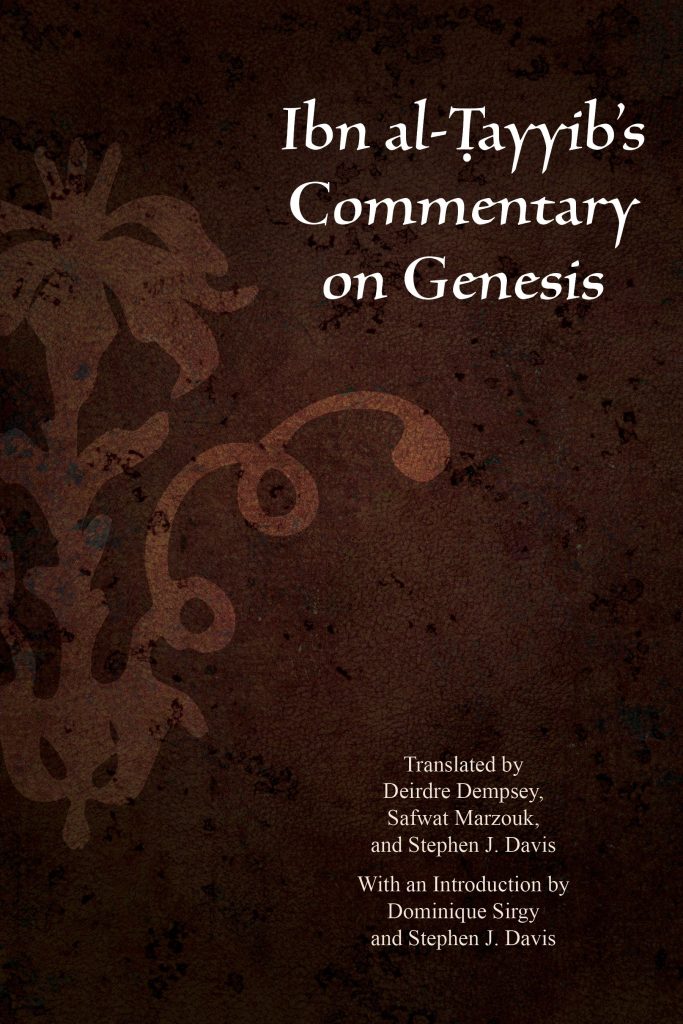
A kind correspondent draws my attention to an interesting new publication, of an English translation of Ibn al-Tayyib’s “Commentary on Genesis”.  The bible commentaries of this Christian Arabic writer (d. 1043) are very little known, and it is wonderful to have this new volume, of 160 pages.  The translators are Deirdre Dempsey, Safwat Marzouk and Stephen J. Davis, and the price is a very reasonable $35.  The Fordham Press website for it is here, and it’s on Amazon.com here.

From the blurb:

The first English-language translation of a major biblical commentary written in Arabic by a seminal figure in the history of Christianity in the Middle East.

Abū-l-Faraj ibn al-Ṭayyib (d. 1043) spent his adult life in Baghdad, where he served as a priest in the Church of the East around the turn of the first millenium. He was a polymath—a physician, philosopher, and theologian—and part of an illustrious line of teachers dedicated to the transmission of scientific knowledge from Greek into Syriac and then later into Arabic. He authored commentaries on Aristotle, Galen, and Hippocrates, as well as original treatises on the Trinity, science and miracles, Christian law, and the resurrection. His major works of biblical interpretation included a complete commentary on the Bible, entitled The Paradise of Christianity. The first part of it, his Commentary on Genesis, is translated here into English for the first time and accompanied by a critical introduction to Ibn al-Ṭayyib’s life and writings; the form, method, and content of his biblical interpretation; and his theology of creation and the divine Word.

I seem to have started writing about Ibn al-Tayyib in 2009, so it is delightful to see something appearing!  Stephen J. Davis seems to be the man pushing things along.  I hope the volume is a success!
New project on Ibn al-Ṭayyib’s commentary on the Psalms

Some fantastic news from Oxford!  It seems that Steven Firmin is working with a team of cool dudes to create a critical edition with English translation of Ibn al-Tayyib’s “Commentary on the Psalms”!  In fact, if he can get some major funding, the team will work on a series of Christian Arabic texts!

Few will have heard of Ibn al-Tayyib.  He was an Arabic-speaking Christian writer belonging to the Church of the East –  basically in Persia.  He lived in Baghdad in the 11th century, and worked for the Abbasid caliph.  He wrote a tremendous amount of interesting material.  There’s a summary of his life and works at Beth Mardutho here.

There are some curious parallels between Ireland and the native inhabitants of the Near East.  When the latter were conquered by the Muslims in the 7th century, the Christian peoples of those lands preserved their identity, language and culture through their church.  Over time they were forced to largely adopt the language of their conquerors, just as the Irish were, but they retained a fierce loyalty to their own culture.  This therefore manifests in ecclesiastical literature, or in apocryphal compositions “predicting” the events of their own time in a disguised form.  Consequently Christian Arabic literature preserves a millennium of lived experience among largely voiceless and unknown communities, in Syria, Palestine, Egypt, Iraq, Iran and elsewhere.  Today these communities are also found in exile in the USA and other western nations today.  The lack of awareness of this material is therefore a huge void.  Access to it must begin with texts like this; and people in the west may learn from the commentaries on the bible, seen through eastern eyes living in a very different culture.

Dr Firmin also tells me that the results of their work will be open-access or public domain, and this is really important for public access.

An edition of some sort of this Commentary on the Psalms does exist, according to the Beth Mardutho site: Y. Manquriyūs and Ḥ. Jirjis, al-Rawḍ al-nadīr fī tafsīr al-mazāmīr, Cairo (1902).  With my non-existent Arabic, I was unable to locate this online, although it must be out of copyright.  There’s probably a PDF somewhere.  But in my experience such texts printed in Cairo at that date are simply copies of whatever manuscript came to hand, always a very late copy, and often corrupt or interpolated.  Establishing a good Arabic text is certainly the first step.

It is very cheering news indeed!