Letters 21-25 of Aeneas of Gaza (including his waterwheel)

Here are the final five letters of the 6th century sophist, Aeneas of Gaza.  Letter 25 describes a hydraulic device to water his gardens.

21. To the Priest Dorotheus.

The common people rush upon sacred things with unwashed feet, as the saying goes, in the same way as that bald blacksmith of Plato’s who approached his mistress while still stinking of smoke and filth.  But you pass from one sacred calling to another; from philosophy to the priesthood. The bearer of this letter is a minister of sacred things, so he belongs to your sphere. He loves peace and, having learned, I know not how, that there is a mountain consecrated to God, a place of solitude well-suited to peace, he sets out for it. But poverty and the obstacles that it brings stand in his path.  You can remedy this by giving orders to the priests of that region to help and support the man on his journey to the mountain.

[The clerical addressee is unknown, and cannot be the man to whom Procopius addresses several letters.  The saying or proverb referred to is also found in Lucian, rhet. praec. 14 (παροιμία φησίν), in the scholia to Lucian Pseudoì. 4, in Syrianus in Hermog. II, 3, 19 f. Rabe, in Bekker Anecd. I 405, 16 (= Bachmann, Anecd. I 99, 16), in Photius, Lex. p. 142, 12 Reitz., in the Suda Lexicon (ed. Adler I p. 221 nr. 2476), as well as in the paroemiographers: Zenob. cent. I 95, Append. prov. I 29, Diogenian. I 49, Apostol. cent. III 20 (ed. Leutsch-Schneidewin I p. 31, 1. 383, 11. II 8, 9. 291, 8).  The citation of the Platonic passage (Republic, book 6, 495e) is not quite accurate. Plato speaks of a small, bald blacksmith who, having gotten rid of his tools, washed himself at the bath, dressed himself in a new garment, as befits a groom, goes to celebrate his wedding with his master’s daughter. With this comparison, Plato wishes to stigmatize those who, without natural disposition or cultural preparation, wish to accede to philosophy. Just as the children of the well-born girl and the blacksmith – Plato continues – will be ill-born, so the thought of these spurious philosophers cannot be other than vain sophistry and will have nothing to do with true science.  Aeneas thus contrasts the common people who, without preparation, discoursed of sacred things (this was the evil of the age) and Dorotheus who, having always remained in a high intellectual sphere, had naturally passed from philosophy, itself a sacred thing for Aeneas, to the priesthood.]

22. To Diodorus Scholasticus.

If war invites us to speak often with one another, while peace instead entails a long silence, then this war alone is better than peace. For what is more delightful than frequent conversation with those we love? Let us, then, put an end to either the peace or the silence. Let not the sun see friends silent, let alone orators!

[This is the same Diodorus as in ep. 7.  The serious enmity addressed there has given way to peace, and somehow they have nothing more to write to each other.]

23. To the Sophist Epiphanius.

The man to whom we have entrusted this letter has devoted himself to a noble life and to writing well. Yet he also knows how to manage a wealthy household for his master with perfect integrity and excellence. Many have wanted him to share their lives, but he loves his homeland more than riches.  Having visited many cities like an Odysseus, he comes to you as to an Alcinous. He will tell you of his wanderings, just as the other did to his host; and you, having brought his wanderings to a close, must welcome him back to his homeland, just as the other did for him. Nor let the hope that leads him to turn to you through me be disappointed.

[For Epiphanius the sophist and jurist see ep. 12.  The suggestion here is that bearer of the letter, endowed with such qualities, can also administer Epiphanius’ opulent house with integrity and skill.  The protégé’s homeland must have been Alexandria, where Epiphanius had moved from Gaza.]

24. To Marcianus.

You invited me to be your friend, and already I am beginning to make requests. The bearer of this letter has suffered a grave injury. He was traveling to buy dates, carrying the money needed for the purchase. But, oh misfortune! not even poverty is immune to danger! He rode along buoyed up by high hopes, but the vilest of the barbarians who profess friendship toward us fell upon him, beat him up, mistreated him, and, brandishing drawn swords, threatened to finish him off entirely. Finally, having robbed him of his gold, they told him he ought to be grateful that his lot had changed but his life had not ended. Justice, who is swift of wing, has caught some of the culprits. The praetor was informed; he was outraged because he has always hated thieves more than open enemies, and rightly so.  Because one can take precautions against the latter in time, whereas the former treacherously attack their friends. The praetor ordered that the poor man’s loss be made good and that he get back what had been taken from him. Such was the praetor’s decree, it is true, yet the poor man still laments his destitution. Come now, put an end to the villainy of the one party and the distress of the other. I greet the magnificent, most pious praetor.

[Positano suggests that the barbarians are mercenaries in the pay of the praetor, with whom Marcianus will have to intervene.  “Magnificent”, Μεγαλοπρεπέστατον, and “Most Pious”, θεοφιλέστατον are among the titles pertaining to high Byzantine dignitaries.]

25. To the architect Julian.

I feel as though I possess the very garden of Alcinous, thanks to the ingenious contrivance that you invented and that the workman constructed. I shall now attempt a description, for the view is truly delightful.

There are two large wheels, connected by a plank and pegs, so that to an outside observer they appear as one; at the bottom of the plank, inside the structure, a young servant, who remains in the same spot, runs continuously; the wheel moves with him, and follows him. The axle, around which the large wheel rotates on a fixed center, also drives, through its motion, a smaller wheel located above the cistern. Ropes and buckets are attached to this smaller wheel at regular intervals.

But while the movement is extremely rapid, the middle part of the small wheel offers too narrow an opening, allowing it to catch only the initial spurts of water. Most of the water falls back easily into the cistern, and once it has poured back down, it is difficult to lift it up again. This problem, therefore, must be remedied. But for one who has discovered the fundamental principle, completing the work is not difficult.

Let us not, then, allow such a magnificent spectacle to require the expertise of another architect. Nor let us suffer the fate of a painter who, while seeking to fully capture the beauty of Helen, forgets to paint her head.

[Aeneas has installed a slave-powered hydraulic machine to water his garden, designed by the architect Julian.   The effect is like the garden of Alcinous (Odyssey 120 ff.), except that the machine is mis-designed – the output channel is too narrow and much of the water is lost.  Aeneas would like Julian to fix it.]

The machine is simple, but hard to visualise in words, so I have tried to generate a picture (below).  The idea is to pick up lots of water from a tank.  The AI-generated image below gives the main features of the system. Two wheels, connected by the axle. A slave walks inside a large open-framed wooden wheel.  This is the drive-wheel.  The drive wheel shares an axle with a smaller open-framed wheel with buckets around the rim.  So as the slave walks, both wheels turn.

The buckets on the small wheel dip into the tank, fill, and are carried up to the top of the wheel.  There, as they come over the top, they empty into a trough.  This is at right angles to the wheel and in the middle of the top, where the buckets empty.  This trough feeds into a pipe taking the water where it is wanted.

The same principle is used in the water lifting “noria,” which is described in Vitruvius.  https://en.wikipedia.org/wiki/Noria

Unfortunately the AI got some bits wrong in the diagram.  The trough at top right, feeding water in, should be receiving waters from the buckets, and it should be parallel to the main axle, sticking out to the right.    Also the slave is actually pushing the drive-wheel in reverse!  I could not get Gemini to make those changes.  But it’s still better than words!
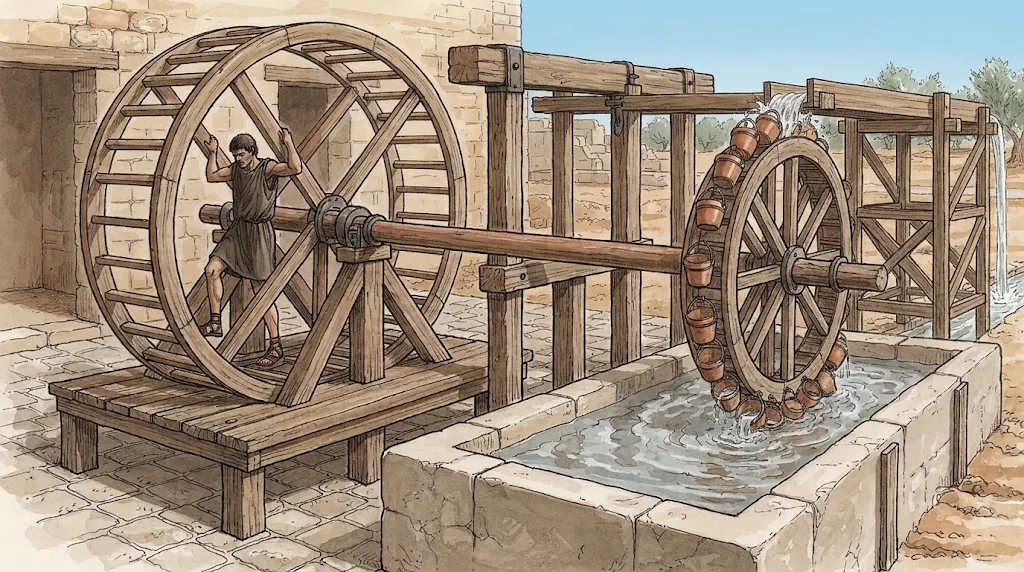
The slave-driven waterwheel of Aeneas of Gaza (6th century)

Dionysius of Antioch, Sophist and his letters

In yesterday’s post there was a letter (ep. 17) from Aeneas of Gaza to the sophist, Dionysius of Antioch.  Dionysius is the author of 85 letters, which the Italian editor, Positano, describes (p.103) as “che sono le più vuote della letteratura greca (v. Schmid, «R. E.» V 975 n. 127).” – “the emptiest in Greek literature”.

This striking phrase made me look up the reference in the Realencyclopädie, and the article is indeed in volume 5, page 975, entry 127.  In English:

127)  Dionysios of Antioch, a Christian (see ep. 41, 42, 49, 70, 71), a sophist (he mentions his students Kalliopios in ep. 23, Severus ep. 24, Modestus ep. 8, 16, 50), living in Daphne (Aeneas Gaz. ep. 17) near Antioch.  The teacher whose death he laments in ep. 66 is probably Procopius of Gaza (+ c. 580), with whose style the letters of D. show the closest affinity. He alludes to his activity as an official panegyrist in ep. 11, 28; he speaks of illness in ep. 41, 42 (podagra and insomnia). 49. The letter of recommendation Aeneas Gaz. ep. 17 is addressed to him. 85 letters by him survive, corresponding to his own conception of the purpose of the letter (ep. 31), almost entirely devoid of content, the first 46 except for 5–7 with named addressees, the rest without such; some of them (1 = Liban. 1108;  33 = Liban. 1188. Synes. 30, see Hercher Epistologr. p. XLa) also appear in the letter collections of Libanios and Synesios respectively. The first 46 were published in the collections of Aldus (Venice 1499), H. Stephanus (Paris 1577), F. Cujacius (Orleans 1606), R. Hercher (Epistologr. Graeci p. 260ff.), the latter of whom added nos. 47–85 after a copy taken by A. Westermann from Parisin. 2010 and his own collation.1

The German author’s “fast völlig inhaltleere Briefe” = “almost entirely contentless letters”, so Positano is not quite reflecting what the RE says.

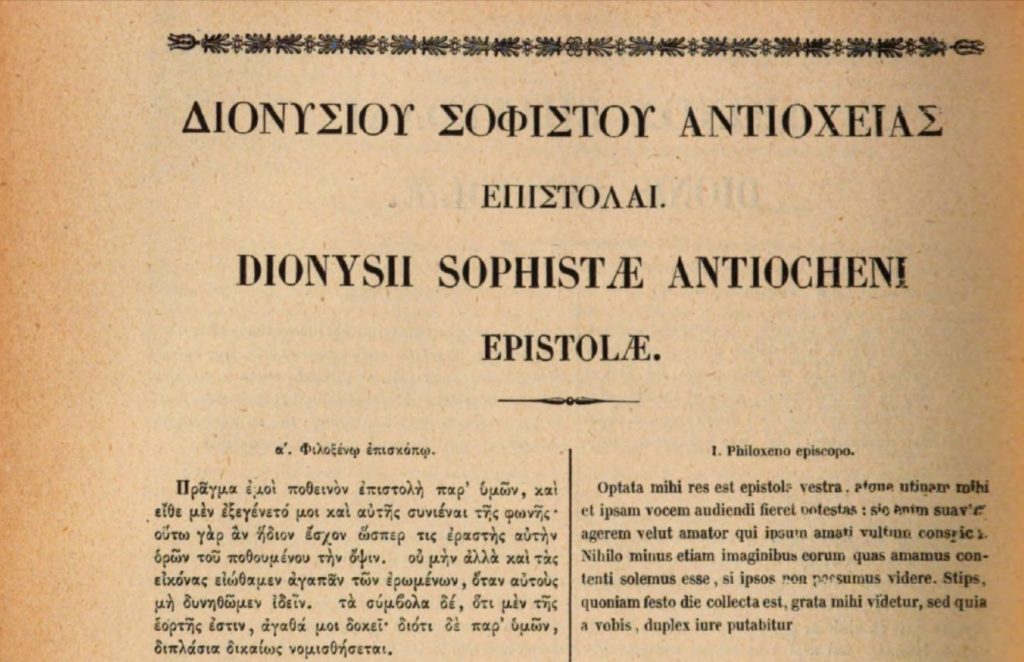
I’d never looked at Ruldolf Hercher’s massive 843 page Epistolographi Graeci (1843), which may be found in a poor-quality scan at Google here, and a very much better quality colour scan at the BSB here.  Here’s the first page (p.260) of the Dionysius page.  Helpfully a Latin translation is supplied with each.

At a site previously unknown to me, AncientLibrary.net, I found an electronic text of the Greek of the letters of Dionysius of Antioch here, taken from the Eulogikon GitHub site.  This supplies the following text:

Φιλοξένῳ ἐπισκόπῳ. Πρᾶγμα ἐμοὶ ποθεινὸν ἐπιστολὴ παρʼ ὑμῶν, καὶ εἴθε μὲν ἐξεγένετό μοι καὶ αὐτῆς συνιέναι τῆς φωνῆς· οὕτω γὰρ ἂν ἥδιον ἔσχον ὥσπερ τις ἐραστὴς αὐτὴν ὁρῶν τοῦ ποθουμένου τὴν ὄψιν. οὐ μὴν ἀλλὰ καὶ τὰς εἰκόνας εἰώθαμεν ἀγαπᾶν τῶν ἐρωμένων, ὅταν αὐτοὺς μὴ δυνηθῶμεν ἰδεῖν. τὰ σύμβολα δέ, ὅτι μὲν τῆς ἑορτῆς ἐστιν, ἀγαθά μοι δοκεῖ· διότι δὲ παρʼ ὑμῶν, διπλάσια δικαίως νομισθήσεται.

which DeepSeek AI gives as:

To Bishop Philoxenus. A letter from you is a thing I long for, and I wish it had been possible for me even to understand your very voice; for so I would have been more pleased, like a lover seeing the face of the beloved. However, we are accustomed to cherish even the likenesses of those we love, when we cannot see them. As for the tokens, that they are of the festival, seems good to me; but because they are from you, they will justly be reckoned twice as much.

Empty indeed.

One of the uses of the AncientLibrary site is that you can open the page in Chrome and then request instant translation in your browser.  This I did, and I found that all the letters were similarly empty of any real content.  It was all about style: all mouth and no trousers, as the saying has it.

Hercher does include a critial apparatus, not at the bottom of the page but in the introduction, on p.xxxix (which is page 44 of the Google PDF).  This tells us that the first 24 letters are from MS. Vaticanus gr. 82, which he added to from Vatican. 1354 and “Mazarineum” (?) 611 A. Three letters, 21, 40 and 46, came from the Aldine editio princeps, and letters 47-85 he took from MS. Paris gr. 2010.  From these critical remarks I learn that the “letter 1” which we have just given is also found among the letters of Libanius (no. 1108).  I suspect that it may not belong to Libanius.

I suspect that few today will have read the preface of Hercher to his Epistolographi Graeci, not since Latin ceased to be the language of scholarship.  Here is Deepseek’s rendering of it.  Already the practice of treating manuscripts with reagents to make them more legible is causing concern, it seems.

PREFACE

We have gathered into one place the scattered and wandering flocks of the Greek letter-writers, so that the modes and varieties of their voice, if anyone’s ears are open to receive it, might be more conveniently known and assessed than before. More than sixty writers come forth, sixteen hundred letters.

The author and initiator of this book was Anton Westermann, professor at Leipzig, whom a fatal necessity recently removed from the sight of his friends. When he had shaped nearly half of what is contained in this volume in such a way that he seemed to have sufficiently satisfied his own intention, being weak from a severe and long-lasting illness, he laid down the burden he had undertaken and sent his papers to Paris, so that they might be handed over to a future editor of the Letter-writers. At Dübner’s urging, they were delivered into my hands.

I have reworked the entire Greek text of Westermann at my own risk, so that I alone now guarantee both whatever is found to have been done well and whatever has been committed against the laws of the art.

It is helpful, so that it may be understood how much progress has been made toward the restoration of certain writers, to set down a few examples by way of specimen.

The ninth letter of Anacharsis, mutilated and cut off at the end, I have filled out with a just supplement by the aid of manuscripts.

The patchwork of Aristaenetus, such as it has been left in the most recent edition, I have repaired and reconstructed—with the patches and stitches of learned men admitted more confidently than was once done—with the rags of the ancient writers, which he had interpolated with his own. Some things were also supplied by the Vienna manuscript.

In the letters of Hippocrates I have introduced nearly an infinite number of readings, which, lying in oblivion, it was possible to draw out from the innermost bosom and lap of the Littré margin. Hence I have not only emended certain letters but transformed them.

I have revised Isocrates against the most noble Urbinate codex, which I myself collated anew.

Some letters of the Emperor Julian I have corrected against Italian codices, by far the most against the Vossian codex, whose collation Dübner had most generously communicated to me (for he himself had once formed the plan of editing Julian). Afterwards the power was granted me to compare this with the Vossian itself. From this I understood that Dübner had passed over one rather serious variant, but had administered the rest excellently and splendidly, in accordance with his constant exercise of codices, which he underwent almost daily. There is also something for which I especially congratulate myself regarding that gift. For Dübner, in order to bring back to light the letter-strokes which had vanished from age in the Vossian, had smeared the most precious pages with a certain staining juice, effective for a time, but in the future disastrous. And so for him indeed, as he said, the outcome proceeded according to his wish; but gradually it came about that the paper, soaked with those liquids, turned black; and now the matter has been brought to such a point that not a few things which he had recovered by his art either wholly or in part can be discerned in no way at all. Therefore the adjudication of these passages has been placed in Dübner’s discoveries alone.

The 104 letters of Procopius, which Angelo Mai—or, to speak the truth, his filthy (“impurus”) assistant Matranga—had copied from the Vatican codex in such a way that in six hundred places the speech was mutilated and gaping, I have made clean by the virtue of the same Vatican read more diligently and skillfully, and of two Laurentian codices, and I have restored to them the hateful and counterfeit elegance of Procopius. I have used the same codices to purify and supplement the Procopian letters published by Aldus, and from the same source I have brought some unpublished things to light.

I have ensured that the letters of Synesius are received as little polluted as possible, chiefly by the integrity of the Laurentian codex. But I must speak here of the Boissonade papers, which Gustavus Boissonadius, son of Franciscus, a man most learned in the discipline of civil law, who has not once embraced the study of antiquity with his benefits, converted to my use by a most welcome derivation. Franciscus, then, wrote at the beginning of the century a commentary on the letters of Synesius, in which he set forth the readings of four Parisian codices with the notes of Petavius and his own, for the most part imperfect and to be supplied by him afterwards. Of these, those pertaining to the fourth letter he published in 1842, most copiously augmented; the others (for he seems to have early abandoned all thought of editing Synesius) he so consumed that he dispersed and scattered them through the multiform commentaries with which, as time went on, he communicated Greek writers. The rest, although they too are less finished, nevertheless even so serve no small purpose for interpreting the speech of Synesius. From them, therefore, I have set down below what seemed most conveniently observed.

But enough about the proper praise of this volume. Αὐτὸ δείξει, ὁ τὸν πονηρὸν καθηγούμενος ἔσται.2 Now I must say a word about some of its faults.

For since this is the eighth year since the Greek Letter-writers began to be written out in type (of which delay I place all the blame and cause on myself alone), it has happened that once I passed myself by, and once another passed me by. Namely, the letters of Aelian, which in the sixty-fifth year they had completed by my order for the Parisian work, I published somewhat more emended at Leipzig in the following year; and likewise the little book On the Epistolary Form, which I had placed at the beginning of this volume chiefly from Westermann’s recension, in the sixty-ninth year Hugo Hinck brought forward with the authority of the Vatican books in such a way that there can be no doubt that they have preserved a more ancient and truer form of the little book.

Then, with so many and such various writers thrown into one bundle, it could not happen that I cultivated, cherished, and loved them all equally, that there was always the same face in me, the same countenance, that I put the same and one care into emending all. For who is there who, unless he was born for this very thing, would apply himself to the Phalaridean letters—to use this term—throughout the whole year, or would linger over the futile and fictitious sentiments of Dionysius of Antioch?

Then Fortune acted maliciously in this, that for the speech of certain writers needing help, the protection of manuscripts, which could be opposed to the first edition, was left either none or sufficiently weak and infirm. Hence, on a badly laid foundation, I have tested conjectures of differing savor, and I have entrusted not a few faults to the sharpness of others. For in making the criticism of the Letter-writers it was not permitted to rest for infinite time and to be moved by perpetual and long-lasting hope, that I, wandering through the same tracks, would always extort new and better things by chance or by my own genius, but the work had to be circumcised at last at some point.

I pass to another matter. The Latin interpretation, with which the Greek Library is accustomed to prelude to the Greek speech, Westermann partly refined diligently and skillfully from the earlier editions, so that the Latin might respond more accurately to the Greek, and partly was the first to compose, such as the letters of Diogenes. I myself have translated into Latin the letters of Dionysius and Procopius, first published by me and by Maius, and likewise the rest which I first made public.

I have compiled two indices, one of the beginnings of letters, the other of names and things.

Concerning the sigla which I have used to abbreviate the names of codices, it will be said in the annotation in their places. Bare words, whenever they are brought in after the lemmata, show the readings of the codices. I have marked the Aldine with the letter a. The letter B signifies Boissonade, W Westermann. I have everywhere indicated emenders and conjecturers with upright uncials, manuscripts with italics. I have made an asterisk in the notes wherever I have of my own accord broken, or certainly wished to break, the authority of the codices; in the text, pairs of asterisks wherever a hiatus lay open.

I did not wish to confine the personated writers in brackets, lest I make things difficult for those who, even after the disputes of Bentley and others, seem to themselves to look upon not the frigid deceits of sophists but the certain offspring of kings themselves, of tyrants, poets, philosophers. Let this therefore be said also for the sake of those who are still accustomed to cling to the letters of Plato and Isocrates as genuine.

I have wrongly included in this volume the letters of Alexander, which Arrian inserted into his book on the deeds of Alexander. Likewise, while engaged in another matter, I have received from Josephus the letters of King Antiochus and Ptolemy Philadelphus together with the letter of Eleazar. These therefore must be skipped over. On the contrary, the letter of Appian ought to have been received, and perhaps the letters of Fronto.

But I shall make an end of prefacing. It remains that I give and have the greatest gratitude my mind can conceive to the most serious helpers of my work, Baehrens of Heidelberg, Bruun of Copenhagen, Halm of Munich, Pluygers of Leiden, who from their treasures have furnished me the most solid foundations for the text of Themistocles and Julian.

Written on the Kalends of December, in the year 1871.

150 years ago, and a magnificent collection.   It is only a pity that the volume does not have a table of contents.

  1. Deutsch: 127) Dionysios von Antiocheia, christlicher (ep. 41. 42. 49. 70. 71) Sophist (Schüler von ihm Kal­liopios ep. 23, Severus ep. 24, Modestus ep. 8. 16. 50) in Daphne (Aeneas Gaz. ep. 17) bei Antiocheia. Mit dem Lehrer, dessen Tod er ep. 66 beklagt, dürfte Prokopios von Gaza (+ c. 580) gemeint sein, mit dessen Stil die Briefe des D. die nächste Verwandtschaft zeigen. Seine Thätigkeit als eines officiellen Festredners deutet er ep. 11. 28 an; von Krankheit redet er ep. 41. 42 (Podagra und Schlaflosigkeit). 49. An ihn gerichtet ist der Empfehlungsbrief Aeneas Gaz. ep. 17. Erhalten sind von ihm 85, seiner eigenen Auffassung vom Zweck des Briefes entsprechend (ep. 31) fast völlig inhaltleere Briefe, die ersten 46 äusser 5—7 mit benannten Adressaten, die übrigen ohne solche; einige von ihnen (1 = Liban. 1108. 33 = Liban. 1188. Synes. 30, s. Hercher Epistologr. p. XLa) stehen auch in den Briefsammlungen des Libanios bezw. Synesios. Die ersten 46 herausgegeben in den Sammlungen von Aldus (Ven. 1499), H. Stephanus (Paris 1577), F. Cujacius (Orleans 1606), R. Hercher (Epistologr. Graeei p. 260ff.), welcher letztere nach einer von A. Westermann genommenen Abschrift aus Parisin. 2010 und eigener Collation noch nr. 47—85 hinzugefügt hat. [↩]
  2. RP: A Greek proverb meaning time will reveal its value or otherwise.[↩]

Letters 17-20 of Aeneas of Gaza

Let’s read a few more letters of our early 6th century AD sophist, Aeneas of Gaza.  Aeneas is unwell (letters 19 and 20) and pleads with Gessius the physician for help.  But the first letter (17) is about Antioch.

17. To the Sophist Dionysius.

Mount Pelion once seemed like the common school of heroes.  But now that role belongs to your city, the city of the Muses. Fathers trust that, by attending your classes, their sons will either learn the literary arts or show knowledge of them. And no wonder, for the city is ancient and rich in old legends.  Many beautiful songs celebrate it, among them the tale that Calliope, captivated by the city, dwells among you, having forsaken Helicon, and persuades her sisters to live there too.  Hermes, surely, would not bear to forgo joining his sisters in their pastimes.  Even Apollo, the god of music, loves your city more than Parnassus.  For the knife of Delphi does not seem to him comparable to the beauty of these youths, nor the Delphic rock to this grove of Daphne, where even the water senses the deity’s presence and is said to echo with soft music.  But finest of all is Dionysius, who truly teaches divine rites.  This awakens the old and draws in the young.  Therefore I hope that excellent opportunities await the young man, especially because, having received an initial initiation and learned of the good things we offer, he has set out on his journey, much like those in Athens who are initiated into the Lesser Mysteries before the Greater ones.

Welcome the young man kindly, then, and gauge his character by the passion he now harbours, a passion that drives him to cross the seas and traverse vast lands, despite his frail physique.  May he also have, thanks to my letter, something more! Indeed, it ought to be bold—and feel no shame, though this is its first visit to you—in asking that you welcome it warmly and speak a kind word to it. May it return to you many times!

[This is addressed to the sophist Dionysius of Antioch, probably a pupil of Procopius of Gaza.  Dionysius was an official orator in the ceremonies of the city.  He has left 85 letters to us, which have been called “the emptiest in Greek literature” (Realencyclopadie V 975, n.127). Calliope had a sumptuous temple in Antioch (Müller, Antiq. Antioch. p. 69, n. 4, and p. 106 f.).  The grove of Daphne was near Antioch and sacred to Zeus and Apollo (v. Julian. ep. XCVIII), which is why, as Aeneas says, the water is possessed by the god.  Cf. Procopius ep. 103. Splendid games took place in the grove (Polyb. 31, 3, 1; Liv. 33,49), including musical contests. Such games lasted until the 6th century; therefore they were still in use in Aeneas’ time, to which he probably alludes with “echo with soft music”. Initiation into the lesser mysteries was a preparatory stage to the great ones.  Aeneas flatters Dionysius by presenting his own teaching as preparatory to that of Dionysius. In reality, the custom was widespread among masters of various cities of exchanging their pupils for further refinement (see also ep. XI). Besides Alexandria, considered by Procopius as “the common mother of orators”, the Gazans used to send their pupils also to the famous law school of Beirut, to Antioch, where the school of theology was famous, to Caesarea, and to Constantinople.]

18. To the Sophist Theodorus.

Smyrna takes pride in Homer and Aristides; now let my rhetorician Theodorus also share in this honour. This honour is entirely mine as well, if it is true that noble deeds performed by sons are considered to belong to the father too. Hail, then, to the elegance of your speech, thanks to which young Athenians seek to learn pure Attic not from their fathers, but from Syrians.  Indeed they no longer dock at the Piraeus eager for instruction at the Academy, nor do they frequent the Lyceum, for they deem that the Academy and the Lyceum are to be found here with us. So I receive ample reward from you if the Ionians sing of me, thanks to you, as a progenitor, and if, by clearly discerning the images of my soul, they are already able to sketch my physical appearance as well. The garment you provided makes my figure shine more brightly and enhances the beauty of your own renown.

[Aelius Aristides (129-189 AD) was born at Hadrianutherai (today Balukeser) in Mysia, but, after much travel, fixed his residence in Smyrna. When the city was destroyed by an earthquake in 178, he worked very hard to have the emperors Marcus Aurelius and Commodus rebuild it, and so Smyrna considered him its citizen and even erected a statue of him in the agora.]

19. To the physician Gessius.

Procopius is mine. And may the son of that Elpidius become yours, he whom I wish were still alive, and through whom the medical art flourished among us. Indeed, it is difficult for one studies hard to keep his body healthy.

I have already described what I have suffered, yet you have become like a spectator of my affliction. What am I to do now?  My kidney pains are severe and acute, but it seems like you are slow to attend to me. How much longer must we exchange letters? For a sick man even a single day feels like many years. Or perhaps the illness is very serious only when the sufferer is not a philosopher?

Have you forgotten the art? Are the ingredients for the medicine not ready? What hindrance is there, other than that you have forgotten our friendship? It is better, truly, to be accused of ignorance than of malice; for a judge directs his anger not at one who has erred through ignorance, but at one who has sinned out of malice. Oh, the betrayal of dearest friends! I remain in the grip of illness, you keep the remedy to yourself, and even as we discourse, I am being torn apart by pain.

[Aeneas has described his illness to Gessius in previous letters, but a reply with treatment is slow in coming.  This Gessius is known to us from four letters of Procopius of Gaza (epp. 38, 68, 123, 134) and an article in the Suda lexicon. In the dialogue Ammonius by Zacharias, brother of Procopius, Gessius appears as a fellow student of the author. The meaning of the opening reference to a “Procopius” and a “son of Elpidius” is unknown to us.  An Elpidius or Helpidius was a Greek physician of the 6th century AD living in Arles, then Spoleto, who attended Theodoric in his final illness in 526.  Libanius was also a sufferer of kidney illness and mentions this in his letters.]

20. Again to Gessius.

The excellent Nemesion, renowned for his legal expertise, commands even greater admiration for his character. What is the finest proof of this? That he knows how to win friends, and rejoices in their good fortune, while grieving over their undeserved misfortunes. And I would wish that you too, adhering to a different philosophy, would also do this.  But will you do so by remembering all your friends, or only those who are close at hand? Indeed, as long as the cause of a disease remains hidden, the remedies remain hidden too, even those close at hand, and treatment proceeds by guesswork.  But the diagnosis of the illness, shining like a light upon the physician’s art, opens the way to abundant remedies and removes all uncertainty from the cure.

We did describe the illness, if by chance you recall?  How a prolonged agitation came first, how a copious flow of blood followed, rather than superfluous fluid, and how rest and diet caused the condition to go dormant. Then came renewed agitation, another flow of blood, and further rest and diet.  But when the disease was no longer dormant, a spasm came on, at first moderate, then not slight, and finally unbearable, which tortured and inwardly tormented, and was utterly tearing at the navel. Why, indeed, should we conceal from you what nature itself does not hesitate to reveal?

There remains, in fact, one remedy to combat the disease single-handedly (unless, through your own wisdom, you discover another): a pill compounded with the herb that physicians solemnly call *physallis*. For this alone is capable of warding off the insidious ambushes of the disease.

[Another plea to Gessius for assistance.  The text most likely depicts kidney stone disease (nephrolithiasis), particularly the process of renal colic caused by stones and hematuria (blood in the urine).  The spasms are caused by the stone moving.  In the Suda, the name Nemesion is given with a quotation from the Life of Isidorus by Damascius. So  he may have been a disciple of Isidorus, that is, of the Athenian school.  The “φυσαλλίς” is a medicinal herb, Physalis Alkekengi, which is often mentioned in ancient physicians as a remedy for kidney or bladder illnesses.  The physalins have a certain anti-bacterial effect.]

Letters 12-16 of Aeneas of Gaza

A few more letters of the early 6th century sophist, Aeneas of Gaza.

12. To the Sophist Epiphanius.

For other lovers, the mere sight of the beloved’s sandal suffices to relieve the pangs of love.  But you ask for portraits of both soul and body.  Words, which clearly interpret thought, truly delineate the soul itself, and that is precisely why they are given you.  For my part I had resolved never again to have an image of an image reproduced. Yet, out of regard for your affection, I summoned the portraitist who resides here, and I sat before him, motionless of face, maintaining a solemn silence, and holding my pose, and allowed art to mirror nature.  Having captured my likeness, the painter’s hand fixed it and rendered it in colour.  The portrait is now with you, so that you may converse with it and gaze upon it, and have nothing less than those who stand beside me. The excellent Euthymius performs this service for us, willingly braving the sea to do so; which seems to be a hard thing for rivals in love. Come then, let us make him forget his hardships through our affectionate solicitude.

[Aeneas addresses letters 12 and 23 to Epiphanius, and he is also the subject of letter 4.  He was part of the circle of Gazan sophists, and was also known to Procopius, who came to know him on the recommendation of Peter (ep. 142). Procopius tells us that Epiphanius became a jurist (ep. 70), and settled in Alexandria (ep. 122). So it is likely that Aeneas is writing to him in Alexandria, enclosing a portrait.  The relationships of the three men are revealed here: Epiphanius is the one asking Aeneas for letters and a portrait; while Procopius is the one addressing Epiphanius and asking for letters and a portrait (ep. 53, 61, 94). The letter also explains the relation of Epiphanius and Euthymius to Aeneas: Euthymius is Epiphanius’ rival in affection for Aeneas, and the more painful his service, the more meritorious his journey precisely because he is bringing Aeneas’ portrait to his rival.]

13. To Encratius.

Yesterday he was a teacher and guide to youths.  Today he is led by a boy.  Once he seemed venerable to the young.  Now he appears so worthy of compassion.  Such is fate. What then? Shall we merely commiserate without coming to his aid? You certainly would not. If a soldier were suddenly deprived by fortune of the very hand with which he had distinguished himself in valour, do you think his fellow soldiers would not pool a share of the spoils for his sake? We draw our livelihood from letters; let us not be considered inferior in loving our neighbour to those who live by the sword.

[Another letter, like letter 10, in which Aeneas acts to help an old man of letters, a teacher.]

14. To the Priest John.

I have just seen the [present of] vegetables with more pleasure than I once felt for the honey-and-almond cake. Back then, indeed, the unjust accusation leveled against the boy robbed the honey of its taste and pleasure.  Now, however, the gentleness of his disposition makes the vegetables seem like gold to me. Truly sweet is the father who does not get angry because of an unjust accusation, but instead urges his son to turn away from thoughtlessness and to pursue virtue, and encourages the teacher to be solicitous towards him.

[Possibly Aeneas is the boy’s teacher, and the priest John is responsible to the parents for the boy.  Perhaps John had sent Aeneas a letter asking about the boy’s conduct, and accompanied by the cake.  Aeneas replied; and now a further letter has arrived, accompanied by vegetables, but accepting that the accusation was false.]

15. To the Priest Stephen.

This is not the first time that I have conversed with you. I did so once before. We used to talk by the Nile, back when I played with the Muses upon its banks. Our conversation would fashion elegant conceits, and while being serious, seemed to laugh. There was a contest of beauty: the Greeks were the judges.  The contenders were Nireus, who was “the handsomest of men on earth,” and Thersites, “the ugliest of men who came to Ilium.”  And the most amusing part was that Thersites thought it right to win; indeed, the discourse awarded him the prize, undeterred by Homer’s mockery, who named every part of his body after its deformity and ridiculed the man from head to toe.

In truth, that is how you used to jest with your listeners back then.  Now, however, I hear that you devote yourself to serious subjects, and in the temples you act as the herald of noble doctrine, and with your words you reform the morals of the citizens. Thus, today, the mason and the carpenter have something to say about divine things, and during their work—men who, before hearing your words, chattered only of stones and wood—they now discourse about virtue.

Great happiness, then, to the excellent Eustratius, who traveled to many cities and filled them all with your name.  May that no good man go unnoticed! It was he who prompted me to send this letter, lifting my hopes to the skies with the promise of even greater things: “gold in exchange for bronze,” your letter in exchange for mine. Come then, let us not be disappointed in this fair hope.

[Stephen is called περιβλέπτος, “illustrious” in letter 11, so must have been a man of consequence.  Some letters of Procopius are also addressed to a Stephen, who must be identified with ours, notably letter 18 which also mentions the Nile with reference to his stay and studies in Alexandria.  In this letter Aeneas recalls his youthful years, when he was in Alexandria at the school of Hierocles. It is likely that in this letter Aeneas is alluding to Lucian, Infer. Dial. 25, where there is also a contest of beauty between Nireus and Thersites and the Homeric verse B 673 is also cited.]

16. To Sarapion.

I have learned of your ordeal and watered the very earth with my tears, because this war originates with the very priests who profess to be heralds of peace. And if our ruin comes from the very source from which salvation should come, what way of escape remains for us? In my opinion these things call for loud lamentation.  Yet I feel both sorrow and satisfaction.  For while it is painful to have endured such perils, on the other hand steadfastness in the face of danger is the ultimate test of greatness of soul. What virtue can ever be called acquired, if no trial preceded it? Unless, of course, you would call a man an excellent general who has never once faced the enemy! But it is right for us to endure and not lose heart, for it is through war that peace is secured for us; and if this is so, let us face the war with courage rather than cowardice. But what a fine service you have rendered to your friends!  In your presence, I used to profess my love for rhetoric, trusting that I would find a cure for it in you.  But the opposite has happened: you have intensified that love rather than extinguishing it, by stirring up the applause of the spectators whom your letter summoned together. How then can one despise what you extol?

[It seems that Sarapion has got into trouble with the church.  Practicing rhetoric could be dangerous, and Aeneas has himself been trying not to do so.]

Letters 7-11 of Aeneas of Gaza

Let’s carry on reading the letters of Aeneas of Gaza.  Here are five more.

7. To Diodorus Scholasticus.

The excellent Herodotus reconciled us through the power of his musical art, an art surpassing that of Orpheus and Thamyris. Now, finally, we actually know one another, as if we had previously been fighting a battle in the dark: and there is now lasting peace.  Come, let us set up a mixing-bowl, as befits a time of peace, and pour libations, among the gods to Hermes, and among men to Herodotus, for they are the ones who finally resolved the discord between us. In honouring them, we shall banish Comedy, with all its attendant vices, from our correspondence.  For Comedy runs about impudently exposing the secrets of closest friends. Instead we shall make room for what safeguards every friendship: persuasion, grace, mutual pleasure, applause, and praise. With these, let us compose a nobler spectacle, forbidding Comedy to cause the slightest annoyance

[This letter, and letter 22, suggest that Aeneas and Diodorus had been fierce enemies, exchanging polemics and even personal attacks.  The two have been reconciled by a mutual friend, Herodotus (not the historian).  Witty personal attacks were part of the Greek Old Comedy – hence the introduction of Comedy – and were known as ὀνομαστὶ κωμῳδεῖν. Diodorus was a pupil of Procopius of Gaza, and accompanied him to Egypt, then settled in Caesarea as a lawyer.  As many as sixteen letters of Procopius are addressed to him and often concern recommendations and gifts sent by him to the master.]

8. To Zosimus the Premier.

I am well aware that your voyage has come to a happy conclusion. For, in truth, you did not set sail in order to engage in piracy, as the mighty leaders of old once did, nor for the sake of commerce, like most people today.  Rather, you travelled out of a longing for cherished people and places.  So it is fitting to say that Zeus, the guardian of friendship, was your companion on the voyage. And so, may the city be as favourable to you as the sea was, and, having received the love of friends, return to friends.

[From the papyri we learn that the πρωτεύων was the leading magistrate, official or citizen of a city, presumably Gaza; or Egyptian nome.  One papyrus uses πρωτεύοντι Ἡρακλεοπολίτου for the leading citizen or magistrate of Herakeopolis.  The letter is intended to flatter this important personage, suggesting that the voyage could never have gone wrong since Zeus Philios accompanied him.]

9. To the Sophist Sopater.

I praise the spirit of the excellent Constantine but pity his fate.  For, to be truly happy, he should have enjoyed only a single city, his home city. Instead, since fortune did not grant this, he has seen the cities of many men and he wanders about in order to earn a living, forced to glorify poverty while practicing a poetic art that originated not in Greece but in Italy. And thus he declaims in a heavy and baroque style. Having arrived here with this craft, he appealed to me to help him, and now I appeal to you. You, too, will surely guide him to a successful outcome by commending him to others.

[A reluctant and somewhat hostile letter of recommendation on behalf of a visitor from the now barbarous Latin world.  We do not know whether the addressee is the Sopater who is the author of an Ἐκλογαὶ διαφόρων (Photius, Bibl. cod. 161), of biographies (Cramer, An. Par. I 389), of Διαιρέσεις ζητημάτων and of scholia to Hermogenes (Walz, Rhet. gr. IV, V, VIII).]  At all events Aeneas simply hands his guest over to Sopater who must find friends for him.

10. To the Sophist Zosimus.

If the excellent Paul were young and a poet, he would still be worthy of honour.  As it is, he is both a poet and an old man, and both of these qualities require someone who knows how to render them their deserved tribute. You wish to be foremost among those who do this, and rightly so. Here, then, is someone to whom you can do a good turn.

[Also a letter of recommendation.  When you are young, it is enough to be famous.  When you are old, you need material help too.  The addressee cannot be the same as the Zosimus of letter 7.  Letter 151 of Procopius of Gaza is also addressed to a Zosimus, who, after being his pupil, has now dedicated himself to the study of law.  The Suda mentions a Zosimus of Ascalon, a sophist, who lived in the time of the emperor Anastasius and wrote an alphabetical lexicon and commentaries on Demosthenes and Lysias. But Aeneas was older than Procopius and so could hardly have had a pupil of Procopius – a young man – as an authoritative friend.  It is possible that the Suda erroneously fused together information concerning two sophists named Zosimus, one native of Gaza put to death by the emperor Zeno (473-491), the other of Ascalon lived under Anastasius I (491-518). In all probability this second Zosimus was Aeneas’ friend.]

11. To Marinianus, of a consular family.

The excellent Ponton has surpassed the others in my school through his unflagging zeal, a quality that greatly aids the acquisition of learning.  He has undoubtedly mastered the techniques of rhetorical oratory and added to them a multifaceted knowledge of the law.  Yet he is not sated by these labours. Indeed, he has set out for your city like a skilled athlete heading to Olympia, superbly prepared for the contest.  For if you inspire him, I prophesy that the young man will emerge an Olympic champion! May you brilliantly organize the games and offer prizes, not for boxing or wrestling, but for the art of eloquence and for wisdom. I greet the most illustrious Victor, the illustrious Stephen, and the most accomplished John, as well as your families and my friends.

[The addressee is clearly an influential person.  A Marinianus was praefectus praetorio Italiae, Illyrici et Africae and then consul ordinarius in 423; another was bishop of Synnada in Phrygia; another was outright bishop of Gaza and took part in the Council of Ephesus in 449: to him John Chrysostom addresses epistle 128 (Migne PG 52, 638). It is clear, therefore, that this is a very influential Gazan family. The personal name Pontus is known from a Latin inscription.]

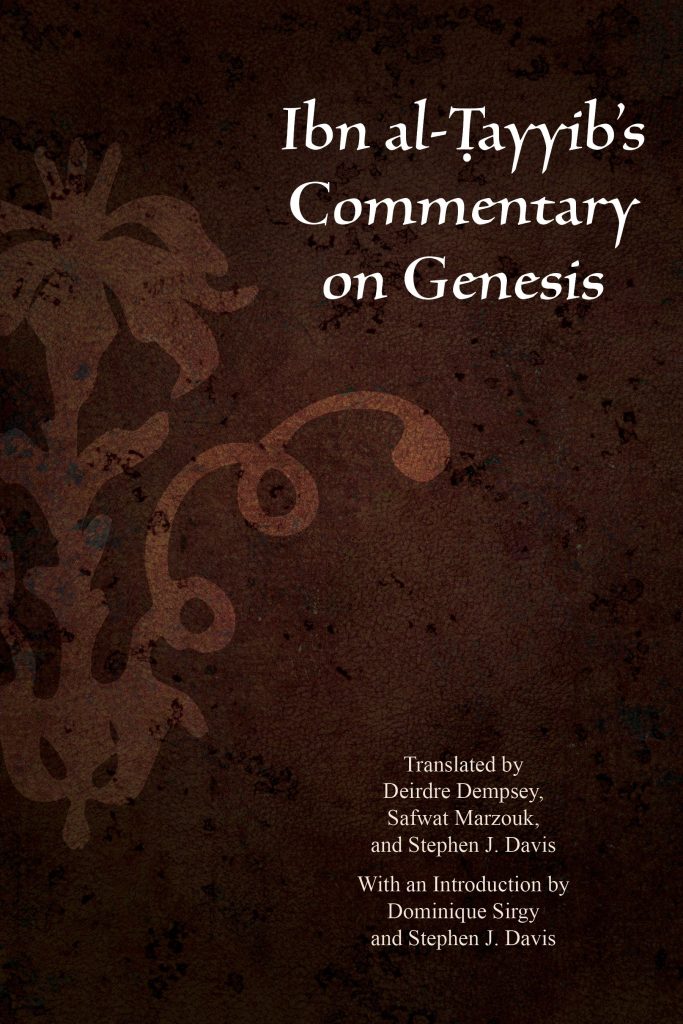
New publication: Ibn al-Ṭayyib’s Commentary on Genesis – in English

A kind correspondent draws my attention to an interesting new publication, of an English translation of Ibn al-Tayyib’s “Commentary on Genesis”.  The bible commentaries of this Christian Arabic writer (d. 1043) are very little known, and it is wonderful to have this new volume, of 160 pages.  The translators are Deirdre Dempsey, Safwat Marzouk and Stephen J. Davis, and the price is a very reasonable $35.  The Fordham Press website for it is here, and it’s on Amazon.com here.

From the blurb:

The first English-language translation of a major biblical commentary written in Arabic by a seminal figure in the history of Christianity in the Middle East.

Abū-l-Faraj ibn al-Ṭayyib (d. 1043) spent his adult life in Baghdad, where he served as a priest in the Church of the East around the turn of the first millenium. He was a polymath—a physician, philosopher, and theologian—and part of an illustrious line of teachers dedicated to the transmission of scientific knowledge from Greek into Syriac and then later into Arabic. He authored commentaries on Aristotle, Galen, and Hippocrates, as well as original treatises on the Trinity, science and miracles, Christian law, and the resurrection. His major works of biblical interpretation included a complete commentary on the Bible, entitled The Paradise of Christianity. The first part of it, his Commentary on Genesis, is translated here into English for the first time and accompanied by a critical introduction to Ibn al-Ṭayyib’s life and writings; the form, method, and content of his biblical interpretation; and his theology of creation and the divine Word.

I seem to have started writing about Ibn al-Tayyib in 2009, so it is delightful to see something appearing!  Stephen J. Davis seems to be the man pushing things along.  I hope the volume is a success!

Letters 1-6 of Aeneas of Gaza

Twenty-five letters of the early sixth century sophist Aeneas of Gaza have been preserved, scattered across a mass of manuscripts.  Let’s read the first six in the collection, using the Positano edition and Italian translation of 1961, thanks to the wonders of Google Translate and Deepseek.1  The notes are abbreviated from Positano.

1. To John.

If the book were yours and I desired it, it would rightly have been already in my hands, for some time: that is how friendship is made. But now the owner of the book is me; and yet you do not give it to me. Oh no, by Zeus the protector of friendship, may this not happen to me because it is a book; in reality it is all that I have; and such possession seems to me worthy of greater consideration than the talents of Croesus.

Certainly, one man loves the hoe [he is a farmer], and one has a passion for dogs [he is a hunter], another delights in the bow, another takes pleasure in horses: for me, it is books and discourses. But the very thing that brings most pleasure to its owner is what brings most pain when taken from him.

So if you return the book to me, I will be convinced that it is imprinted upon your mind.  But if not, it will look as if you do not care about its contents, but rather about appearing to be its owner. But why do I say this?  Certainly not in order to get pain from something that so often brought me joy.

[The letter is only intelligible if John is a rather wealthier man than Aeneas.  The name John is very common; note that letter 14 is directed to a priest John, and another John is greeted in letter 11.  Procopius of Gaza refers in letter 103 to a John who returns books swiftly, and addresses letters 5, 12, 33, 55, 95, 154 and 156 to him; but we cannot be sure the two are the same.]

2. To Cassus.

In his old age, Laertes no longer wished to be king or rule over peoples; instead, he wanted to be a gardener and tend to trees. It seems to me that you have emulated him; otherwise, you would not have left the city and your own people to spend such a long time in the countryside conversing with plants. You ought, however, to have kept in mind not Laertes, but Socrates and the Socratic precepts, where he, discoursing with elegance and gravity, maintains that fields and trees are not disposed to teach anything, whereas the men of the city are.  Listen to him instead: hold the fields in low regard, for it is unlikely that farmers there reap the fruit of wisdom; remember, rather, those familiar, customary discussions where one can learn and teach knowledge and, most importantly, bring joy to friends.

[The addressee was probably “Cassius”, but it is given as “Cassus” in the manuscripts, and Κάσσος does exist as a name, because it appears in the Suda.]

3. To the Priest Alphius.

The opposite has happened. Anastasius is at peace, while you are making war.  That course of action is not fitting for you, nor is it honourable. Shall I tell you how the conflict came about? Cornelius occupied Anastasius’s farm while the latter was away.  Upon his return, the owner wanted to reclaim the land, while the farmer, for his part, wished to become the owner.  And not for free either, for he had actually negotiated a price. They came to an agreement; a purchase contract was drawn up, and Cornelius was already preparing to hand over the money for the farm.

Then you swooped in unexpectedly and prevented the transaction, claiming ownership of the land yourself. Hence the anger and the conflict. If you are in the wrong, settle the dispute even before you come to us. If, however, there is only the appearance of wrongdoing rather than the reality, come and answer to the judges as soon as possible. For I would not want friends to be unjust, nor even merely to seem so.

[Anastasius inclines towards a reconciliation; Alphius, on the other hand, a priest, has assumed a litigious attitude. Both are friends of Aeneas.  It’s possible that Alphius has invoked an ecclesiastical privilege over the land. Anastasius is very likely the Anastasius whom Procopius mentions as his relative in one of his letters addressed to Gessius the physician, who is also a friend of Aeneas (ep. 68).]

4. To the Sophist Zoneus.

May the excellent Epiphanius enjoy great happiness, because he filled us with joy.  Indeed, in calling you a fine orator, he admired your character more than your eloquence. For—and this is the essential point—you proved yourself a sincere friend.  He would often turn to me in jest, and this in your name; because you had instructed him to do so. You know what he is like: a man who cultivates every grace. To tell the truth, he was sometimes even a nuisance to me with his constant delivery of greetings on your behalf.  But you are to blame.  Had you sent me even a brief note, just to exchange a few words, I would have received it with pleasure.

[The name of the addressee is corrupt in the manuscripts.  A Zoneus is mentioned in Letter 107 by Procopius of Gaza, and it seems to be the same person. It is uncertain whether this is the same orator who wrote, according to the Suda lexicon both ἐρωτικαὶ ἐπιστολαὶ καὶ ἀγροικικαί and a treatise Περὶ τῶν σχημάτων. A short work Περὶ τῶν κατὰ λόγον καὶ κατὰ λέξιν has come down to us under the name of Zoneus, but the attribution is perhaps due to the 16th century forger Constantine Palaeocappa. It has also been thought that the letters attributed to Aristaenetus are instead by Zoneus. For Epiphanius see letter 12, addressed to him.]

5. To Ulpia.

May the wicked, whoever they may have been, perish miserably for the damage that they inflicted upon your household.  By the gods, I cannot express how deeply distressed I was by it.  Yet, fortunately, a source of comfort has presented itself to me, albeit belatedly, and I felt it was right to share it with you, so that the misfortune will not have been entirely in vain.

Now indeed you will believe more firmly that, while gold, silver, and splendid garments are eagerly sought after by the many, they are insecure and unstable possessions, even for their actual owners, because anyone who wants to can steal them.  Culture and wisdom, on the other hand, may be objects of ridicule for fools, but they are a secure and steadfast possession that cannot be taken away: a treasure, in short, that is proof against theft.   Cling on to these things instead, and in future you will need neither walls nor weapons nor a troop of guards to protect your wealth.

[This and the following letter are letters addressed separately to Ulpia and Pampus to console them for a theft. The central theme of this letter, that culture and wisdom are the only secure possession, is a recurring motif in rhetoric.]

6. To the Grammarian Pampus.

The joy of receiving your letter was overshadowed by the pain I felt at the news of the theft.  This troubled me no less than if I had suffered it myself. Let this statement not seem incredible: for if friends share possessions, do they not share losses too. But why do I grieve so? Undoubtedly he who is superior to gain is also above loss.  In this, we find comfort. I should like to know from you if I am right.

  1. Lidia Massa Positano, Enea di Gaza: Epistole, 2nd ed., Naples (1961).[↩]

Coming back to life

Apologies for the outage.  I did indeed have to move host – twice in fact.  Nixihost was great until I tried to upload my site and found the upload speed was 50 kilobytes per second.  My internet connection upload runs as 81 megabytes a second.  So that was impossible.  Clearly they have sold too many websites for their capacity.  But they were nice people.  The web hosting trade seems every bit as wild west as it was 20 years ago, and it’s quite a minefield.  Let’s see how it goes with the new host (upload speed in megabytes, thankfully).

Update: I’ll update this post as things get fixed.

The Tertullian Project website is back, mostly, at tertullian.org.  I did remove some PDF books that are on Archive.org, just to keep bandwidth down.

The Mithras site is now up.

I have decided to retire the QuickLatin software and site.  I still use it myself, of course.

The old Syriac Wiki site (link to archive.org) has been lost in the move, unfortunately.  I did back up the database, but I find that I am unable to import it to a current version of the software.  Nor do I know what version it was running on.  The only bit I regret is that material that I had in a private area, on Attis. Oh well.

This blog is up, as you can see; but I’m not sure whether comments are getting through to my email yet.  Time will tell.  The Twitter and OpenGraph cards have been added.

There’s bound to be something outstanding, but I don’t know of anything.

Taking offline tertullian.org and roger-pearse.com

My apologies, but both roger-pearse.com and tertullian.org will probably go off-line shortly for about a week.  My web host, Pair Networks, has just presented me with an $85 bill for “over usage” last month.  Unfortunately there is no indication of why this occurred, nor any warning that it was occurring.  Nor can I get in contact with anybody with authority to help until Monday.

It is likely that I will have to move hosts, hence the outage.  In the mean time I will block access to the sites.  My apologies.  Everything will reappear eventually.

The little that is known about Demetrius of Cyzicus… part 2

In my previous post about this obscure 11th century Byzantine bishop, I gave the 1959 entry by Beck.  This drew upon and abbreviated the old  French (1912!) DHGE (Dictionary of Ecclesiastical History and Geography) article.

Many volumes of the DHGE are online somewhere.  I know this because I have a directory full of volumes.  But I was unable to find a link now.  Since it is out of copyright, but inaccessible, I thought that I would make it available here.  I will put the original French in a footnote.1

Here is what ChatGPT gives us for it.

    *    *    *    *

DEMETRIUS OF CYZICUS. — There is no reason to believe in two Demetriuses of Cyzicus, or to distinguish the polemicist from the canonist; instead we should adhere to Lequien, Oriens Christianus, II, 758. The only argument advanced by L. Petit, in the Dictionnaire de théologie catholique (D. T. C.), in favour of the existence of the former, in the tenth century, is the address preceding the short treatise on the Jacobites, written at the request of Constantine Porphyrogenitus (P. G., cxxvii, 879–902). Now, this Porphyrogenitus cannot necessarily be identified with Constantine VII (944–59); his grandson, brother and successor of Basil II, Constantine VIII (1025–28), had far more reason to consult a churchman about the Jacobites than did his grandfather, who was sufficiently learned. Moreover, during the effective reign of Constantine VII, there is no place for a Demetrius on the see of Cyzicus, which was occupied continuously by Theodore. Indeed, before 946, the date of the death of Anastasius of Heraclea (Theoph. Cont., ed. Bonn, 439; S. Runciman, Romanus Lecapenus, 235), Theodore of Cyzicus, together with Anastasius, was a member of a commission charged with investigating Alexander of Nicaea: ms. Patm. 706, fol. 104. In 956, the same Theodore is noted for his opposition to Polyeuctus and, in 959, Constantine Porphyrogenitus came to visit him at Olympus shortly before his death (Cedrenus, II, 335, 337).

Petit seems to have revised the categorical opinion he expressed in the article Demetrius, for in the article Isaac the Armenian (D. T. C., viii, 13), he attributes the exposition of the Armenian errors to the metropolitan living under Alexis Studites (1025–46). In any case, this short treatise De Jacobitis et Chatzizariis must be clearly distinguished from the Narratio de rebus Armeniae, whose origins G. Garitte has recently elucidated: what is certain is that the latter has nothing to do with Demetrius of Cyzicus, except accidentally through the fault of copyists and, above all, editors after Combefis. To the manuscripts of the De Jacobitis indicated by L. Petit — Athous 927, 3666, 3758, 4501, Palatinus 356, Scorialensis R I 15, Constantinopolitanus S. Sepulcri 391, Mosquensis 319 and 323 — must be added Parisinus 1315 (the editor’s prototype), Angelicus 30, Atheniensis Bibl. nat. 2972, Lesbiensis Leim. 7; and the list is doubtless not complete.

In the historical sources, Demetrius appears for the first time in January 1028, at the synod presided over by Alexis Studites (Grumel, Regestes, no. 835). Before the end of 1029, Romanos Argyros conferred upon him the title of syncellus, as he did upon two other metropolitans. In 1030, he attended the synod held against the Jacobites of Melitene (Regestes, no. 839), whose tome was confirmed in 1032 (Regestes, no. 840). In 1037, he appears among the opponents of Patriarch Alexis (Regestes, no. 842). After this, there is no further trace of him in the sources. We do, however, know of a poem by Christopher of Mytilene (Gedichte, ed. Kurtz [Teubner], 13), addressed to Demetrius of Cyzicus to console him for his gout. Demetrius survived his patriarch, who died in 1046, but in 1054 (Regestes, no. 869), it is Theophanes who is metropolitan of Cyzicus.

For the record, we may mention a lost chronicle by Demetrius of Cyzicus, known only from the testimony of Scylitzes; there is no reason to think that its author was different from our metropolitan.

The published works are found in P. G., CXIX, 1097–1120: they consist of two canonical consultations concerning impediments to marriage.

The unpublished works are found in two manuscripts, Vatic. gr. 712 and Ambrosianus 682 (Q 76 sup.), independent of one another; only the Ambrosianus gives the name of Demetrius in the title. Two discourses are common to both witnesses:

Δίκαιον ἦν ἡμᾶς τοῖς θείοις (It is right to follow the divine canons): addressing the “emperors,” Demetrius, invoking the ancient canons, claims to prohibit the patriarch of Constantinople from consecrating bishops of another eparchy and even metropolitans whose consecration is reserved to the bishops of his own province.

Δέσποτα ἡμῶν… οὐ τὸ ἴδιον θέλημα (Our master… should not follow his own will): a discourse addressed to an emperor who was attempting to overturn synodal judgments, in a letter in which he had written: “Whoever opposes an imperial document, let him be punished like the sacrilegious.”

The Ambrosianus has a third discourse of its own: Ἐπειδή τινες ὡς οἴονται (Since certain people suppose…), directed against those who say that one cannot resign from the episcopate.

The Vaticanus has two more:

Ἔδει μὲν ἡμᾶς ὦ παναγιώτατε δέσποτα (It was indeed incumbent upon us, O most holy master): a discourse delivered before the patriarch against those who maintain that synods should not be held every year at Constantinople but in the eparchies;

Τίς λαλήσει τὰς δυναστείας (Who shall declare the mighty acts?): a discourse before the emperor requesting a precise law concerning degrees of kinship in relation to marriage.

These short works are essentially canonical dissertations, and it is not possible to establish their date at first sight. Only discourse 4, Vatic. 712, fols. 182v–192, contains a precise historical datum. The speaker cites several examples of Constantinopolitan synods: two under Photius, the synod of union (Nicholas), the synod that restored Euthymius to the diptychs under Polyeuctus, the synod of Sisinnius, and then two synods of Patriarch Antony, “which some of us have seen, those who were admitted by him to the ranks of the clergy” (fol. 190v). This remark presupposes a certain lapse of time: the speech would therefore date from shortly before 1054.

On the other hand, in this discourse Demetrius takes a position fairly contrary to that which he maintains in the first, where he calls for a restriction of patriarchal jurisdiction. One may suppose that the first was directed against Alexis, with the connivance of an emperor (Michael IV?). Under Cerularius, Demetrius, now elderly and chastened by his gout, seems to have taken the patriarch’s side and supported claims that he had formerly judged to be contrary to the canons. A connection may also be seen between the speech on marriage and a document of 1051–52 (Regestes, no. 858).

It is worth asking whether another speech, of a tendency quite similar to that of the first, does not also belong to the same metropolitan. It is contained in Scorial. R I 15, fols. 24v–47: Καὶ πᾶσι μὲν ἄλλοις ἁρμόζειν (And while it is fitting for all others), and advocates a return to the ancient discipline, that is, to the discipline preceding the encroachments of the patriarchs of Constantinople.

A sixteenth-century manuscript, Meteor. S. Stephani (cf. Νέος Ἑλληνομνήμων, xxi, 1927, p. 326), indicates Demetrius of Cyzicus as the author of a short treatise on fasting; this is an erroneous attribution, for this text, which has also been attributed to Patriarch Nicholas, is by John the Oxite (cf. Échos d’Orient, xxxii, 1933, pp. 287–89).

In addition to the works that cited in the course of the article, see:

J. Croce, E. Hermann, Textus selecti ex operibus commentatorum byzantinorum juris ecclesiastici, Rome, 1939, pp. 11–12; they distinguish two Demetriuses.
— Codices Vaticani Graeci, III, recension by R. Devreesse: the editor dates the first speech to the period of Alexios Komnenos.
— G. Garitte, La « Narratio de rebus Armeniae », Louvain, 1952, especially pp. 386–97.
— V. Grumel, Les métropolites syncelles, in (Revue des) Études Byzantines, III, 1945, pp. 94–95.
— K. Krumbacher, Gesch. der byzant. Literatur; see the index, where three Demetriuses of Cyzicus are distinguished.

    *    *    *    *

A few thoughts on this elderly article.  The 19th century claims about two or more authors of the same name are not important now.

First a bibliographical point, which confused me initially.  “Regestes” means V. Grumel, Les Regestes des actes du Patriarcat de Constantinople, fasc 3. (1932).

The lost history is worth a bit more discussion.  In his introduction, Scylitzes mentions a lost Chronicle “of his own times and a little before” by Demetrius of Cyzicus, who is presumably our author.2  This is translated by John Skyzilites: A Synopsis of Byzantine History, 811-1057, tr. John Wortley, CUP 2010, p.4:

Theodore Daphnopates, Niketas the Paphlagonian, Joseph Genesios and Manuel, these two of Constantinople, Nikephoros the deacon from Phrygia, Leo from Asia, Theodore, bishop of Side and his nephew of the same name who presided over the church of Sebasteia, Demetrios, bishop of Kyzikos and the monk John the Lydian – these all set themselves their own goals: maybe the glorification of an emperor, the censure of a patriarch, or to extol a friend – each attains his own ends under the guise of writing history and everyone of them falls far short of the mentality of those godly men of whom we spoke. For in composing a rambling account of his own times (and a little before) as though he was writing history, one of them writes a favourable account, another a critical one, while a third writes whatever he pleases and a fourth sets down what he is ordered to write. Each composes his own ‘history’ and they differ so much from each other in describing the same events that they plunge their audience into dizziness and confusion.

Setting aside this dismissal of rival authors, we learn that the work covered the times of Demetrius himself, and a period beforehand.

We can also expand on the mention of Romanus III Argyrus.  Cedrenus records that before the end of 1029, Romanos III Argyros (1028-1034) conferred the title of Syncellus upon him and two other metropolitans, and that Romanos had thought well of Demetrius even before he became emperor.3

The De Jacobitis et Chatzizariis was first edited by F. Combefis, in his two volume Novum Auctarium Graeco-Latinae Bibliothecae Patrum,  volume 2, column 261 f., and his text has been reprinted ever since.  Those looking for this volume online need to know that volume 2 of the book, (the Tomus Alter Historicis et Dogmaticus) of the 1648 edition is uniquely titled, and therefore catalogued, under the name of its core treatise: Historia Haeresis Monothelitarum sanctaeque in eam sextae synodi actorum vindiciae.  It may be found online here.  If you go to column 261, you will find that it is anonymous, but under the correct title, with parallel Latin translation and marginal notes.  Only at the end does Combefis include a note attributing it to Demetrius of Cyzicus.

Let’s end with a screen-grab of that page:

  1. 5. DEMETRIUS DE CYZIQUE. — Rien n’oblige à admettre l’existence de deux Démétrius de Cyzique ni à distinguer le polémiste du canoniste; il faut s’en tenir à Lequien, Oriens Christianus, 11, 758. Le seul argument énoncé par L. Petit, dans le D. T. C., en faveur de l’existence du premier, au Xe s., est l’adresse qui précède l’opuscule sur les jacobites, écrit à la demande de Constantin Porphyrogénète (P. G., cxxvii, 879-902). Or ce Porphyrogénète ne s’identifie pas nécessairement avec Constantin VII (944-59); son petit-fils, frère et successeur de Basile II, Constantin VIII (1025-28), avait bien plus de raisons de consulter un ecclésiastique sur les jacobites que son grand-père, suffisamment érudit. D’autre part, sous le règne effectif de Constantin VII, il n’y a pas de place pour un Démétrius sur le siège de Cyzique, occupé sans interruption par Théodore. En effet, avant 946, date de la mort d’Anastase d’Héraclée (Theoph. Cont., éd. Bonn, 439; S. Runciman, Romanus Lecapenus, 235), Théodore de Cyzique, en compagnie d’Anastase, est membre d’une commission chargée d’enquéter sur Alexandre de Nicée : ms. Patm. 706, fol. 104. En 956, le méme Théodore se signale par son opposition à Polyeucte et, en 959, Constantin Porphyrogénète vient le voir A l’Olympe peu avant de mourir (Cedrenus, II, 335, 337).

    Petit semble avoir révisé son opinion catégorique exposée à l’article Démétrius, car à l’article Isaac l’Arménien (D. T. C., viii, 13), il attribue l’exposé des erreurs arméniennes au métropolite vivant sous Alexis Studite (1025-46). En tout cas il faut bien distinguer cet opuscule De Jacobitis et Chatzizariis de la Narratio de rebus Armeniae, dont G. Garitte vient d’élucider les origines : ce qui est certain c’est que celle-ci n’a rien à voir avec Démétrius de Cyzique, sinon accidentellement par la faute des copistes et surtout des éditeurs postérieurs à Combefis. Aux mss. du De Jacobitis indiqués par L. Petit: Athous 927, 3666, 3758, 4501, Palatinus 356, Scorialensis R I 15, Constantinopolitanus S. Sepulcri 391, Mosquensis 319 et 323, il faut ajouter Parisinus 1315 (prototype de l’éditeur), Angelicus 30, Atheniensis Bibl. nat., 2972, Lesbiensis Leim. 7; et la liste n’est sans doute pas complète.

    Dans les sources historiques, Démétrius apparaît pour la première fois en janv. 1028, au synode présidé par Alexis Studite (Grumel, Regestes, n. 835). Avant la fin de 1029, Romain Argyre lui confère le titre de syncelle ainsi qu’à deux autres métropolites. En 1030, il assiste au synode tenu contre les jacobites de Méli-tène (Regestes, n. 839), dont le tome est confirmé en 1032 (Regestes, n. 840). En 1037, il figure parmi les opposants au patriarche Alexis (Regestes, n. 842). Après cela, il n’y a plus trace de lui dans les sources. On connaît cependant un poème de Christophore Mitylenaios (Gedichte, éd. Kurtz [Teubner], 13), adressé à Démétrius de Cyzique pour le consoler de sa podagre. Démétrius survécut à son patriarche, décédé en 1046, mais en 1054 (Regestes, n. 869), c’est Théophane qui est métropolite de Cyzique.

    Citons pour mémoire une chronique perdue de Démétrius de Cyzique, connue par le seul témoignage de Skylitzès; on n’a aucune raison de penser que l’auteur diffère de notre métropolite.

    Les oeuvres éditées se trouvent dans P. G., CXIX, 1097-1120 : il s’agit de deux consultations canoniques sur les empêchements de mariage.

    Les oeuvres inédites se rencontrent dans deux mss., Vatic. gr. 712 et Ambrosianus 682 (Q 76 sup.), indépendants l’un de l’autre; seul l’Ambrosianus porte dans le titre le nom de Démétrius. Deux discours sont communs aux deux témoins : Δίκαιον ἡν ἡμᾶς τοῖς θεῖοις: s’adressant aux « empereurs », Démétrius, au nom des anciens canons, prétend interdire au patriarche de Constantinople de consacrer les évêques d’une autre éparchie et même les métropolites dont le sacre est réservé aux évêques de sa province. Δέσποτα ἡμῶν… οὐ τὸ ἴδιον θέλημα: discours à un empereur qui prétendait casser les sentences synodiques dans une missive où il écrivait : « Quiconque s’oppose à un écrit impérial, qu’il soit puni comme Démétrius sacrilège. » L’Ambrosianus a en propre un troisième discours : Ἐπειδή τινες ὡς οἴονται, contre ceux qui disent qu’on ne peut démissionner (de l’épiscopat). Le Vaticanus en a deux autres : Εδει μὲν ἡμᾶς ὧ παναγιώτατε δέσποτα : discours prononcé devant le patriarche contre ceux qui affirment que les synodes ne doivent pas avoir lieu chaque année à Constantinople mais dans les éparchies; Τίς λαλήσει τὰς δυναστείασ: discours devant l’empereur pour demander une loi précise concernant les degrés de parenté par rapport au mariage.

    Ces opuscules sont essentiellement des dissertations canoniques et il n’est pas possible d’en fixer la date à première vue. Seul le discours 4, Vatic. 712, fol. 182v0-92, contient une donnée historique précise; l’orateur cite plusieurs exemples de synodes constantinopolitains, deux de Photius, le synode d’union (Nicolas), le synode qui rétablit Euthyme dans les diptyques sous Polyeucte, le synode de Sisinius, puis deux synodes du patriarche Antoine « que certains d’entre nous ont vu, ceux qui ont été admis par lui aux rangs du clergé » (fol. 190v°). Cette remarque suppose un certain éloignement dans le temps : ce serait peu avant 1054. D’autre part, dans ce discours, Démétrius prend une position assez contraire à celle qu’il soutient dans le premier où il demande une restriction de la juridiction patriarcale. On peut supposer que le premier est dirigé contre Alexis, avec la connivence d’un empereur (Michel IV?). Sous Cérulaire, Démétrius, âgé et assagi par sa podagre, semble avoir pris le parti du patriarche et soutenu ses prétentions jugées naguère anticanoniques. On peut voir aussi un rapport entre le discours sur le mariage et un acte de 1051-52 (Regestes, n. 858).

    Il y a lieu de se demander si un autre discours, de tendance assez semblable à celle du premier, n’appartient pas au même métropolite. Il est contenu dans le Scorial. R I 15, fol. 24v°-47 : Καὶ πᾶσι μὲν ἄλλοις ἀρμόζειν et propose un retour à la discipline ancienne, c.-à-d. antérieure aux empiétements des patriarches de Constantinople.

    Un ms. du xvıe s., Meteor. S. Stephani (cf.Νέος Ἑλληνομνήμων, xxi, 1927, p. 326), indique Démétrius de Cyzique comme auteur d’un opuscule sur le jeüne; c’est une erreur d’attribution, car ce texte, qui a été aussi attribué au patriarche Nicolas, est de Jean l’Oxite (cf. Échos d’Orient, xxxιι, 1933, p. 287-89).

    En plus des ouvrages qui ont dû être cités au cours de l’article, voir : J. Croce, E. Hermann, Textus selecti ex operibus commentatorum byzantinorum juris ecclesiastici, Rome, 1939, p. 11-12; ils distinguent deux Démétrius. — Codices Vaticani Graeci, ΙΙΙ, recension R. Devreesse : le rédacteur rapproche le premier discours de l’époque d’Alexis Commène. — G. Garitte, La « Narratio de rebus Armeniae », Louvain, 1952, surtout 386-97. — V. Grumel, Les métropolites syncelles, dans (Revue des) Études Byzantines, 111, 1945, p. 94-95. — K. Krumbacher, Gesch. der byzant. Literatur; voir index où trois Démétrius de Cyzique sont distingués.[↩]

  2. the CFHB 5 edition (1973) p.4, l.30.[↩]
  3. Cedrenus, Bonn edition (1839), vol. 2, p.486 lines-16, 487 line 8; from V. Grumel, Titulature de Métropolites Byzantins. I.  Les métropolites syncelles, in (Revue des) Études Byzantines 3, 1945, pp. 92-114: p.94-5 n.14: “He also made three metropolitans into syncelli: Cyriacus of Ephesus, as being a kinsman of the patriarch; Demetrius of Cyzicus, whom he had greatly loved even before he became emperor; …”.[↩]